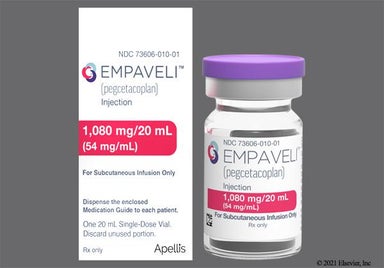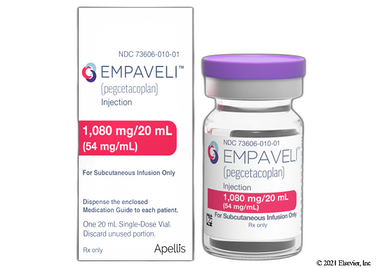
Empaveli
Empaveli (pegcetacoplan) is a newly-approved medication used in adults to treat a rare blood condition called paroxysmal nocturnal hemoglobinuria, or PNH. It's injected under the skin using an infusion pump.


What is Empaveli (pegcetacoplan)?
What is Empaveli (pegcetacoplan) used for?
- Paroxysmal nocturnal hemoglobinuria (PNH)
How Empaveli (pegcetacoplan) works
Empaveli (pegcetacoplan) is a complement inhibitor. It works by attaching to certain proteins in your immune system. This prevents them from being activated so your immune system can't attack your own red blood cells, which is what happens in PNH. This helps treat symptoms of PNH.
Drug facts
| Common Brands | Empaveli |
|---|---|
| Drug Class | Complement inhibitor |
| Controlled Substance Classification | Not a controlled medication |
| Generic Status | No lower-cost generic available |
| Availability | Prescription only |

Side effects of Empaveli (pegcetacoplan)
The following side effects may get better over time as your body gets used to the medication. Let your healthcare provider know immediately if you continue to experience these symptoms or if they worsen over time.
Common Side Effects
- Injection-site reactions (e.g., pain, swelling, redness, itching, rash; 39%)
- Infections (up to 29%)
- Diarrhea (22%)
- Stomach pain (20%)
- Feeling tired (12%)
Less Common Side Effects
- Chest pain
- Back pain
- Headache
- High blood pressure
Empaveli (pegcetacoplan) serious side effects
Contact your healthcare provider immediately if you experience any of the following.
- Serious infections: fever, difficulty breathing, headache, weakness, confusion, sweating, chills, stiff neck, fast heart rate, muscle aches, diarrhea
- Severe allergic reaction: hives; swelling of the lips, tongue, or face; difficulty breathing; chest pain
The following Empaveli (pegcetacoplan) side effects have also been reported
Side effects that you should report to your care team as soon as possible:
- Allergic reactions—skin rash, itching, hives, swelling of the face, lips, tongue, or throat
- Infection—fever, chills, cough, sore throat, wounds that don't heal, pain or trouble when passing urine, general feeling of discomfort or being unwell
- Infusion reactions—chest pain, shortness of breath or trouble breathing, feeling faint or lightheaded
- Low potassium level—muscle pain or cramps, unusual weakness or fatigue, fast or irregular heartbeat, constipation
Side effects that usually do not require medical attention (report these to your care team if they continue or are bothersome):

Pros and cons of Empaveli (pegcetacoplan)
Pros
- Works well to raise hemoglobin levels in people with PNH
- Typically injected twice per week
- Can be infused at home
- A good option for people switching from Soliris (eculizumab) or Ultomiris (ravulizumab)
Cons
- Hasn't been studied in children younger than 18 years old
- Might be difficult for some people to administer as instructed
- Can cause serious or life-threatening infections
- Brand name only, which can be expensive

Pharmacist tips for Empaveli (pegcetacoplan)

- Mark your appointments to see your provider and get your lab work done on your calendar so your provider can check how well Empaveli (pegcetacoplan) is working for you.
- Make sure you know how to give yourself Empaveli (pegcetacoplan) to avoid accidentally hurting yourself or wasting the medication. Carefully read the instructions for use, and contact your provider or pharmacist if you have any questions on how to use this medication.
- Store Empaveli (pegcetacoplan) vials in the refrigerator in the original carton and away from light.
- When it's time for your dose, take a Empaveli (pegcetacoplan) vial out of the refrigerator and allow it to reach room temperature. This will take about 30 minutes. Don't try to warm up the medication any other way (e.g., microwave, under hot water) because this could damage it.
- Empaveli (pegcetacoplan) is given through an injection under the skin, into the fat tissue between your skin and muscle, using an infusion pump. You can infuse the medication into your stomach, thighs, hips, or the back of your upper arms.
- Don't inject Empaveli (pegcetacoplan) into tender, bruised, red, or hard skin so you don't further damage your skin. Avoid places with tattoos, scars, or stretch marks because you might not absorb the medication well through these areas.
- You can infuse Empaveli (pegcetacoplan) using one or two injection sites. The infusion will take 1 hour if you're using one injection site, or 2 hours if you're using two injection sites.
- Use different infusion sites from the last time you infused Empaveli (pegcetacoplan) to lower your risk of bruising and skin irritation. If you're using multiple injection sites, they should be at least 3 inches apart.
- After giving yourself the medication, throw away your used syringe and needle in a sharps container or something made of heavy-duty plastic (e.g., empty milk carton, laundry detergent bottle) to lower the risk of needle-stick injuries. Don't throw them away in your trash can. Visit the FDA's website to learn more about throwing away your sharps safely in accordance to your state regulations.
- Don't stop taking Empaveli (pegcetacoplan) without speaking with your provider first. If you stop taking this medication too suddenly, your symptoms could come back.

Risks and warnings for Empaveli (pegcetacoplan)
Empaveli (pegcetacoplan) can cause some serious health issues. This risk may be even higher for certain groups. If this worries you, talk to your doctor or pharmacist about other options.
Serious infections
 Empaveli (pegcetacoplan) can affect your body's ability to fight off infections. This can raise your risk of serious or life-threatening infections like pneumonia, meningitis (infection of brain and spinal cord), and Hib disease. To lower your risk of infection, you'll need to get the pneumonia (or pneumococcal) vaccine, meningitis (or meningococcal) vaccine, and the Hib vaccine at least 2 weeks before starting Empaveli (pegcetacoplan). If you need to receive Empaveli (pegcetacoplan) right away and you haven't completed your vaccinations yet, your provider will give you antibiotics to prevent these infections while you finish getting the vaccinations.
 Because of the risk for serious infections, Empaveli (pegcetacoplan) is only available through a restricted program (Empaveli REMS). Your provider will give you a Patient Safety Card about the risk of serious infections to carry with you at all times during Empaveli (pegcetacoplan) treatment. They will also monitor you routinely for infections before and during treatment. If you get an infection, you might have to stop taking Empaveli (pegcetacoplan) so your body can fight it off with proper treatment. Get medical help right away if you have symptoms of an infection such as fever, cough, difficulty breathing, weakness, sweating, chills, or diarrhea while taking Empaveli (pegcetacoplan).
After stopping Empaveli (pegcetacoplan), keep your Patient Safety Card with you for 2 months after your last dose. Your risk for infections is still high for several weeks after stopping this medication.
Severe allergic reactions
Although rare, severe allergic reactions to Empaveli (pegcetacoplan) are possible, including life-threatening reactions like facial swelling, hives, and anaphylaxis (e.g., closing of the throat). If you notice a choking sensation, difficulty breathing, swelling around your eyes, swelling of the lips or tongue, dizziness, or nausea at any time during your Empaveli (pegcetacoplan) treatment, get medical attention right away.
Return of PNH symptoms
After your provider determines you no longer need to take Empaveli (pegcetacoplan), you'll still need to see your provider and be monitored for at least 2 months to make sure your PNH symptoms don't come back. Contact your provider if you notice you're having PNH symptoms (e.g., fatigue, stomach pain, shortness of breath, blood in your urine, trouble swallowing). You might have to restart Empaveli (pegcetacoplan).

Empaveli (pegcetacoplan) dosage
Typical dosage for Empaveli (pegcetacoplan)
The typical dose is 1,080 mg injected under the skin twice per week through an infusion pump.
Your provider will adjust your dose based on how your body responds to the medication.

Empaveli (pegcetacoplan) contraindications
Contraindications are specific health conditions or situations in which a person should not take a medication due to safety concerns. If you have any of the following conditions or if any of the following apply to you, let your healthcare provider know because Empaveli (pegcetacoplan) will not be safe for you to take.
- Not currently vaccinated against Streptococcus pneumoniae, Neisseria meningitidis, and Haemophilus influenzae, unless your provider says it's okay
- Current serious infection with Streptococcus pneumoniae, Neisseria meningitidis, or Haemophilus influenzae

What are alternatives to Empaveli (pegcetacoplan)?

Empaveli (pegcetacoplan) images