Key takeaways:
Generic drugs are lower-cost equivalents of brand-name medications. They’re made from chemicals and have simple structures.
Biosimilars are biologics that are highly similar to an original (reference) biologic. Biologics are made from living sources and have complex structures.
Biosimilar and generic drugs are made and regulated differently. But they can both help you save money on your prescription.
Save on related medications
There are many barriers that keep people from taking their medications as prescribed. Of these, cost is a common concern. If this sounds like you, chances are you’ve asked your healthcare provider about more affordable options.
For many people, generic drugs are one way to access medications at a lower cost. But not all drugs have generics. In fact, some drugs can’t be copied in the same way as generics. These drugs are known as biologics, and their lower-cost versions are called biosimilars.
So, how do biosimilars compare to generics?
1. Biosimilar and generic drugs are made differently
Most medications you see on pharmacy shelves are made from chemicals. These are sometimes referred to as “small molecule drugs.” Blood pressure pills, nasal sprays for allergies, and antibiotics are a few examples.
Small molecule drugs have simple chemical structures, making them easier to copy and produce in bulk. Each one contains active and inactive ingredients that can be measured and combined together. When a brand-name small molecule drug is copied, it’s called a generic.
Biosimilars are a different type of drug. They’re biologics, which means they come from living sources (e.g., plant or animal cells). Biologic structures are more complex, and they aren’t well-defined. So, no two batches of a biologic will be exactly the same. However, these small differences are expected and don’t impact their safety and effectiveness.
2. Biosimilar and generic drugs are regulated differently
Not only are biosimilar and generic drugs made differently, they’re approved and regulated differently in the U.S., too.
Generics
A new small molecule drug needs to go through years of testing in clinical trials. If it’s shown to be safe and effective, a New Drug Application must be submitted and approved before it can be marketed. This is how brand-name medications become available.
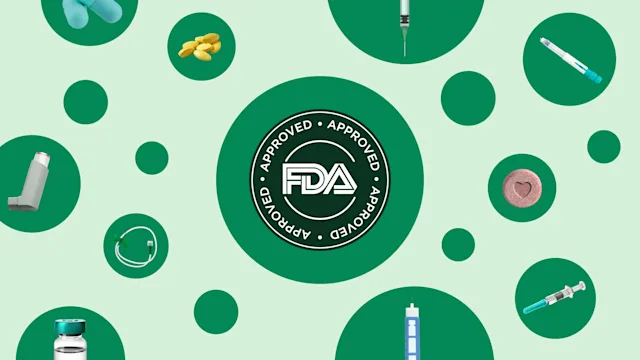
Generic drugs go through a shorter version of this process — called an Abbreviated New Drug Application. The FDA’s Office of Generic Drugs is responsible for reviewing and approving new generic drugs.
Since generics are copies of a brand-name drug, they get to skip several steps of the typical approval process. Instead of proving that they’re safe and effective, generics need to meet several criteria to show they are equivalent to the brand version, including:
Same dosage form, strength, and route of administration
Same intended use(s)
Same quality
Maintains its potency and purity for a reasonable amount of time
Absorbed into the bloodstream at the same rate
In other words, the generic works the same as the brand-name version. It also needs to meet the same quality and safety standards. So, you should expect the same benefits and risks in most cases.
Biosimilars
Given their complexity, biologics are approved through a different regulatory process. This is called a Biologics Licensing Application. Biologics still need to go through clinical trials to show they’re safe and effective. But there’s additional focus on how they’re made since there may be some variability.
Like generics, biosimilars go through an abbreviated version of this process. The FDA’s Center for Biologics Evaluation and Research (CBER) usually reviews and approves new biologics (and biosimilars).
A biosimilar isn’t an exact copy of its reference biologic. But it needs to show that its structure and function in the body is highly similar. CBER places a big priority on reviewing analytical (lab) data that shows the biosimilar moves through and affects the body the same way as the reference biologic. And clinical studies may be done comparing the reference biologic and biosimilar in people with a certain medical condition.
But does a biosimilar need to be studied for all medical conditions the reference biologic is approved to treat? No, not necessarily. Often, evidence from using it in one condition is applied to other conditions.
3. Biosimilar and generic drugs are sometimes substituted for other medications
When you make a trip to your local pharmacy to pick up a prescription, there’s a good chance you’re receiving a generic. In fact, generics make up 90% of prescriptions filled in the U.S.
There are processes in place that make it easier for your pharmacist to switch your prescription from a brand-name product to a generic. This can vary by state. And in some cases, your pharmacist is required to switch you to a generic.
For example,if you’ve been prescribed brand-name Lipitor for high cholesterol, your pharmacist may switch you to the generic, atorvastatin.
A similar process exists for biosimilars — but only for interchangeable biosimilars. These are biosimilars that have demonstrated that you can switch between them and their reference biologic without issues. In this case, your pharmacist may be able to switch you from the reference biologic to an interchangeable biosimilar. But this can also vary by state.
For example, if you’ve been prescribed Lantus (insulin glargine) for diabetes, your pharmacist may be able to switch you to a Lantus biosimilar, like Semglee (insulin glargine-yfgn).
Keep in mind that your healthcare provider can still prescribe a biosimilar for you, even if it’s not interchangeable. But interchangeable biosimilars usually don’t require their approval to make the switch.
4. Biosimilar and generic drugs can help you save money
One of the reasons you may switch to a generic drug is to save money on your prescription. After all, generics can cost up to 85% less than their brand-name counterparts. The more generic versions available, the more you may be able to save.
Similarly, biosimilars typically cost less than their reference biologic. On average, you may be able to save 15% to 35% off the retail price with a biosimilar. The FDA has been approving new biosimilars every year since 2015, including seven that were approved in 2022. As more biosimilars enter the market, you may start to see additional savings.
The bottom line
Both biologic and generic drugs can help you save money on your prescription, but they aren’t exactly the same. There are some key differences with how biosimilars versus generics are made and regulated.
Generics are small molecule drugs made from chemicals with simple structures. Biosimilars are more complex and come from living sources. Generics are often substituted for brand-name versions at the pharmacy. But only interchangeable biosimilars can be substituted in this way.
If you’re interested in switching to a generic or biosimilar, talk to your healthcare provider or pharmacist. They can help you determine the options available to you.

Why trust our experts?



References
American Medical Association. (2020). 8 reasons patients don't take their medications.
Becker, C. (2022). Decreasing drug costs through generics and biosimilars. National Conference of State Legislatures.
Song, Y., et al. (2018). The effects of state-level pharmacist regulations on generic substitution of prescription drugs. Health Economics.
U.S. Food and Drug Administration. (n.d.). Biosimilar regulatory review and approval.
U.S. Food and Drug Administration. (n.d.). Biosimilars info sheet.
U.S. Food and Drug Administration. (2018). About CBER.
U.S. Food and Drug Administration. (2021). Biologics license applications (BLA) process (CBER).
U.S. Food and Drug Administration. (2021). Generic drug facts.
U.S. Food and Drug Administration. (2022). Abbreviated new drug application (ANDA).
U.S. Food and Drug Administration. (2022). Biosimilar product information.
U.S. Food and Drug Administration. (2022). New drug application (NDA).
U.S. Food and Drug Administration. (2022). Office of generic drugs 2021 annual report.
U.S. Food and Drug Administration. (2022). Office of generic drugs.
U.S. Food and Drug Administration. (2022). Review and approval.