Key takeaways:
The best treatment for erectile dysfunction (ED) for you will depend on several factors, including your treatment goals. Sildenafil (Viagra, Vybrique) and tadalafil (Cialis) are the most commonly prescribed medications for ED. Other options include vardenafil and avanafil (Stendra).
For occasional use, most people start with sildenafil. For regular use, tadalafil may be a better fit. For fast-acting but shorter-lasting effects, vardenafil or avanafil could be a good fit. Some people prefer to alternate between medications.
All ED medications are considered safe and effective when taken as prescribed. Your unique relationship needs, lifestyle, and budget can help you decide between them.
There are ways to save on ED medications. You may be able to save with a lower-cost generic or a copay savings card. A GoodRx discount could also make your prescription more affordable. And you can get generic Viagra or Cialis delivered directly to your door with GoodRx for ED.
Save on related medications

You’ve likely heard of Viagra (sildenafil), Cialis (tadalafil), vardenafil (previously sold as Staxyn and Levitra), and Stendra (avanafil). These are commonly prescribed treatments for erectile dysfunction (ED), or regular difficulties getting or maintaining an erection for satisfying sexual intercourse. But is one considered the best ED medication?
Below, we’ll discuss some key differences between commonly prescribed ED medications to help you navigate your treatment options.

What is the best ED medication?
Phosphodiesterase 5 (PDE5) inhibitors are the most commonly prescribed ED medications. And there isn't one that’s considered the "best." In fact, all the medications in this class are first-choice options for ED treatment. They're all proven to be safe and effective. But there are some differences between them that may determine which are the best fit.
Search and compare options
Although they don't affect arousal, all PDE5 inhibitors work by increasing the amount of blood that fills the penis, which can help an erection last long enough for satisfying sex. Sildenafil, tadalafil, and vardenafil have been around the longest, while avanafil and Vybrique (sildenafil oral film) are newer options.
The main differences between these medications have to do with:
How they’re taken (with or without food)
How long they last in your body
What side effects they cause
How much they cost
In addition to these differences, how often you plan to use ED medication is an important factor to keep in mind. Your healthcare professional might also consider whether your ED is mild or more severe when recommending a specific medication.
Viagra and Vybrique (sildenafil)
Viagra was the first major medication the FDA approved for ED. It’s been available in the U.S. since 1998. Vybrique is a new brand-name version of sildenafil that comes as a dissolvable oral film. It was FDA approved in February 2026.
For occasional use, most people start with sildenafil tablets. The tablets are often prescribed for mild or moderate symptoms. Vybrique may be a better option for people who have difficulty swallowing pills.
Here are key points to keep in mind if you’re considering taking sildenafil:
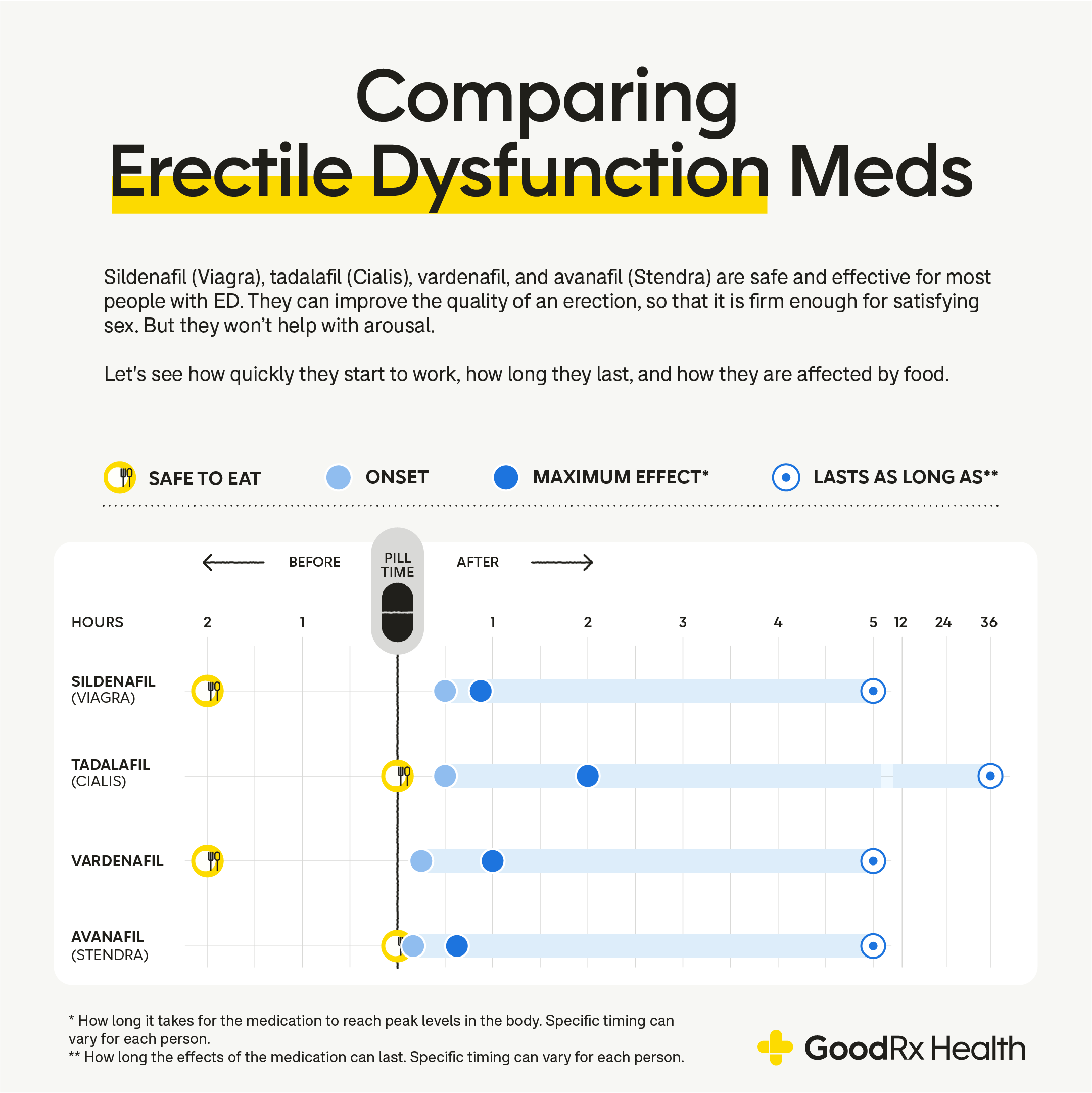
How to take it: You should take sildenafil on an empty stomach. If you really need to eat, then try waiting at least 1-2 hours after your meal before you take a dose. And opt for a light, low-fat meal. Fatty meals and alcohol can slow down the time it takes for sildenafil to start working — by about 1 hour for Viagra and 1.5 hours for Vybrique.
How fast it works: Sildenafil can start to take effect in as little as 30 minutes. But it may take up to 2 hours to feel the peak effects of the tablets. And it may take up to 5 hours with the oral film. Both forms can keep working for up to 8 hours.
The typical dose: The typical starting dosage of sildenafil is one 50 mg tablet or film taken 30 minutes to 4 hours before sex, as needed. If you’re having side effects, your dose may be lowered to 25 mg. If your dose isn’t working well enough, it can be increased to 75 mg if you’re taking the oral film or 100 mg if you’re taking the tablets.
Cialis (tadalafil)
Cialis is different from Viagra and other ED medications because it lasts much longer. You can also take it on a daily basis. For this reason, Cialis may be a better fit than Viagra or Vybrique for regular use. It’s especially helpful for people who don’t respond as well to medications that are only taken “on demand.”
Here are key points to keep in mind if you’re considering taking Cialis:
How to take it: Food doesn’t affect Cialis. You can take it just when you need it or regularly — every day — if needed.
How fast it works: Cialis can start working in as quickly as 30 minutes, but you may have to wait up to 2 hours for it to be fully effective. The effects of Cialis can last for up to 36 hours, helping you with erections at any point in that time period.
The typical dose: The typical starting dosage of Cialis for occasional use is one 10 mg tablet taken at least 30 minutes before sex. Your dose may be lowered to 5 mg or increased to 20 mg depending on how you respond. The daily dose for regular use ranges from 2.5-5 mg.
Vardenafil (formerly Levitra and Staxyn)
Generic vardenafil was previously sold under the brand names Levitra and Staxyn, but those brands have been discontinued. Vardenafil can work for up to 5 hours, so it may be a good fit for people looking for an option that may last longer than Viagra but not as long as Cialis.
Here are some points to keep in mind if you’re considering taking vardenafil:
How to take it: Vardenafil can be taken with or without food. But high-fat foods can delay vardenafil's absorption and lower its effectiveness. Two food studies showed that a high-fat meal could lower the effects of vardenafil by up to 50%. Ideally, try to wait 1-2 hours after eating before you take it. If that’s not possible, stick to a light, low-fat meal. You can take it as needed for occasional ED symptoms.
How fast it works: Vardenafil can start working in as quickly as 15 minutes, but you may have to wait 1 hour to experience its peak effects.
The typical dose: The typical starting dosage of vardenafil is one 10 mg tablet taken about 1 hour before sex. Your dose may be lowered to 5 mg or increased to a maximum of 20 mg. Vardenafil is available as a traditional pill that you swallow and a rapidly dissolving pill (which works faster).
Stendra (avanafil)
Stendra is a newer ED medication that works similarly to sildenafil, tadalafil, and vardenafil. Out of all the PDE5 inhibitors for ED, Stendra works the fastest. And its effects typically last for a shorter time span. It’s helpful for people who want a fast-acting “on demand” pill but don’t want the effects to last most of the day.
Here are some things to keep in mind if you’re considering taking avanafil:
How to take it: Avanafil comes in pill form and it’s not affected by food. You can take it as needed for occasional ED symptoms.
How fast it works: Avanafil works a little faster on average than other ED medications. The usual starting dose of 100 mg works within 15 minutes. With a lower dose, you’ll need to wait about 30-45 minutes.
The typical dose: The recommended starting avanafil dosage is 100 mg taken 15 minutes before sex, as needed. But doses can range from 50-200 mg.
ED medications at a glance
Here’s a side-by-side look at common ED medications that covers how quickly they work, how long their effects may last, and other key differences.
Sildenafil (Viagra) | Sildenafil (Vybrique) | Tadalafil (Cialis) | Avanafil (Stendra) | ||
|---|---|---|---|---|---|
Generic available? | Yes | No | Yes | Yes | Yes |
Dosage form | Tablet | Dissolvable film | Tablet | Tablet and dissolvable tablet | Tablet |
Starts working in as fast as | 30 minutes | 30 minutes | 30 minutes | 15 minutes | Under 15 minutes |
Time until maximum effect* | 30 minutes - 2 hours | 30 minutes - 5 hours | 2 hours | 60 minutes | 30-45 minutes |
Lasts as long as** | 3-8 hours | 3-8 hours | 36 hours | 4-5 hours | 5 hours |
Affected by food? | Yes, take it 1-2 hours after eating, or with a low-fat meal. | Yes, take it 1-2 hours after eating, or with a low-fat meal. | No | Yes, take it 1-2 hours after eating, or with a low-fat meal. | No |
Most common side effects | Headaches, flushing, nasal congestion, upset stomach, vision changes | Headaches, flushing, nasal congestion, upset stomach, vision changes | Headaches, flushing, upset stomach; less vision changes but more muscle/back pain | Headaches, flushing, nasal congestion, upset stomach | Headaches, flushing, congestion, flu-like symptoms |
* Based on Tmax data, which indicates when the medication reaches the highest concentration in the body
** Based on T½ data, which indicates how long it takes the medication to leave the body
How effective are ED medications?
Sildenafil, tadalafil, vardenafil, and avanafil are effective ED medications for most, though results can vary from person to person. Studies suggest that these medications improve erections and sexual function in a majority of people who take them.
There isn’t much data that directly compares these medications head-to-head. So there’s no clear evidence that one works better than the others overall.
One systematic review and meta-analysis of 83 studies where male participants took PDE5 inhibitors as needed found that sildenafil and tadalafil may improve ED symptoms more than vardenafil and avanafil. But most of the studies compared each medication with a placebo (a pill without medication) rather than directly comparing them with one another. Without more direct comparisons, it’s difficult to say whether one ED medication works best.
How do ED medications compare when it comes to side effects?
PDE5 inhibitors share a number of common side effects, most of which are typically mild. Examples include:
Flushing
Nasal congestion
Indigestion (upset stomach)
Vision changes
Muscle pain
There are some differences when it comes to the likelihood of these side effects, though. For example, studies show that vision changes are more commonly reported with sildenafil, especially with the 100 mg dose. But tadalafil is more likely to cause muscle pain.
Overall, the immediate side effects of PDE5 inhibitors don’t last very long and aren’t usually bothersome. But less is known about the risks of taking these medications long term. If you’re concerned about the possible side effects of ED medications, speak with a healthcare professional.
Are ED medications safe to take?
Like all medications, ED medications carry potential safety risks. Below is an overview of what you should know before starting any of these medications.
Heart safety
PDE5 inhibitors are generally safe for the heart, and most people with heart conditions can take them. But there are two potentially serious issues to know about:
All PDE5 inhibitors can lower your blood pressure. This may be a problem if you also take a blood pressure medication. A sudden drop in blood pressure can make you feel dizzy, fall, black out, or even cause more serious heart issues.
Nitrate medications can have dangerous interactions with PDE5 inhibitors. Nitrate medications, like nitroglycerin (Nitrostat), are commonly given to people with heart conditions such as angina and high blood pressure. If you take a nitrate medication, you should never take ED medications.
Interactions
ED medications are metabolized (broken down) by an enzyme in your body called CYP3A4. Certain medications and substances can block this enzyme, causing PDE5 inhibitors to build up in the body. You are more likely to experience side effects or toxic levels if this happens.
Several medications — such as ketoconazole, verapamil, and erythromycin — can cause this interaction. Even grapefruit juice can be a culprit. Talk with your healthcare team to find out if there are certain medications or foods you should avoid while taking an ED medication.
Liver or kidney disease
PDE5 inhibitors are processed through both your liver and kidneys. If you have mild to moderate liver or kidney disease, your prescriber may need to lower your dose of ED medication. If your condition is severe, they may want you to avoid PDE5 inhibitors altogether. Speak with your healthcare team to see if PDE5 inhibitors are safe for you to take.
Who shouldn’t take ED medications?
ED medications are generally considered safe, but they are not for everyone. You may be advised to avoid ED medications if you:
Have had recent heart problems, such as a heart attack or stroke within the last 6 months
Have vision problems such as non-arteritic anterior ischemic optic neuropathy (NAION) or retinitis pigmentosa
Take any medications that can cause a dangerous interaction
Are allergic to ED medications or their ingredients
Have a higher risk of priapism (a long-lasting painful erection)
People with certain health conditions, such as liver or kidney problems, should use ED medications with caution. Depending on your condition, your prescriber may adjust your dose to lower the risk of side effects. Your healthcare team can review your personal health history to decide if it’s OK for you to take an ED medication.
How to save on ED medications
There are ways to save on ED medications:
Save with GoodRx. GoodRx could help you save significantly on the generic versions of ED medications. With a free GoodRx discount, you may be able to pay as low as $11.70 for 30 tablets of generic sildenafil 50 mg at certain pharmacies. You may be able to find the same quantity of generic tadalafil 5 mg or vardenafil 20 mg for as low as $12.00 or $81.90, respectively. Exclusive GoodRx savings are also available for brand-name Viagra.
Save with GoodRx for ED. You can get generic Viagra delivered directly to your door starting at $18 per month through GoodRx for ED. Generic Cialis starts at $21 per month.
Save with a copay savings card. You may be able to reduce your out-of-pocket costs for brand-name ED medications with copay savings cards. For example, if you’re eligible, you could save up to 50% off brand-name Viagra for up to 12 months using a manufacturer savings card.
Frequently asked questions
In general, ED medications work by relaxing smooth muscles and blood vessels in the penis. This improves blood flow, which can help you get and maintain an erection.
Herbal products and dietary supplements that claim to be alternatives for treating ED aren’t regulated by the FDA. So it’s hard to determine which ones are the best or if they’re even safe and effective. If you’re experiencing ED symptoms, it’s a good idea to speak with a healthcare professional about your treatment options.
Like all medications, ED medications carry a risk of side effects. If you’re thinking about taking an ED medication, a healthcare professional can discuss the potential side effects and whether it would be safe for you to take.
If you’re taking an ED medication and experiencing side effects, speak with your prescriber. They may lower your dose or try switching you to a different ED medication.
In general, ED medications work by relaxing smooth muscles and blood vessels in the penis. This improves blood flow, which can help you get and maintain an erection.
Herbal products and dietary supplements that claim to be alternatives for treating ED aren’t regulated by the FDA. So it’s hard to determine which ones are the best or if they’re even safe and effective. If you’re experiencing ED symptoms, it’s a good idea to speak with a healthcare professional about your treatment options.
Like all medications, ED medications carry a risk of side effects. If you’re thinking about taking an ED medication, a healthcare professional can discuss the potential side effects and whether it would be safe for you to take.
If you’re taking an ED medication and experiencing side effects, speak with your prescriber. They may lower your dose or try switching you to a different ED medication.
The bottom line
Phosphodiesterase 5 (PDE5) inhibitors are a class of medications used to treat erectile dysfunction (ED). The available PDE5 inhibitors include sildenafil (Viagra, Vybrique), tadalafil (Cialis), vardenafil (previously sold as Levitra and Staxyn), and avanafil (Stendra).
Currently, there isn’t one PDE5 inhibitor that’s considered the best for ED. The best ED medication for you will depend on many factors, such as how often you plan to use it, the potential side effects, and the costs. Like many people, you may even choose to alternate between multiple ED medications, depending on your individual needs. Talk to a healthcare professional about which ED medication might be the best choice for you.

Why trust our experts?




Quiz: Is it erectile dysfunction?
References
Ausó, E., et al. (2021). Visual side effects linked to sildenafil consumption: An update. Biomedicines.
Bryant Ranch Prepack. (2026). Tadalafil - tadalafil tablet [package insert].
Camber Pharmaceuticals. (2025). Avanafil - avanafil tablet [package insert].
Dhaliwal, A., et al. (2023). PDE5 inhibitors. StatPearls.
Dugan, C., et al. (2026). Non-arteritic anterior ischemic optic neuropathy (NAION). EyeWiki.
Ferguson, J. E., III., et al. (2013). Phosphodiesterase type 5 inhibitors as a treatment for erectile dysfunction: Current information and new horizons. Arab Journal of Urology: An International Journal.
Gan, K. Z., et al. (2025). Enhancement and evaluation of vardenafil hydrochloride trihydrate absorption in orodispersible tablet formulations: Establishment of in vitro, in vivo correlation and bioequivalence study. Chemico-Biological Interactions.
IBSA. (2026). IBSA USA announces FDA approval of Vybrique, the first and only oral film to treat men with erectile dysfunction. BioSpace.
IBSA Pharma. (2026). Vybrique - sildenafil citrate film [package insert].
Leslie, S. W., et al. (2024). Erectile dysfunction. StatPearls.
National Eye Institute. (2025). Retinitis pigmentosa. National Institutes of Health.
Padda, I. S., et al. (2023). Phosphodiesterase inhibitors. StatPearls.
Salonia, A., et al. (2026). A comparative evaluation of on-demand phosphodiesterase-5 inhibitor efficacy in erectile dysfunction treatment: A systematic review and network meta-analysis of double-blind, placebo-controlled, randomized trials. The Journal of Sexual Medicine.
Torrent Pharmaceuticals. (2026). Sildenafil citrate - sildenafil tablet, film coated [package insert].
Wang, C. M., et al. (2023). Management of male erectile dysfunction: From the past to the future. Frontiers in Endocrinology.
Zydus Pharmaceuticals USA. (2026). Vardenafil - vardenafil tablet, film coated [package insert].