Key takeaways:
Antidepressants can help treat anxiety, depression, and other mental health conditions. Some antidepressants can be started and stopped quickly, while others take longer.
If you’re taking an antidepressant that’s not working or is causing a lot of side effects, your prescriber might suggest switching to a new medication.
Your prescriber might use an antidepressant switching chart to help decide how quickly you can start the new medication. Always talk with a healthcare professional before switching to a new antidepressant.
Save on related medications
Antidepressants are common medications. They’re used to treat many different mental health conditions, including major depression, anxiety, panic disorder, and more.
A lot of people find that their symptoms start to get better in the first month after starting an antidepressant. But what if your medication doesn’t work as well as you’d hoped? Or you’re having a lot of side effects? In these cases, it could be time to talk with a healthcare professional about switching to another antidepressant.
Starting a new antidepressant doesn’t have to be scary — but it’s helpful to know what to expect. Here are five things to keep in mind when switching to a new antidepressant, as well as a handy antidepressant switching chart.
Antidepressant switching chart
Let’s be clear: Switching antidepressants isn’t a one-size-fits-all process.
When switching you to a new antidepressant, a healthcare professional will consider:
Your current symptoms
Your current diagnosis
Your current medication’s side effects
How well you’re able to function in daily life
How sensitive you are to the side effects of medication
Whether you’re at risk for life-threatening complications
Whether you have any other medical problems
Your treatment goals
Your preferences
Your prescriber will use all of this information — combined with their knowledge about medication effectiveness and safety — to decide how quickly to switch you over to a new antidepressant.
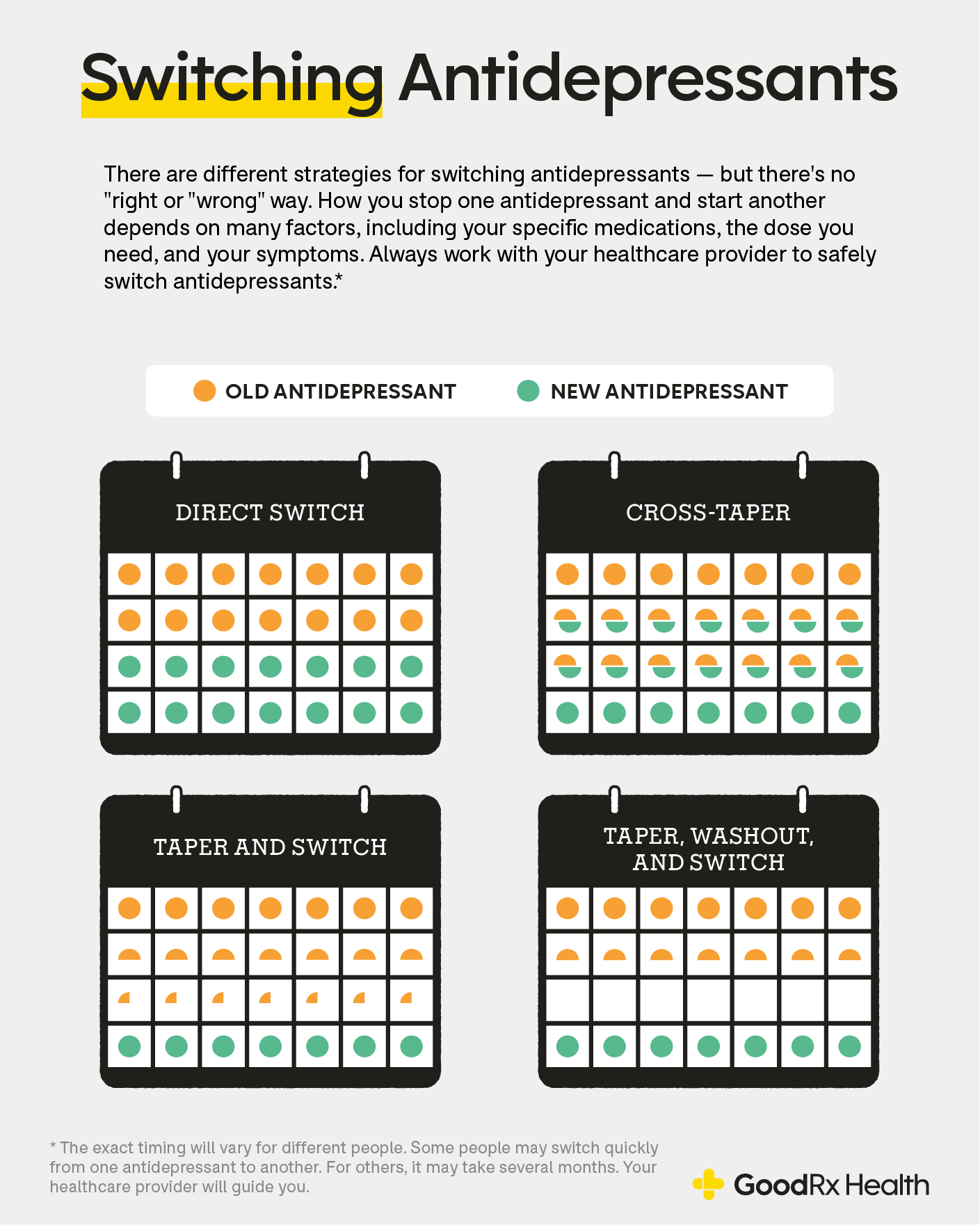
In general, there are four different strategies for switching antidepressants:
Direct switch: This means you stop your old antidepressant and start the new one the next day. For example, you might switch directly from one selective serotonin reuptake inhibitor (SSRI) to another.
Cross-taper: This means you gradually lower (taper) the dose of your old antidepressant, while slowly starting the new one at the same time. This usually happens over a 1- to 2-week period. An example is tapering down on an SSRI or serotonin-norepinephrine reuptake inhibitor (SNRI), while at the same time slowly building up the dose of a different antidepressant.
Taper and switch: This means you taper and stop your old antidepressant. Then, once you’ve fully stopped, you start a new one the next day. This is sometimes used to change from one SSRI to another, or to another antidepressant.
Taper and switch with a medication-free washout period: This means you taper and stop your old antidepressant, and then wait a period of time (days or weeks) before starting the new medication. This strategy is used when the two antidepressants have the potential to interact with each other. An example is when switching to or from a monoamine oxidase inhibitor (MAOI) and another antidepressant.
Below is an antidepressant switching chart with a breakdown of the process. This will help you understand the different strategies your prescriber might use, depending on your medications.
| Switching from | Switching to | Possible strategy |
|---|---|---|
| Selective serotonin reuptake inhibitor (SSRI) or serotonin and norepinephrine reuptake inhibitor (SNRI) | SSRI or SNRI |
|
| SSRI or SNRI | Tricyclic antidepressant (TCA) |
|
| SSRI or SNRI | Other antidepressants (not SSRIs, SNRIs, or TCAs) |
|
| Bupropion | Any antidepressant |
|
| Mirtazapine | Any antidepressant |
|
| TCA | Any antidepressant |
|
| Monoamine oxidase inhibitor (MAOI) | Any antidepressant |
|
| Any antidepressant | MAOI |
|
5 things you should know before switching antidepressants
1. Your new antidepressant might take a while to kick in
Antidepressants can take a month or longer to start working in full effect. Until then, your symptoms may get better, worse, or stay the same.
During this time, be sure to keep track of how you’re feeling. Tell your prescriber if anything worries you, and appreciate your progress — even if it’s slow. Above all, even if you feel like your antidepressant isn’t helping, don’t stop taking it before talking with your prescriber.
2. You may have side effects when starting your new medication
Like any medication, antidepressants can have side effects. And that’s true even if you’ve taken antidepressants before.
Side effects are different for each medication. Common side effects for SSRIs and SNRIs include:
Nausea and stomach pain
Diarrhea and constipation
Fatigue
Problems sleeping
Low libido
Problems with orgasm
Appetite changes
Other types of antidepressants can have different side effects.
For most people, the side effects of antidepressants are temporary. They usually get better within a couple of weeks.
But if side effects are bothering you, talk with a healthcare professional. They can help you understand whether your side effects are normal and whether you can expect them to go away. A healthcare professional may also be able to adjust your medication to help with side effects.
3. You may experience withdrawal symptoms when switching antidepressants
If you’ve been taking your current antidepressant for more than a few weeks, it’s possible that you’ll experience withdrawal symptoms when slowing down and/or stopping your medication. This is sometimes called antidepressant discontinuation syndrome.
Different medications have different withdrawal symptoms. Physical symptoms can include:
Flu-like symptoms
Sleep changes
Nausea or vomiting
Dizziness or problems with balance
Burning, tingling, or electric shock-like sensations
Tapering off your medication can also cause mood and anxiety symptoms, including:
Mood changes
Difficulty concentrating
Irritability
Anxiety
Low mood
Nightmares or vivid dreams
These symptoms usually go away in 1 to 2 weeks for most people, as your body adjusts to being off of the medication. In some cases, they’ll also get better when you start your new antidepressant.
In the meantime, talk with a healthcare professional if withdrawal symptoms are bothering you. They can suggest strategies to help you feel more comfortable while transitioning to the new medication.
4. Therapy can help you feel better when starting a new antidepressant
In addition to starting a new antidepressant, starting or continuing therapy can also help you get better. There’s evidence that therapy works well for many different mental health conditions, including:
According to the American Psychological Association, certain types of therapy work just as well — or sometimes even better — than medication. And in some cases, combining therapy with medication might actually give you the best result.
5. Remember to take good care of yourself while switching to a new antidepressant
Switching to a new antidepressant can be hard. It’s important to make time for self-care while you’re adjusting to the new medication. Try to do the following:
Take it easy at work, school, and home.
Add in physical activity.
Enjoy nutritious foods.
Be kind to yourself.
Connect with a peer support group.
And remember: Communication is key. Be sure to reach out to a healthcare professional with any questions or concerns. They can help you understand what you’re going through and encourage you to keep moving forward.
It can also be helpful to let your friends and family know that you’re transitioning to a new medication, so that they can support you in taking the next step.
Frequently asked questions
The time period for switching antidepressants depends on the process. A direct switch (where you substitute one medication for another) takes just 1 day. But if you’re gradually tapering off a medication, it may take weeks to switch. And if you need a washout period between medications, this can make the whole process take longer.
Depending on what medication you take, switching antidepressants too quickly may increase the chance of withdrawal symptoms. There’s also a possibility that switching too quickly could put you at risk for side effects — or for a dangerous reaction called serotonin syndrome.
Some antidepressants are known to be especially hard to taper off of, with a higher chance for withdrawal. Examples include:
Paroxetine (Paxil)
Desvenlafaxine (Pristiq)
Duloxetine (Cymbalta)
Venlafaxine (Effexor)
The bottom line
Antidepressants are helpful for many people. But sometimes you have to try more than one to find a medication that works for you.
If you’re not happy with your current medication, talk with a healthcare professional. They can help you decide if transitioning to a new antidepressant makes sense for you. If it does, they can support you in safely changing over to the new medication.

Why trust our experts?



References
American Psychiatric Association. (2010). Practice guideline for the treatment of patients with major depressive disorder.
American Psychiatric Association. (2017). How do I choose between medication and therapy?
BC Guidelines. (2013). Appendix D: Switching antidepressants.
Cipriani, A., et al. (2018). Comparative efficacy and acceptability of 21 antidepressant drugs for the acute treatment of adults with major depressive disorder: A systematic review and network meta-analysis. The Lancet.
Gabriel, M., et al. (2017). Antidepressant discontinuation syndrome. Canadian Medical Association Journal.
Keks, N., et al. (2016). Switching and stopping antidepressants. Australian Prescriber.
Mind. (2020). Antidepressants: What are the alternatives to antidepressants?
Mind. (2020). Antidepressants: What withdrawal effects can antidepressants cause?
National Health Service. (2025). Antidepressants.
Soreide, K. K., et al. (2017). Strategies and solutions for switching antidepressant medications. Psychiatric Times.
Vinkers, C. H., et al. (2024). Discontinuation of psychotropic medication: A synthesis of evidence across medication classes. Molecular Psychiatry.