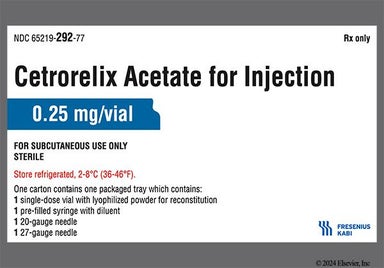
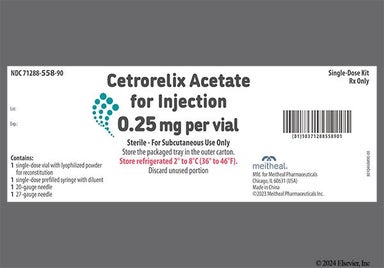
Cetrorelix (Cetrotide) is an injectable fertility medication that's used during in vitro fertilization (IVF). It belongs to a drug class called GnRH antagonists. It helps prevent your body from releasing eggs too early before egg retrieval in the IVF process. You typically inject a dose of the medication under the skin once a day on certain days of the IVF cycle. Potential side effects include ovarian hyperstimulation syndrome, nausea, and headache.
By blocking GnRH, cetrorelix (Cetrotide) temporarily delays ovulation. This prevents the ovary from releasing eggs too soon before egg retrieval. It can help egg retrieval be more successful.
The following side effects may get better over time as your body gets used to the medication. Let your healthcare provider know immediately if you continue to experience these symptoms or if they worsen over time.
The following Cetrorelix (Cetrotide) side effects have also been reported
Along with its needed effects, a medicine may cause some unwanted effects. Although not all of these side effects may occur, if they do occur they may need medical attention.
Check with your doctor immediately if any of the following side effects occur:
Some side effects may occur that usually do not need medical attention. These side effects may go away during treatment as your body adjusts to the medicine. Also, your health care professional may be able to tell you about ways to prevent or reduce some of these side effects. Check with your health care professional if any of the following side effects continue or are bothersome or if you have any questions about them:
More common
Headache
injection site bruising, itching, swelling, or redness
Given once a day on certain days of the IVF process
Usually well-tolerated with few side effects
Cons
Must prepare the injection each time (must mix and draw up into a syringe)
Can cause redness or itching around the injection site
Not safe if you have severe kidney problems or a mannitol allergy
Pharmacist tips for Cetrorelix (Cetrotide)
You can give yourself cetrorelix (Cetrotide) injections at home. Your fertility care team will first show you how to prepare and inject it safely before you can do it on your own.
The number of days you'll use cetrorelix (Cetrotide) will be unique. This is because it's based on your personal IVF journey. Follow your fertility specialist's directions carefully so the medication has the best chance to work.
If you forget to inject cetrorelix (Cetrotide), call your fertility specialist. They'll tell you what to do and if you need to visit the clinic to make sure everything is still on track. Missing a dose of cetrorelix (Cetrotide) or taking it late could affect the chances of successful egg retrieval.
For some people, the area where you inject cetrorelix (Cetrotide) might get red, itchy, or swollen. These reactions are usually mild and go away quickly afterwards. Talk to your fertility care team about how to lessen or prevent these side effects.
Keep cetrorelix (Cetrotide) in the refrigerator in its original packaging until you're ready to use it. Be careful not to let the medication freeze.
How to prepare and how to inject cetrorelix (Cetrotide):
Review the cetrorelix (Cetrotide) instructions for use. Ask your fertility team if you have any questions about how to prepare and inject the medication.
Before preparing and injecting cetrorelix (Cetrotide), wash your hands well with soap and water. Use an alcohol swab to clean the area of skin before injecting.
To prepare your cetrorelix (Cetrotide) injection, follow your fertility specialist's directions. You'll mix the powder with the liquid from the prefilled syringe using the yellow-marked needle (20 gauge). Once mixed well, draw up the prescribed amount. Then, switch the needle to the gray-marked needle (27 gauge). Inject the medication right after preparing. If you're not sure how to prepare the medication, ask your fertility team or pharmacist for help.
Inject cetrorelix (Cetrotide) under the skin of your lower stomach (at least 1 inch away from your belly button). Make sure to choose a different spot each time so the area can heal between injections.
After each cetrorelix (Cetrotide) injection, throw away the used vial, syringe, and needles in a sharps container. Don't put any of these supplies in the regular trash. Using a sharps container helps keep you and others safe from needles.
Don't reuse any syringes or needles you use. The syringes and needles that come with the cetrorelix (Cetrotide) kit are only meant to be used once.
Risks and warnings for Cetrorelix (Cetrotide)
Cetrorelix (Cetrotide) can cause some serious health issues. This risk may be even higher for certain groups. If this worries you, talk to your doctor or pharmacist about other options.
Allergic reactions
Risk factors: Mannitol allergy
Severe allergic reactions to cetrorelix (Cetrotide) can happen. This can include a life-threatening reaction called anaphylaxis. The risk might be higher if you're allergic to mannitol, an ingredient in this medication.
Call 911 right away if you notice any signs of a serious allergic reaction after your cetrorelix (Cetrotide) injection. Look out for hives, rash, swelling of your lips or tongue, coughing, and trouble breathing.
Not safe to use while pregnant
You shouldn't use cetrorelix (Cetrotide) if you're pregnant. Based on animal studies, this medication might harm an unborn baby. Your prescriber might order a pregnancy blood test before you start fertility treatment to make sure you're not pregnant.
Tell your fertility specialist right away if you get pregnant while using cetrorelix (Cetrotide).
Cetrorelix (Cetrotide) dosage
The average cost for 6 kits of 0.25mg of Cetrorelix (Cetrotide) is $278.06 with a free GoodRx coupon. This is 83.10% off the average retail price of $1,644.94.
Interactions between Cetrorelix (Cetrotide) and other drugs
Cetrorelix (Cetrotide) may interact with certain medications or supplements. Always let your doctor and pharmacist know about any other medications or supplements (including prescribed and over-the-counter medications, vitamins, and dietary or herbal supplements) that you are currently taking. The list below does not include all possible drug interactions with Cetrorelix (Cetrotide). Please note that only the generic name of each medication is listed below.
Although certain medicines should not be used together at all, in other cases two different medicines may be used together even if an interaction might occur. In these cases, your doctor may want to change the dose, or other precautions may be necessary. Tell your healthcare professional if you are taking any other prescription or nonprescription (over-the-counter [OTC]) medicine.
How much does Cetrorelix (Cetrotide) cost?
To access savings, use a GoodRx coupon and pay just a fraction of the retail price.
Contraindications are specific health conditions or situations in which a person should not take a medication due to safety concerns. If you have any of the following conditions or if any of the following apply to you, let your healthcare provider know because Cetrorelix (Cetrotide) will not be safe for you to take.
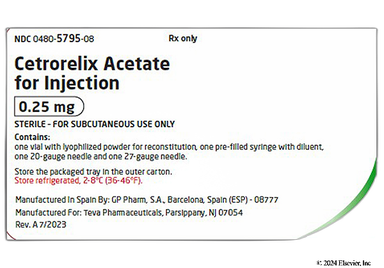
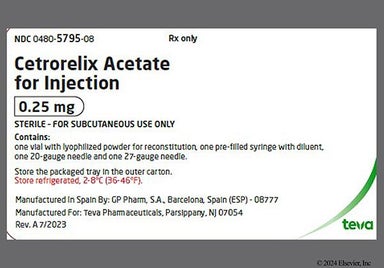
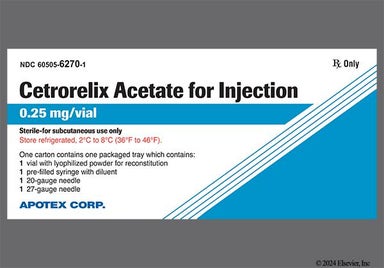
This medicine is White Kit.White Not applicable - Cetrorelix Acetate 0.25mg Powder for InjectionThis medicine is White Kit.White Not applicable - Cetrorelix Acetate 0.25mg Powder for InjectionThis medicine is White Kit.White Not applicable - Cetrorelix Acetate 0.25mg Powder for InjectionThis medicine is White Kit.White Not applicable - Cetrorelix Acetate 0.25mg Powder for Injection
GoodRx Health has strict sourcing policies and relies on primary sources such as medical organizations, governmental agencies, academic institutions, and peer-reviewed scientific journals. Learn more about how we ensure our content is accurate, thorough, and unbiased by reading our editorial guidelines.
Prescription savings
Stop paying too much for your prescriptions. Compare prices, get pharmacy coupons, and save up to 80%.
The number of days you use Cetrotide before your trigger shot can be different for everyone. This is because it depends on how fast your eggs grow and mature inside your ovaries. It also depends on the specific protocol your fertility specialist is following. In general, most people use Cetrotide for less than a week. Your fertility specialist might be able to give you an estimate based on your ultrasound scans.
No, Cetrotide and ganirelix aren't the same. But they work in the same way and are under-the-skin injections that are used during the IVF process. They both help prevent eggs from releasing from the ovary too early before retrieval. Your fertility specialist might choose one over the other based on many things. This includes your particular situation, preferences, treatment plan, medication cost, or medication availability. They can help you compare and decide which option is best for you.
Yes. Make sure to keep Cetrotide in the refrigerator until you're ready to use it. You can use the medication up until its expiration date when it's stored in the fridge.
If you need to adjust the time you inject Cetrotide, talk to your fertility specialist. There isn't enough information to know how well it works when taken at different times every day.
Some people might feel mild pain or a burning sensation when injecting Cetrotide. This can sometimes happen if the medication is too cold. To reduce discomfort, you could let the medication reach room temperature before injecting it.
During studies, people didn't usually say they felt tired while using Cetrotide. If you feel more tired than usual and you're not sure why, reach out to your healthcare professional. They can help you figure out what might be going on.
You should inject Cetrotide under the skin of your lower stomach. Make sure it's at least 1 inch away from your belly button. Since you inject the medication under the skin, be sure to pinch your skin a bit and inject into the fold of skin. Ask your fertility team or pharmacist about how to inject Cetrotide.
Cetrotide starts working within 2 hours after the injection to stop the release of a hormone called luteinizing hormone (LH). Together with GnRH, LH helps your body prepare for ovulation. By blocking GnRH, Cetrotide stops LH from releasing in the body. This helps delay ovulation. You won't feel it working, so it's important to use the medication every day as your fertility specialist tells you so it keeps working. They'll let you know when to stop. This is usually based on your ultrasound results, which check if you're ready for egg retrieval.