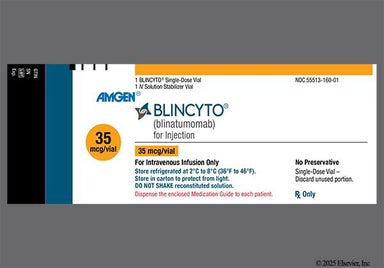
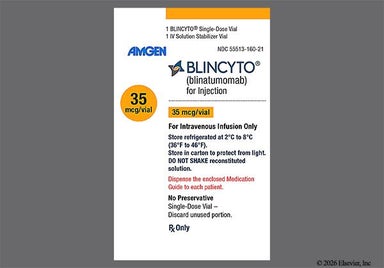
Blincyto (blinatumomab) is an injection used to treat certain types of a blood cancer called B-cell precursor acute lymphoblastic leukemia (ALL). It's FDA approved for adults and children 1 month and older. The medication is given through a continuous intravenous (IV) infusion, meaning it goes straight into your bloodstream over several days. You’ll typically start treatment in the hospital and continue at home using a portable pump. Possible side effects include infection, headaches, and a serious reaction called cytokine release syndrome.
In certain people who are in complete remission but still have a small amount of cancer cells in their body
In certain people whose cancer has come back or hasn’t responded to earlier treatment
In certain people going through the consolidation phase of multistep chemotherapy
How Blincyto (blinatumomab) works
Blincyto (blinatumomab) is a bispecific T-cell engager (BiTE), which is a type of monoclonal antibody that’s designed to bind to two different targets. One side of the antibody attaches to CD19, a protein on cancer cells, while the other side binds to CD3, a protein on T-cells in your immune system. By connecting these two cells, Blincyto (blinatumomab) brings T-cells close to the cancer cells, helping the immune system attack and destroy the cancer cells.
The following side effects may get better over time as your body gets used to the medication. Let your healthcare provider know immediately if you continue to experience these symptoms or if they worsen over time.
Common Side Effects
B-cell precursor ALL with MRD:
Fever (91%)
Infusion-related reactions (77%)
Headache (39%)
Infections (39%)
Tremor (31%)
Chills (28%)
B-cell precursor ALL that’s come back or not responded to treatment:
Fever (55%)
Low white blood cell count (31%)
Infusion-related reactions (30%)
Infection (28%)
Low red blood cell count (25%)
Headache (23%)
Low platelet count (21%)
B-cell precursor ALL in consolidation phase:
Low white blood cell count (up to 82%)
Fever (76%)
Low platelets (75%)
Low red blood cell count (up to 59%)
Nausea (up to 43%)
Headache (up to 41%)
Infection (up to 35%)
Diarrhea (29%)
Tremor (23%)
Muscle and bone pain (up to 23%)
Rash (22%)
Less Common Side Effects
B-cell precursor ALL with MRD:
Trouble sleeping
Low white blood cell count
Low platelets
Low blood pressure
Dizziness
Rash
Cough
Back pain
Weight gain
Speech problems
Confusion
High liver enzymes
B-cell precursor ALL that’s come back or not responded to treatment:
Swelling
High liver enzymes
Irregular heartbeat
Rash
B-cell precursor ALL in consolidation phase:
High blood pressure
Trouble speaking
Stomach pain
Bleeding
Mouth sores
High liver enzymes
Blincyto (blinatumomab) serious side effects
Contact your healthcare provider immediately if you experience any of the following.
Fever, chills, unusual weakness or fatigue, loss of appetite, nausea, headache, dizziness, feeling faint or lightheaded, shortness of breath, fast or irregular heartbeat, which may be signs of cytokine release syndrome
Infection—fever, chills, cough, sore throat, wounds that don't heal, pain or trouble when passing urine, general feeling of discomfort or being unwell
Liver injury—right upper belly pain, loss of appetite, nausea, light-colored stool, dark yellow or brown urine, yellowing skin or eyes, unusual weakness or fatigue
Pain, tingling, or numbness in the hands or feet, muscle weakness, change in vision, confusion or trouble speaking, loss of balance or coordination, trouble walking, seizures
Pancreatitis—severe stomach pain that spreads to your back or gets worse after eating or when touched, fever, nausea, vomiting
Tumor lysis syndrome (TLS)—nausea, vomiting, diarrhea, decrease in the amount of urine, dark urine, unusual weakness or fatigue, confusion, muscle pain or cramps, fast or irregular heartbeat, joint pain
Side effects that usually do not require medical attention (report these to your care team if they continue or are bothersome):
Hospital stay required before some treatment cycles
Can cause serious side effects like CRS and nervous system problems
Pharmacist tips for Blincyto (blinatumomab)
Blincyto (blinatumomab) is given as a continuous infusion into your vein that runs 24 hours a day. You’ll start treatment in the hospital for the first few days of your first and second cycles. After that, you’ll continue treatment at home using a portable pump.
Don’t change any settings on your Blincyto (blinatumomab) infusion pump yourself since this could lead to mistakes in your dose. Call your oncology care team right away if the pump alarms or stops working.
Sometimes, you might need to stop Blincyto (blinatumomab) for a short time if you have a side effect or if the pump stops working. If your treatment is paused for 4 hours or more, you might need to go to the hospital or clinic to restart it.
Blincyto (blinatumomab) can cause a serious side effect called cytokine release syndrome (CRS). This happens when your immune system becomes overly active. Tell your oncologist right away if you have fever, chills, headache, trouble breathing, nausea, vomiting, or feel very tired.
To help prevent CRS, you’ll need to take medications like dexamethasone or prednisone 1 hour before each dose of Blincyto (blinatumomab).
A fever of 100.4°F or higher during Blincyto (blinatumomab) treatment could be a sign of CRS or an infection. Call your oncologist or get help right away if this happens.
Blincyto (blinatumomab) can lower your blood cell counts, which makes it harder for your body to fight infections. Let your oncologist know right away if you have fever, chills, cough, or trouble breathing.
Avoid driving or using machinery while taking Blincyto (blinatumomab). This is because the medication can make you feel very tired and might cause nervous system problems like confusion or seizures.
Avoid live vaccines starting 2 weeks before, during treatment, and after treatment with Blincyto (blinatumomab) until your oncologist says it’s okay. Ask your care team before getting any vaccines.
Blincyto (blinatumomab) can harm an unborn baby. If you can get pregnant, use birth control during treatment and for 48 hours after your last dose. Let your oncologist know right away if you become pregnant.
Don’t breastfeed while taking Blincyto (blinatumomab) and for 48 hours after your last dose. It’s not known if this medication passes into breast milk, but it could be harmful to a nursing baby.
Risks and warnings for Blincyto (blinatumomab)
Blincyto (blinatumomab) can cause some serious health issues. This risk may be even higher for certain groups. If this worries you, talk to your doctor or pharmacist about other options.
Cytokine release syndrome
Blincyto (blinatumomab) can cause a reaction called cytokine release syndrome (CRS), which happens when your immune system reacts too strongly to the medication. Symptoms can include fever, headache, nausea, weakness, low blood pressure, or changes in liver tests or blood clotting. CRS usually starts about 2 days after treatment begins and can last around 5 days.
To lower your risk, your care team will give you dexamethasone or prednisone about 1 hour before each infusion. You’ll get Blincyto (blinatumomab) in a hospital for the first few days of the first or second treatment cycle, so staff can watch you closely and treat CRS right away if it happens. If CRS does occur, your oncologist might pause the medication and give you treatment based on how serious your symptoms are.
Serious nervous system problems
Risk factors: Down syndrome
Blincyto (blinatumomab) can cause serious nervous system problems, including a condition called immune effector cell-associated neurotoxicity syndrome (ICANS). In studies, more than half of people had some kind of nervous system side effect, often within the first two weeks of treatment. People with Down syndrome might be more likely to have seizures and might need seizure medication before starting treatment. Tell your care team right away if you notice symptoms like a headache, tremor, confusion, speech problems, seizures, or balance problems.
Since there is a risk of passing out during treatment, you shouldn’t drive or do any work or activities that involve heavy or dangerous machinery while you're receiving Blincyto (blinatumomab).
Infection
Sometimes, people taking Blincyto (blinatumomab) developed serious infections such as sepsis and pneumonia. Your oncologist might give you preventative antibiotics and do regular tests to watch for infection. It’s important to tell your care team right away if you have signs or symptoms of an infection such as fever, body aches, chills, cough, or trouble breathing.
Tumor lysis syndrome
Blincyto (blinatumomab) can cause tumor lysis syndrome (TLS), a complication that might happen when cancer cells are destroyed and release what was inside the cells into the bloodstream. This complication can be dangerous because it can lead to high levels of uric acid and potassium in the blood, which can cause problems with your kidneys and other organs. To help prevent TLS, your care team might give you extra fluids or other treatments before and during Blincyto (blinatumomab). They will also monitor you closely for signs like nausea, vomiting, confusion, or irregular heartbeat. If TLS happens, your doctor may need to pause or stop your treatment.
Low white blood cell count and fever
Blincyto (blinatumomab) can cause low white blood cell counts, with or without a fever. This makes it harder for your body to fight off infections. Your care team will check your blood counts regularly during treatment. If your blood cell levels drop too much, they might pause the medication.
High liver enzymes
Blincyto (blinatumomab) can raise your liver enzymes, which might be a sign that your liver is irritated. Your care team will check your liver tests before and during treatment. If your liver levels get too high, they might pause the medication until things return to normal. Tell your oncologist if you notice signs of liver problems, like yellowing of your skin or eyes, dark urine, or pain in the upper right stomach.
Inflammation of the pancreas
Risk factors: Also taking dexamethasone
Sometimes, people taking Blincyto (blinatumomab) with dexamethasone developed inflammation in their pancreas (pancreatitis). Symptoms include fever, nausea, vomiting, and severe stomach pain in the upper stomach area. Contact your care team if you develop any of these symptoms. You might need to pause taking Blincyto (blinatumomab) while your oncologist looks into it.
Vaccinations
It’s not known if live vaccines are safe to use during or after Blincyto (blinatumomab) treatment. Because of this, it’s recommended to avoid live vaccines for at least 2 weeks before starting, during treatment, and until your immune system has recovered after your last cycle. Talk to your care team before getting any vaccines.
Serious risk to newborn babies from benzyl alcohol
Risk factors: Very small or premature babies
Serious side effects, including death and a condition called “gasping syndrome,” have been reported in very small or premature babies who were given IV medications with benzyl alcohol as a preservative. Your oncology care team will most often use the preservative-free Blincyto (blinatumomab) for newborns to reduce this risk. If the version with preservative must be used, they will watch your baby closely for signs of a serious blood imbalance.
Harm to unborn baby
Based on the way Blincyto (blinatumomab) works, it might cause harm to an unborn baby. If you’re able to get pregnant, use birth control while taking this medication and for 48 hours after the last dose. Let your oncologist know if you’re pregnant or thinking about becoming pregnant while taking Blincyto (blinatumomab).
Blincyto (blinatumomab) dosage
Typical dosage for Blincyto (blinatumomab)
The dose of Blincyto (blinatumomab) is based on your weight or body surface area (BSA).
The typical dose is given as a continuous infusion for 28 days in a row, followed by 14 days off. This 6-week period (4 weeks on, 2 weeks off) is called one treatment cycle.
Most people receive 1 to 2 cycles for induction, 3 to 5 cycles for consolidation, and up to 4 more cycles for continued therapy, depending on your condition and how well the medication is working for you.
GoodRx Health has strict sourcing policies and relies on primary sources such as medical organizations, governmental agencies, academic institutions, and peer-reviewed scientific journals. Learn more about how we ensure our content is accurate, thorough, and unbiased by reading our editorial guidelines.
Prescription savings
Stop paying too much for your prescriptions. Compare prices, get pharmacy coupons, and save up to 80%.
No. While Blincyto is used to treat cancer, it works differently than traditional chemotherapy. Chemotherapy attacks all fast-growing cells, including both cancer cells and some healthy cells, which can lead to many side effects. Blincyto is a immunotherapy, meaning it’s designed to help your immune system find and kill cancer cells more directly. It connects your immune cells to the cancer cells, which might lead to less harm on healthy cells.
Yes, many people will get Blincyto at home using a special pump you can wear. You’ll need to stay in the hospital for the first few days of your first and second treatment cycle since this is when serious side effects are more likely during that time. Once it’s safe, you’ll go home to finish the cycle, and most other cycles can happen at home too. A home health nurse or infusion center will refill your pump with medication as needed. Your cancer care team will show you how the pump works and tell you what to do if there’s a problem. Make sure you have a phone number to call if you have any questions at home.
How long you receive Blincyto depends on why you're taking it, how well it's working, and how your body handles the treatment. One cycle usually includes 28 days (4 weeks) of continuous infusion, followed by a break without treatment. This break is typically 14 days (2 weeks) for induction or consolidation, or 56 days (8 weeks) for continued therapy. Your oncologist will decide how many cycles you need based on your condition and response to treatment.
Not typically. Hair loss wasn’t a reported side effect in people receiving Blincyto during studies. If you do notice hair loss while on this medication, talk to your oncologist — they can help figure out what might be causing it.
It can, but not everyone experiences it. In clinical studies, some people who took Blincyto reported back pain, joint pain, or muscle pain during treatment. If you’re feeling any kind of pain while taking this medication, let your care team know. They can help manage your symptoms and make sure nothing more serious is going on.
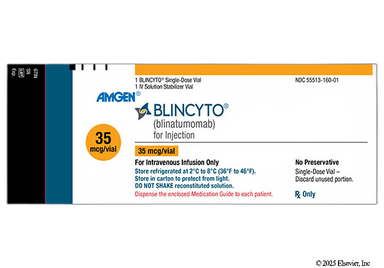




 Blincyto (blinatumomab) can cause a reaction called