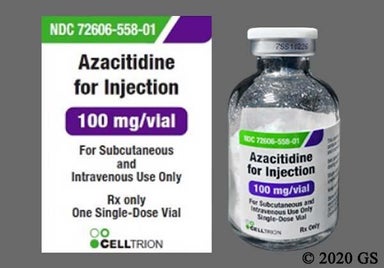
Azacitidine (Vidaza) is a type of chemotherapy known as a hypomethylating agent. It's FDA-approved to treat myelodysplastic syndromes (MDS) in adults and juvenile myelomonocytic leukemia (JMML) in children ages 1 month and older. Oncologists might also prescribe it off-label to treat acute myeloid leukemia (AML). Azacitidine (Vidaza) is given as an injection under the skin or into the vein by a healthcare professional. It's typically given daily for a week during each 28-day treatment cycle. Some of the more common side effects of this medication include nausea, fever, and constipation.
Azacitidine (Vidaza) is a chemotherapy medication called a hypomethylating agent. The main way it fights blood cancers is by allowing these immature blood cells to grow up properly into healthy “adult” blood cells. Sometimes, this also leads to cell death of the immature blood cells.
The following side effects may get better over time as your body gets used to the medication. Let your healthcare provider know immediately if you continue to experience these symptoms or if they worsen over time.
Common Side Effects
Nausea (up to 71%)
Low red blood cells (up to 70%)
Low platelets (up to 70%)
Vomiting (up to 54%)
Fever (up to 52%)
Constipation (up to 50%)
Low white blood cells (up to 66%)
Injection site redness or warmth (up to 43%)
Diarrhea (36%)
Bruising (up to 31%)
Trouble breathing (29%)
Small red skin spots (up to 24%)
Injection site pain (up to 23%)
Joint pain (22%)
Headache (22%)
Less Common Side Effects
Low white blood cells with fever
Stomach pain and swelling
Bleeding gums and mouth
Chest pain
Chills or shivering
Weakness
Pneumonia
Cough, sore throat, and other symptoms of an upper respiratory tract infection
Muscle pain
Dizziness
Anxiety
Trouble sleeping
Rash
Tiredness
Azacitidine (Vidaza) serious side effects
Contact your healthcare provider immediately if you experience any of the following.
Liver damage: tiredness, loss of appetite, nausea or vomiting, dark urine, right-side stomach pain, easy bruising or bleeding, or yellowing of the eyes or skin
Kidney damage: blood in urine, changes in urination (more or less)
High uric acid and electrolyte imbalances: dark urine, not urinating as much as usual, pain on either side of the lower back, racing heart, muscle cramps or spasms, numbness, nausea, vomiting
Serious bleeding: unusual bleeding, easy bruising, blood in urine or stool, confusion, vision changes
The following Azacitidine (Vidaza) side effects have also been reported
Along with its needed effects, a medicine may cause some unwanted effects. Although not all of these side effects may occur, if they do occur they may need medical attention.
Check with your doctor or nurse immediately if any of the following side effects occur:
Some side effects may occur that usually do not need medical attention. These side effects may go away during treatment as your body adjusts to the medicine. Also, your health care professional may be able to tell you about ways to prevent or reduce some of these side effects. Check with your health care professional if any of the following side effects continue or are bothersome or if you have any questions about them:
A first-choice treatment option for myelodysplastic syndromes
Can be given as an injection into the vein or under the skin
Available as a lower-cost, generic medication
Cons
Common side effects include nausea, low red blood cells, and low platelets
Might affect the ability to have children in both males and females
Might cause liver damage in people with a history of liver problems
Pharmacist tips for Azacitidine (Vidaza)
Make sure to get your lab work done on time so your oncologist can monitor your blood cell counts during treatment. You’ll need to do blood work before every cycle, and sometimes even more often.
Tell your care team about all the medications you take, including supplements and over-the-counter medications. Before starting any new medications, make sure your provider knows you're taking azacitidine (Vidaza) so they can help you look for interactions. For example, taking azacitidine (Vidaza) with non-steroidal anti-inflammatory drugs (NSAIDs) or aspirin can raise your risk of bleeding.
Azacitidine (Vidaza) can cause low white blood cell counts. This can make it hard for your body to fight infections as well if you get sick. You can help prevent infections by washing your hands often, avoiding crowds, and washing raw fruits and vegetables thoroughly before eating them.
Azacitidine (Vidaza) can cause nausea and vomiting. You might receive some medications to help with nausea, like ondansetron (Zofran), before your treatment with azacitidine (Vidaza) to help prevent nausea and vomiting. Your oncologist might also prescribe these medications for you to take at home in case you have nausea and vomiting later on.
Regardless of sex, if you or your partner is able to become pregnant, use birth control during treatment to help prevent pregnancy. Continue to use birth control for at least 3 months (males) or 6 months (females) after your last dose. Azacitidine (Vidaza) might cause harm to an unborn baby.
Risks and warnings for Azacitidine (Vidaza)
Azacitidine (Vidaza) can cause some serious health issues. This risk may be even higher for certain groups. If this worries you, talk to your doctor or pharmacist about other options.
Low blood cell counts
Azacitidine (Vidaza) can cause your white blood cells, red blood cells, and platelets to drop. When these cell counts are lower than normal, you might be at risk for bleeding and developing infections. Your provider will check your blood cell counts before every treatment cycle while you’re receiving azacitidine (Vidaza) (and sometimes even more often). Let your provider know if you develop a fever of 100.4 degrees Fahrenheit or higher, or start to feel sick or have any unusual bruising or bleeding. If this happens you might need to have your dose lowered or stop this medication altogether.
Liver damage in people with a history of liver problems
Risk factors: Liver problems | High tumor burden | Cancer that has spread to other parts of the body | Low albumin level
Azacitidine (Vidaza) can cause rare, but life-threatening damage to your liver, especially if you have a history of liver problems. You might be at a higher risk for liver damage if you have cancer that has spread to other parts of the body and/or a greater amount of cancer in the body. You might not be able to use this medication if you have a liver tumor. You’ll need to get blood tests before every treatment cycle to make sure that your liver is healthy. If you develop any liver problems, your provider might have you stop taking azacitidine (Vidaza). Let your provider know if you experience tiredness, loss of appetite, nausea or vomiting, dark urine, right-side stomach pain, easy bruising or bleeding, or yellowing of the eyes or skin, as these can be symptoms of liver problems.
Kidney damage
Risk factors: Also taking other chemotherapies | History of kidney problems
Azacitidine (Vidaza) can cause rare, but serious and life-threatening kidney problems. Your provider will monitor your kidney health regularly before each cycle of azacitidine (Vidaza) through lab work during treatment. If you develop kidney problems, your provider might pause azacitidine (Vidaza) until your kidney gets better. Talk to your provider if you notice any changes in how often you urinate (more or less) or any blood in your urine so they can check for kidney issues.
High uric acid and electrolyte imbalances (from tumor lysis syndrome)
Treatment with azacitidine (Vidaza) can cause a serious reaction called tumor lysis syndrome (TLS). TLS is when many cancer cells die quickly and break down in your body. This causes a rapid release of the cells’ contents, like uric acid, potassium, and phosphorus, into your blood. High levels of uric acid and electrolytes in your body can cause serious kidney damage and abnormal heart rhythms.
Your provider will monitor you more closely if you have a higher risk for TLS. You also might need to take preventative medication to lower uric acid levels, such as allopurinol (Zyloprim), and receive extra hydration with fluids. Tell your provider right away if you’re urinating less than usual or have dark urine, muscle cramps, or a racing heartbeat.
Harm to an unborn baby
Based on animal studies, azacitidine (Vidaza) can harm an unborn baby. Because of these risks, females taking azacitidine (Vidaza) should use birth control during treatment and for at least 6 months after the last dose. Men with female partners who are able to become pregnant should use birth control during treatment with azacitidine (Vidaza) and for at least 3 months after the last dose. Let your provider know right away if you become pregnant during this time.
Azacitidine (Vidaza) dosage
The average cost for 10 vials of 100mg of Azacitidine (Vidaza) is $141.25 with a free GoodRx coupon. This is 97.30% off the average retail price of $5,225.82.
Interactions between Azacitidine (Vidaza) and other drugs
Azacitidine (Vidaza) may interact with certain medications or supplements. Always let your doctor and pharmacist know about any other medications or supplements (including prescribed and over-the-counter medications, vitamins, and dietary or herbal supplements) that you are currently taking. The list below does not include all possible drug interactions with Azacitidine (Vidaza). Please note that only the generic name of each medication is listed below.
Although certain medicines should not be used together at all, in other cases two different medicines may be used together even if an interaction might occur. In these cases, your doctor may want to change the dose, or other precautions may be necessary. When you are receiving this medicine, it is especially important that your healthcare professional know if you are taking any of the medicines listed below. The following interactions have been selected on the basis of their potential significance and are not necessarily all-inclusive.
Using this medicine with any of the following medicines is usually not recommended, but may be required in some cases. If both medicines are prescribed together, your doctor may change the dose or how often you use one or both of the medicines.
Contraindications are specific health conditions or situations in which a person should not take a medication due to safety concerns. If you have any of the following conditions or if any of the following apply to you, let your healthcare provider know because Azacitidine (Vidaza) will not be safe for you to take.
Advanced cancerous liver tumors
Serious allergy to mannitol
What are alternatives to Azacitidine (Vidaza)?
There are a number of medications that your doctor can prescribe in place of Azacitidine (Vidaza). Compare a few possible alternatives below.
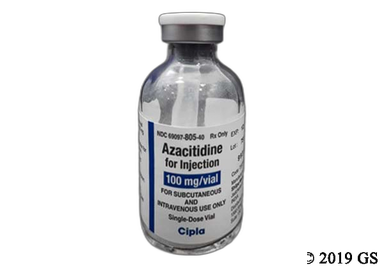
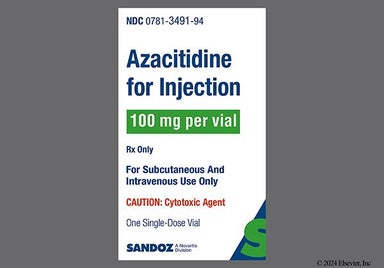
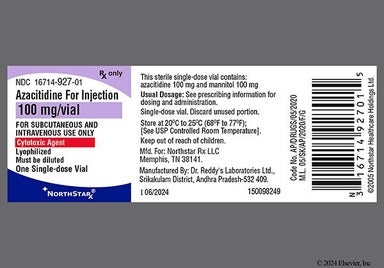
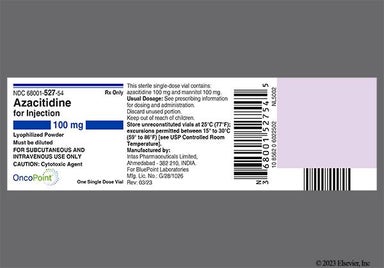
This medicine is White Vial.White Not applicable - Azacitidine 100mg Powder for InjectionThis medicine is Colorless Vial.Not applicable - Azacitidine 100mg Powder for InjectionThis medicine is White Vial.White Not applicable - Azacitidine 100mg Powder for InjectionThis medicine is Colorless Vial.Not applicable - Azacitidine 100mg Powder for InjectionThis medicine is White Vial.White Not applicable - Azacitidine 100mg Powder for InjectionThis medicine is White Vial.White Not applicable - Azacitidine 100mg Powder for InjectionThis medicine is White Vial.White Not applicable - Azacitidine 100mg Powder for InjectionThis medicine is White Vial.White Not applicable - Azacitidine 100mg Powder for Injection
GoodRx Health has strict sourcing policies and relies on primary sources such as medical organizations, governmental agencies, academic institutions, and peer-reviewed scientific journals. Learn more about how we ensure our content is accurate, thorough, and unbiased by reading our editorial guidelines.
Prescription savings
Stop paying too much for your prescriptions. Compare prices, get pharmacy coupons, and save up to 80%.
No, Vidaza can’t cure MDS. But this medication can slow its progression. If you have MDS, your bone marrow isn't able to make as many mature, "adult" blood cells. Many people need to get blood transfusions to make up for the lower blood cell count. But when you receive Vidaza, the immature cells start to mature into "adult" blood cells again. Having more mature blood cells can ease some symptoms of MDS, like tiredness or trouble breathing. This can also lessen your need for blood transfusions.
How long the side effects of Vidaza last depends on what you're experiencing. Nausea is one of the most common side effects of this medication, but it's usually mild. Your oncologist can help you manage nausea with antiemetic medications, such as ondansetron (Zofran) or prochlorperazine (Compazine). Another common side effect is skin redness and swelling around the injection site. This usually goes away after a day or two for most people, but your oncologist might recommend ice packs and appropriate over-the-counter pain medications in the meantime. There are also other side effects, such as tiredness and low blood cell counts, that can last for weeks to months. If you have side effects that are bothersome or that aren’t getting better, contact your care team.
You should take Vidaza for as long as your provider recommends. The length of treatment can differ from person to person depending on different factors, such as how well Vidaza is working to treat your cancer and how well you tolerate the side effects. You might need to receive this medication for a few cycles before you and your oncologist can tell how well this medication is working. If you stop treatment, it’s possible for your cancer symptoms to return. Don’t stop Vidaza without first discussing with your oncologist.
If Vidaza stops working well to manage your cancer, your oncologist will discuss next steps and other treatment options with you. These can differ from person to person, depending on the type of cancer. For example, if you have MDS and the cancer has a certain mutation (genetic change), your oncologist might prescribe an oral medication called Tibsovo (ivosidenib). Or, your oncologist might discuss the possibility of receiving chemotherapy and a stem cell transplant as your next treatment. If you’re concerned about what happens after Vidaza stops working, talk with your provider about their plan for you.
Vidaza can be given either as an injection into the vein (IV) or as an injection underneath the skin (SQ). The injection under the skin is quicker and only takes a couple of minutes. But depending on your dose, you might need more than one shot for a single treatment. The injection through the veins is typically infused over 10 to 40 minutes, but only requires you to be stuck with a needle once. Both methods of injection work just as well as the other. If you’re unsure how you should receive Vidaza, talk with your oncologist.
No, hair loss is not a common side effect of Vidaza. If you do develop hair thinning or loss while taking Vidaza, let your oncologist know. There might be other causes of hair loss they want to look into.
Vidaza isn’t recommended for use in pregnancy, because it might cause harm to your unborn baby. If you’re a female who’s able to become pregnant, you should use birth control while taking Vidaza and for at least 6 months after the last dose. If you’re male and have partners who are able to become pregnant, you should use effective contraception during treatment with Vidaza and for at least 3 months after the last dose. Let your provider know right away if you become pregnant while taking this medication.
It isn’t recommended to breastfeed while taking Vidaza. We don’t know if the medication can pass into your breast milk, but there’s a risk of serious harm to nursing infants if it does. Because of this risk, you shouldn’t breastfeed while taking Vidaza and for 1 week after your last dose. Talk with your provider about other ways to feed your baby during treatment.