



How Much Is Austedo Without Insurance?
Austedo can cost over $6,000 a month without insurance or discounts. Learn more about how much Austedo costs without insurance and ways to save with GoodRx.
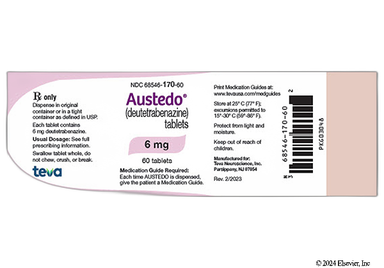
Austedo (deutetrabenazine) treats chorea in adults with Huntington's disease. It also treats tardive dyskinesia in adults. It works as a vesicular monoamine transporter 2 (VMAT2) inhibitor to help control body movements. Austedo (deutetrabenazine) comes as a tablet you take by mouth. The immediate-release version (Austedo) is taken twice a day, and the extended-release version (Austedo XR) is taken once a day. You start at a low dose, and then your prescriber slowly raises it over a few weeks. Austedo XR has a 4-week titration pack to help with this. Side effects include sleepiness, diarrhea, and dry mouth. As of mid-2025, it's only as a brand-name version; there's no generic yet.

Austedo (deutetrabenazine) is a vesicular monoamine transporter 2 (VMAT2) inhibitor. It's not exactly known how it works.
But researchers think the medication blocks a protein in your nerves called VMAT2. This helps lower the amount of certain chemicals in your nerves. These chemicals can include dopamine, serotonin, norepinephrine, and histamine. They play a role in body movement.
Lowering these chemicals in your nerves might help with movement problems.
| Common Brands | Austedo, Austedo XR |
|---|---|
| Drug Class | VMAT2 inhibitor |
| Controlled Substance Classification | Not a controlled medication |
| Generic Status | No lower-cost generic available |
| Availability | Prescription only |

The following side effects may get better over time as your body gets used to the medication. Let your healthcare provider know immediately if you continue to experience these symptoms or if they worsen over time.
Chorea from Huntington's disease:
Tardive dyskinesia:
Chorea from Huntington's disease:
Tardive dyskinesia:
Contact your healthcare provider immediately if you experience any of the following.
Side effects that you should report to your care team as soon as possible:
Side effects that usually do not require medical attention (report these to your care team if they continue or are bothersome):




Austedo (deutetrabenazine) can cause some serious health issues. This risk may be even higher for certain groups. If this worries you, talk to your doctor or pharmacist about other options.
 People with Huntington's disease have a higher risk of depression and thoughts of suicide. Austedo (deutetrabenazine) might make this risk even higher.
 If you or a loved one notices that you have signs of depression or unusual behavior while taking Austedo (deutetrabenazine), talk to your prescriber right away. Call 911 as soon as possible if you think about hurting yourself. If these feelings don't go away, you might have to stop taking this medication.
Some side effects of Austedo (deutetrabenazine) can look like symptoms of Huntington's disease. These include mood changes, trouble thinking clearly, and stiff muscles.
Your prescriber will check on you regularly while you take Austedo (deutetrabenazine). Tell them if you notice these symptoms or if they get worse. They might lower your dose or stop the medication for a while. This can help figure out if the symptoms are from the medication or if your Huntington's disease is getting worse.
Although it's rare, Austedo (deutetrabenazine) might make your heart take longer to recharge between beats. This is called QT prolongation and can sometimes cause changes in heart rhythm. It's not likely to be harmful if you take the recommended dose.
Tell your prescriber about your full medical history and all the medications you take. Some health problems and medications can raise your risk of QT prolongation. Your prescriber can check if Austedo (deutetrabenazine) is safe for you.
Get medical help right away if you have chest pain, trouble breathing, or feel faint or dizzy while taking Austedo (deutetrabenazine). These could be signs of heart rhythm changes.
Some people taking tetrabenazine (Xenazine), a medication like Austedo (deutetrabenazine), had a rare but very serious problem called neuroleptic malignant syndrome (NMS). People taking Austedo (deutetrabenazine) haven't had NMS. But the risk is still possible.
The risk might be higher if you take other medications that can cause NMS. Examples include haloperidol and olanzapine (Zyprexa). Make sure to tell your prescriber about all the medications you take.
If you have symptoms of NMS while taking Austedo (deutetrabenazine), get medical help right away. Signs include a high fever, sweating, stiff muscles, confusion, or an uneven heartbeat.
Austedo (deutetrabenazine) can make you feel like you can't sit still. You might feel restless, squirmy, fidgety, or tense.
Austedo (deutetrabenazine) can also cause movement problems called parkinsonism. These include tremors, slow movement, stiff muscles, or losing balance. This usually happens within the first 2 weeks after starting the medication or raising the dose. It can sometimes lead to falls.
Tell your care team if you have these abnormal movements while taking Austedo (deutetrabenazine). It's especially important to mention stiff muscles. This is because it can be a sign that your Huntington's disease might be getting worse. If the medication is causing these problems, your prescriber might lower your dose or have you stop taking it.
Tetrabenazine (Xenazine), a similar medication to Austedo (deutetrabenazine), can raise prolactin levels. To be safe, it's important to be aware of this risk with Austedo (deutetrabenazine).
Prolactin is a hormone that helps with milk production and breast growth in females. Males also make some prolactin as well. Too much prolactin can cause weak bones, leakage of milk from the breast, and breast growth. These symptoms can happen in both females and males. Males can also have erectile dysfunction (ED).
If you notice any of these symptoms while taking Austedo (deutetrabenazine), talk to your care team. They might have you get a blood test to check your prolactin levels.


Contraindications are specific health conditions or situations in which a person should not take a medication due to safety concerns. If you have any of the following conditions or if any of the following apply to you, let your healthcare provider know because Austedo (deutetrabenazine) will not be safe for you to take.







Prescription savings
Stop paying too much for your prescriptions. Compare prices, get pharmacy coupons, and save up to 80%. Find expert answers to your health questions so you can make the best decisions for yourself and your family.
Health conditions
Medications & treatment
Access & affordability
Medication discounts

In studies, people who took Austedo didn't report weight gain as a side effect. If you notice weight gain that you can't explain, talk to your primary care provider.
In studies, people started having better control of their body movements within 2 weeks of starting Austedo. But for some, it might take longer. Overall, it can take a few months to get the full benefits from the medication. Ask your prescriber if you have questions about how long it's taking to work for you.
No, Austedo isn't a controlled substance. It doesn't have a risk of misuse or dependence.
No, Austedo isn't an antipsychotic. It's a medication that can help treat a possible side effect of antipsychotics called tardive dyskinesia. If you start having TD from your antipsychotic, talk to your prescriber. They can help find ways to manage this side effect. They can see if Austedo is right for you.
Yes, Austedo is usually safe for older adults. Studies didn't include many people 65 years and older. But there doesn't seem to be a big difference between how older and younger adults respond to the medication. To be safe, prescribers might start older adults on a lower dose of Austedo. They might check in more often about side effects. Ask your prescriber if you have questions about taking this medication as an older adult.
Both Austedo and Austedo XR contain the same active ingredient (deutetrabenazine). Austedo is the immediate-release version. The medication gets released from the tablet and into the body quickly, but it doesn't last long. Austedo is taken twice per day with food. Austedo XR is the extended-release version of the medication. The XR tablet slowly releases medication into the body throughout the day, so you only need to take it once a day. You can take Austedo XR with or without food. Talk to your prescriber about which version is right for you.
It's not known if Austedo works well or is safe for treating essential tremor. There haven't been any studies on using the medication to treat this problem. Talk to a healthcare professional to learn about treatment options for essential tremor.
