Key takeaways:
Lion’s mane (Hericium erinaceus) is a functional mushroom traditionally used in Chinese medicine. It can be eaten raw or cooked. You can also take it as a pill, powder, or liquid supplement.
Some research shows that lion’s mane may have benefits for brain health and may improve brain function in Alzheimer’s disease. But as of now, we don’t have large, well-designed studies with humans to support this.
No vitamin or supplement, including lion’s mane, has been proven to prevent or treat Alzheimer’s disease.
Humans have foraged mushrooms for thousands of years — and not just for food. Mushrooms show up in ancient folklore, healing traditions, and art. In recent years, they’ve become frequent research topics and trendy ingredients in health and wellness products.
Lion’s mane is one such functional mushroom, commonly found in East Asia. Known as hóu tóu gū in China or yamabushitake in Japan, it’s been used in traditional Chinese and Japanese medicine for centuries. It’s thought to have positive effects on several organs, including the stomach, brain, and liver.
Lion’s mane is particularly known for its potential effects on brain health. And there’s growing interest in whether lion’s mane can help manage Alzheimer’s disease — a type of dementia that affects memory and other brain functions.
Search and compare options
What is lion’s mane?
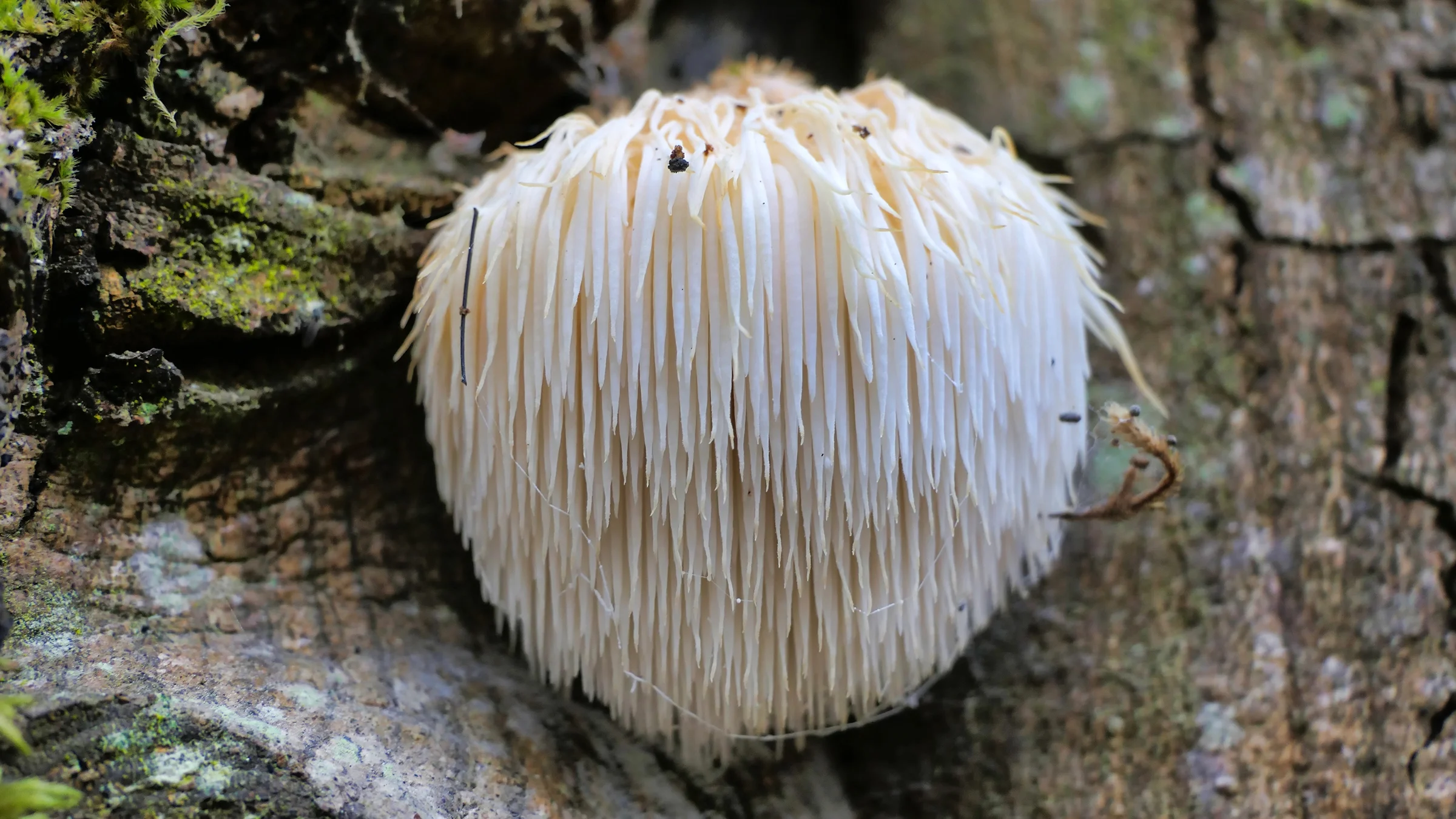
Lion’s mane is an edible mushroom found in forests. It’s scientifically known as Hericium erinaceus. Like a lion’s mane, these mushrooms are shaggy and lush-looking — like big, white pom-poms. Their taste and texture is often described as crab- or lobster-like.
A lion’s mane mushroom has two main parts:
The shaggy part of the mushroom (fruiting body), which contains hericenones
The root-like structure (mycelium), which contains erinacines
Erinacines and hericenones are two active chemicals in lion’s mane that may be largely responsible for positive effects on the brain (especially erinacines).
Good to know: Lion’s mane is a functional mushroom, which isn’t the same as “magic mushrooms.” It doesn’t cause hallucinations and euphoria since it doesn’t contain psilocybin — the active chemical in magic mushrooms.
How does lion’s mane work?
The vast amount of research on lion’s mane has been done in labs — in test tubes, petri dishes, and animals. From this work, scientists have found that lion’s mane has the potential to:
Reduce brain inflammation
Decrease beta-amyloid protein plaques (protein clumps that are thought to worsen Alzheimer’s disease)
Help brain and nerve cells grow and develop
Prevent brain cell death

Read more like this
Explore these related articles, suggested for readers like you.


Can lion’s mane treat Alzheimer’s disease?
Before we talk about the benefits and risks of lion’s mane, it’s important to know that lion’s mane cannot treat Alzheimer’s disease on its own. In fact, there isn’t one food, vitamin, or supplement that’s singlehandedly been shown to prevent or treat Alzheimer’s disease. Over-the-counter products that claim to cure or delay Alzheimer’s are not backed by scientific research.
There is some evidence that various lifestyle habits — like eating a brain-healthy diet and exercising regularly — may help prevent dementia. And if you have signs of Alzheimer’s, there are several FDA-approved medications that can improve your symptoms.
Some medications can even target the disease process itself and may prevent Alzheimer’s from getting worse. Talk with your healthcare team about your options if you’re experiencing changes to your memory and thinking. Many medications work best during the early phases of Alzheimer’s dementia.
Potential brain benefits of lion’s mane
Lion’s mane may have several benefits to the brain. A few examples include:
Increasing nerve growth factor (NGF) and brain-derived neurotrophic factor (BDNF): These are two chemicals that support brain health. Studies show people with Alzheimer’s dementia have decreased levels of these brain chemicals. However, lion’s mane has been shown to increase the levels of NGF and BDNF in mice and in test-tube experiments.
Increasing ergothioneine (ERGO) levels in the body: This is an amino acid (protein building block) known as the “longevity vitamin.” ERGO has possible anti-aging and brain-protecting properties. Mushrooms, particularly lion’s mane, are the richest food source of ERGO. But we don’t know whether getting ERGO from foods or supplements translates to a true benefit. So just because you consume a product with ERGO, doesn’t mean you’ll reap any anti-aging or brain benefits.
However, there’s minimal research on the effects of lion’s mane in humans. In fact, only three small studies have been done in older adults taking lion’s mane. These studies all compared lion’s mane to a placebo (a pill with nothing in it).
One study included 34 healthy participants between the ages of 55 to 65 years old, taking 3.2 grams of a concentrated lion’s mane supplement per day for 3 months. Compared to a placebo, participants taking the supplement had better scores on a test that measures memory and thinking abilities.
A second study included 30 participants with mild cognitive impairment between the ages of 60 to 80 years old. Participants taking about 3 grams of a lion’s mane supplement per day for 4 months had better scores on a standardized test that measures brain function. The improvement went away after participants stopped taking the supplements.
A third study of lion’s mane in humans looked at about 40 people over the age of 50 who had mild Alzheimer’s disease. Participants received about 1 gram of a lion’s mane supplement per day for close to a year. Compared to a placebo, the lion’s mane group had better scores on a test that measures how easily you can perform certain mental tasks. But lion’s mane wasn’t better than the placebo on other tests that measured memory and thinking abilities.
Based on these small studies, it’s possible that higher doses of lion’s mane supplements (3 grams or more) are necessary to see improvement in Alzheimer’s symptoms. But larger studies are needed to know for sure. And the supplements tested in these studies aren’t equivalent to consuming lion’s mane mushrooms from the grocery store. These supplements are concentrated forms of certain chemicals in lion’s mane.
However, lion’s mane does seem more likely to help Alzheimer’s symptoms compared to other types of mushrooms.
Potential risks of lion’s mane
Lion’s mane supplements seem generally safe, though no long-term data is available. Some people taking concentrated lion’s mane supplements have reported stomachaches, nausea, and rashes. An allergic reaction to lion’s mane is possible, but a severe reaction is unlikely.
Still, it’s possible that lion’s mane products can have harmful contaminants. For example, lion’s mane can contain heavy metals (like arsenic or lead) from the environment it grew in. Consuming large amounts could result in potentially harmful amounts of heavy metals in your body. Additionally, lion’s mane supplements aren’t regulated by the FDA. It’s possible that what’s actually inside a lion’s mane product doesn’t match what’s on the label.
Lion’s mane comes in several forms, including pills, liquids, and powders. This GoodRx article provides tips for how to choose a safe supplement product.
Who shouldn’t take lion’s mane supplements?
Children and women who are pregnant or nursing should avoid lion’s mane supplements. Lion’s mane hasn’t been studied in these groups. In addition, the FDA warns that children, older adults, and people with chronic health conditions are more vulnerable to the effects of heavy metals, which may be present in lion’s mane supplements.
Check with your healthcare professional (HCP) or pharmacist before taking lion’s mane, especially if you take other medications. Drug interactions between lion’s mane and other medications are possible, but we don’t have much information on them. Giving your HCP and pharmacist a list of all your medications, including over-the-counter products, can help them evaluate your risk.
Talking to your healthcare team about lion’s mane supplements
Fresh or dried lion’s mane can be part of a balanced, nutrient-dense diet. But it’s best to talk to your healthcare team before taking lion’s mane supplements, or before adding large amounts of fresh or dried mushrooms to your diet.
It’s also a good idea to get help early if you notice memory and thinking changes, even if your day-to-day routines haven’t been impacted. You may have mild cognitive impairment, an often treatable condition that may be reversible. Your care team can help figure out what’s causing your symptoms and come up with a plan of action.
If you or a loved one is living with Alzheimer’s, keeping up with regular medical appointments is important. Your care team can make sure that your Alzheimer’s treatment is safe and effective. In addition, as new treatments become available, they can discuss whether one might be an option for you.
The bottom line
Lion’s mane is a functional mushroom that may promote brain health. But we don’t have a lot of human research on how effective or safe it is. The human research we do have shows there may be a possible benefit of lion’s mane supplements in older adults with mild cognitive impairment or Alzheimer’s disease. But larger studies are needed to confirm this.
Mushrooms like lion’s mane are nutrient-rich and can be eaten as part of a balanced diet. But talk with your prescriber and pharmacist before taking lion’s mane supplements. These aren’t regulated by the FDA. Although lion’s mane is generally safe, there are possible risks, including harm from contaminants. Lion’s mane also hasn’t been studied in children or during pregnancy.

Why trust our experts?




References
Agarwal, S., et al. (2021). Nutritional impact of adding a serving of mushrooms to USDA Food Patterns - a dietary modeling analysis. Food & Nutrition Research.
Alzheimer's Association. (2020). Alternative treatments.
Beelman, R. B., et al. (2020). Is ergothioneine a 'longevity vitamin' limited in the American diet? Journal of Nutritional Science.
Brandalise, F., et al. (2023). Hericium erinaceus in neurodegenerative diseases: From bench to bedside and beyond, how far from the shoreline? Journal of Fungi.
Cha, S., et al. (2024). A review of the effects of mushrooms on mood and neurocognitive health across the lifespan. Neuroscience & Biobehavioral Reviews.
Docherty, S., et al. (2023). The acute and chronic effects of lion’s mane mushroom supplementation on cognitive function, stress and mood in young adults: A double-blind, parallel groups, pilot study. Nutrients.
Gao, L., et al. (2022). Brain-derived neurotrophic factor in Alzheimer’s disease and its pharmaceutical potential. Translational Neurodegeneration.
Li, I. C., et al. (2018). Neurohealth properties of Hericium erinaceus mycelia enriched with erinacines. Behavioural Neurology.
Li, I. C., et al. (2020). Prevention of early Alzheimer's disease by erinacine A-enriched Hericium erinaceus mycelia pilot double-blind placebo-controlled study. Frontiers in Aging Neuroscience.
Łysakowska, P., et al. (2023). Medicinal mushrooms: Their bioactive components, nutritional value and application in functional food production-a review. Molecules.
Ma, B-J., et al. (2010). Hericenones and erinacines: Stimulators of nerve growth factor (NGF) biosynthesis in Hericium erinaceus. Mycology.
Martin, R. L., et al. (2022). Evaluation of the generally recognized as safe (GRAS) status of lion's mane mushroom 8-glucan as a food ingredient (GRN no. 1124). U.S. Food and Drug Administration GRAS Notice Inventory.
Martínez-Mármol, Ramón, et al. (2023). Hericerin derivatives activates a pan-neurotrophic pathway in central hippocampal neurons converging to ERK1/2 signaling enhancing spatial memory. Journal of Neurochemistry.
Mushroom Council. (n.d.). Lion's mane.
National Institute on Aging. (2021). 8 frequently asked questions about Alzheimer's disease.
National Institute on Aging. (2023). How Is Alzheimer's disease treated?
Pentz, R., et al. (2021). The human brain NGF metabolic pathway is impaired in the pre-clinical and clinical continuum of Alzheimer's disease. Molecular Psychiatry.
Spelman, K., et al. (2017). Neurological activity of lion’s mane (Hericium erinaceus). Journal of Restorative Medicine.
Szućko-Kociuba, I., et al. (2023). Neurotrophic and neuroprotective effects of Hericium erinaceus. International Journal of Molecular Sciences.
Tripodi, F., et al. (2022). Anti-aging and neuroprotective properties of Grifola frondosa and Hericium erinaceus extracts. Nutrients.
U.S. Food and Drug Administration. (2023). Environmental contaminants in food.
Varghese, R., et al. (2019). Historical and current perspectives on therapeutic potential of higher basidiomycetes: an overview. 3 Biotech.