Key takeaways:
Pickleball is a paddle sport that combines tennis, ping pong, and badminton.
It provides health benefits –– like better balance and cognitive function –– that may be particularly appealing for older adults.
You can enjoy the beginner-friendly sport at any age or skill level.
In 1965, three dads improvised the first pickleball game with ping-pong paddles on a badminton court. Today, it's one of the fastest-growing sports in the country. The low-impact game blends elements of tennis, ping pong, and badminton. It's easy to learn and packed with health benefits. Learn more about why the game is so popular, especially among older adults.
How do you play pickleball?
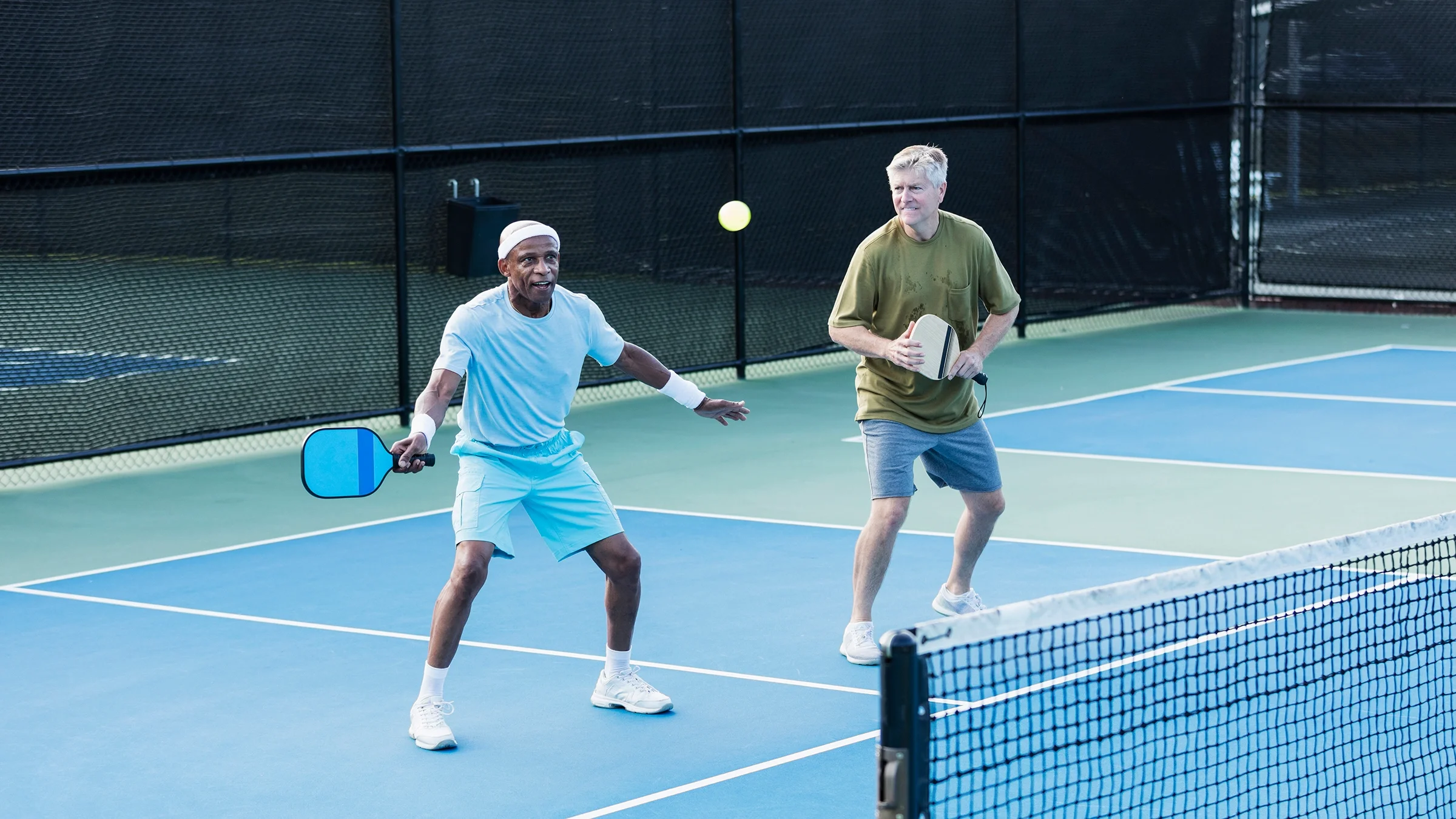
You play pickleball on an indoor or outdoor badminton-sized court with a modified tennis net. Although you can play in singles (one person on either side of the net), the doubles version (two against two) is more popular.
Let's look at the basics of how to play pickleball:
A player starts the game with a diagonal, underhand serve from the right side of the court.
With the first serve and the return serve, the ball must bounce once on each side of the net (two-bounce rule).
Then, players can hit the ball in the air or after a single bounce (volleying).
Volleying continues until someone faults. Faults include double bounces, hitting the pickleball out of bounds, and hitting the pickleball into the no-volley zone (7 feet on either side of the net).
Only the serving team can score points in pickleball. If the server doesn't score, the serve goes to the opposing player or team.
To win, you must reach 11 points and be ahead by at least two points.
Search and compare options
What do you need to start playing pickleball?
All you need to play pickleball is a paddle, ball, and court. You can find a court designated for pickleball or set up a makeshift court in a safe location. Some pickleball courts may have equipment that you can borrow or rent.
Pickleball paddles are smaller than a tennis racquet but larger than a ping-pong paddle. Older paddles are wooden, and modern paddles are made with composite materials, so they're lightweight and easier to wield. Pickleballs are plastic and have holes throughout. They are a little larger than a tennis ball and come in outdoor and indoor variants.
Why is pickleball so popular?
Pickleball continues to attract new players because of its accessibility. People who try pickleball may become casual or core players who participate in games eight or more times per year. Here’s why.
Pickleball rules are simple. Pickleball rules are similar to tennis and ping pong. Straightforward rules make the game approachable in settings like middle schools and older-adult communities.
It's accessible to many people. The USA Pickleball Board developed official rules for wheelchair pickleball, making it a good option for people with limited mobility. Seated and standing players can enjoy the game together.
It’s inexpensive. Minimal equipment and affordable options make pickleball an inexpensive sport. Some courts may even have equipment you can borrow for free.
There are many places to play. By the end of 2021, there were 9,524 places to play pickleball in the U.S. Venues like YMCAs, senior centers, parks, and community centers continue to add pickleball courts to their spaces. And thanks to USA Pickleball, it's easier than ever to find a venue. You can search by city to find walk-in, open-play options. Or you can join a league.
It’s a great way to stay social. Socializing is important at any age — but especially for older adults. One study reported that socialization was one of the main reasons that older adults played pickleball. And research suggests that pickleball is a great way for older adults to stay social and feel fulfilled as they move into retirement.
It’s an enjoyable exercise. Nearly half of adults over age 18 don’t get enough aerobic physical activity. One way to get motivated to exercise is to choose something fun and social like pickleball. It can double as a way to have fun with friends and get some exercise.
What are the health benefits of pickleball?
Ongoing studies support the many health advantages of pickleball. These research-backed benefits will give you more reasons to play this popular sport.
1. Provides moderate-intensity exercise
Adults need at least 150 minutes of moderate aerobic exercise every week. And ongoing movement while volleying during a game of pickleball can provide the aerobic activity your body needs. Playing pickleball regularly may provide heart health benefits like better blood pressure, cholesterol, and cardiorespiratory fitness.
2. Sharpens cognitive function
Research shows that participating in mentally stimulating or challenging activities can enhance cognitive function. Certain types of exercise — particularly open-skill activities –– may fit the bill. Open-skill exercises require you to focus in an unpredictable environment. Examples include tennis, baseball, and pickleball. In all three sports, players must adapt to dynamic or changing stimuli (the ball).

Read more like this
Explore these related articles, suggested for readers like you.
Open-skill exercises may enhance cognitive function more effectively than closed-skill exercises like running or swimming. One study found that a single session of open-skill training improved both memory and perception while closed-skill exercise only enhanced memory.
3. Improves mental health
Playing pickleball may be a good way to boost your mood — especially for older adults. Research suggests that pursuing pickleball as a hobby could reduce depression and increase a sense of well-being. One study linked pickleball with more happiness and social connection in older adults.
4. Increases lower body function
Regular pickleball may enhance lower-body function and mobility. A small sample of older pickleball players showed greater knee extensor power after just six weeks of play. And they increased their veritable jump by 7.5%. Knee extensor power has been linked to improved mobility in those with knee osteoarthritis.
5. Boosts balance and reduces falls
Balance problems can impair your stability and increase your chances of falling. Luckily, many exercises can help improve your balance. And pickleball may be one of them. In one study, pickleball players between the ages of 50 and 79 reported fewer falls off the court. This is particularly useful for people 65 and older who may have a higher risk of falling.
The bottom line
Pickleball is the fastest-growing sport in the country — and for good reason. It’s easy to learn, fun to play, and beneficial for many people, especially older adults. Pickleball may help older adults with cognitive abilities, physical health, and social satisfaction. The volley sport may also improve your cognitive function, heart health, and well-being. These and other benefits might have you ready to grab a paddle and get started.

Why trust our experts?


References
Accettura, A. J., et al. (2015). Knee extensor power relates to mobility performance in people with knee osteoarthritis: Cross-sectional analysis. Physical Therapy.
American Heart Association. (2018). American heart association recommendations for physical activity in adults and kids.
Casper, J. M., et al. (2018). Psychological connection to pickleball: Assessing motives and participation in older adults. Journal of Aging and Physical Activity.
Centers for Disease Control and Prevention. (2021). Exercise or physical activity.
Centers for Disease Control and Prevention. (2021). Facts about falls.
Dennis, C. H. (2019). The effects of a novel sport-based intervention on lower body muscle function in older adults. All Graduate Plan B and other Reports.
Gu, Q., et al. (2019). Effects of open versus closed skill exercise on cognitive function: A systematic review. Frontiers in Psychology.
Heo, J., et al. (2018). Serious leisure and depression in older adults: A study of pickleball players. Leisure Studies.
Kim, A. C. H., et al. (2020). Sport participation and happiness among older adults: A mediating role of social capital. Journal of Happiness Studies.
Kim, I., et al. (2020). Teaching pickleball with in-depth content knowledge in middle school physical education. Journal of Physical Education, Recreation & Dance.
National Institute on Aging. (2017). Balance problems and disorders.
National Institute on Aging. (2019). Social isolation, loneliness in older people pose health risks.
O’Brien, J., et al. (2017). One bout of open skill exercise improves cross-modal perception and immediate memory in healthy older adults who habitually exercise. PLoS One.
Ryu, J., et al. (2018). Understanding pickleball as a new leisure pursuit among older adults. Educational Gerontology.
Smith, L. E., et al. (2018). The acute and chronic physiological responses to pickleball in middle-aged and older adults. International Journal of Research in Exercise Physiology.
Søgaard, I. M. (2021). Longitudinal associations of pickleball-playing with cognitive function and balance in community-dwelling older adults. Wichita State University.
Sports and Fitness Industry Association. (2022). SFIA’s topline report shows Americans’ inactivity rate declining.
Tranter, L. J., et al. (2008). Age and flexible thinking: An experimental demonstration of the beneficial effects of increased cognitively stimulating activity on fluid intelligence in healthy older adults. Aging, Neuropsychology, and Cognition.
USA Pickleball. (n.d.). Adaptive/wheelchair pickleball.
USA Pickleball. (n.d.). History of the game.
USA Pickleball. (n.d.). Places 2 play.
USA Pickleball. (n.d.). Rules summary.
USA Pickleball. (n.d.). What is pickleball?.
USA Pickleball. (n.d.). What is pickleball: Description of equipment.
USA Pickleball. (2022). 2022 pickleball fact and media sheet.