Key takeaways:
Macadamia nuts are nutritious, thanks to their healthy fats, antioxidants, and plant compounds that can support heart health, gut health, and more.
Compared to other types of nuts, macadamia nuts are higher in fat and calories. They’re also lower in protein and fiber.
Try to choose macadamia nuts that are roasted and low in sodium.
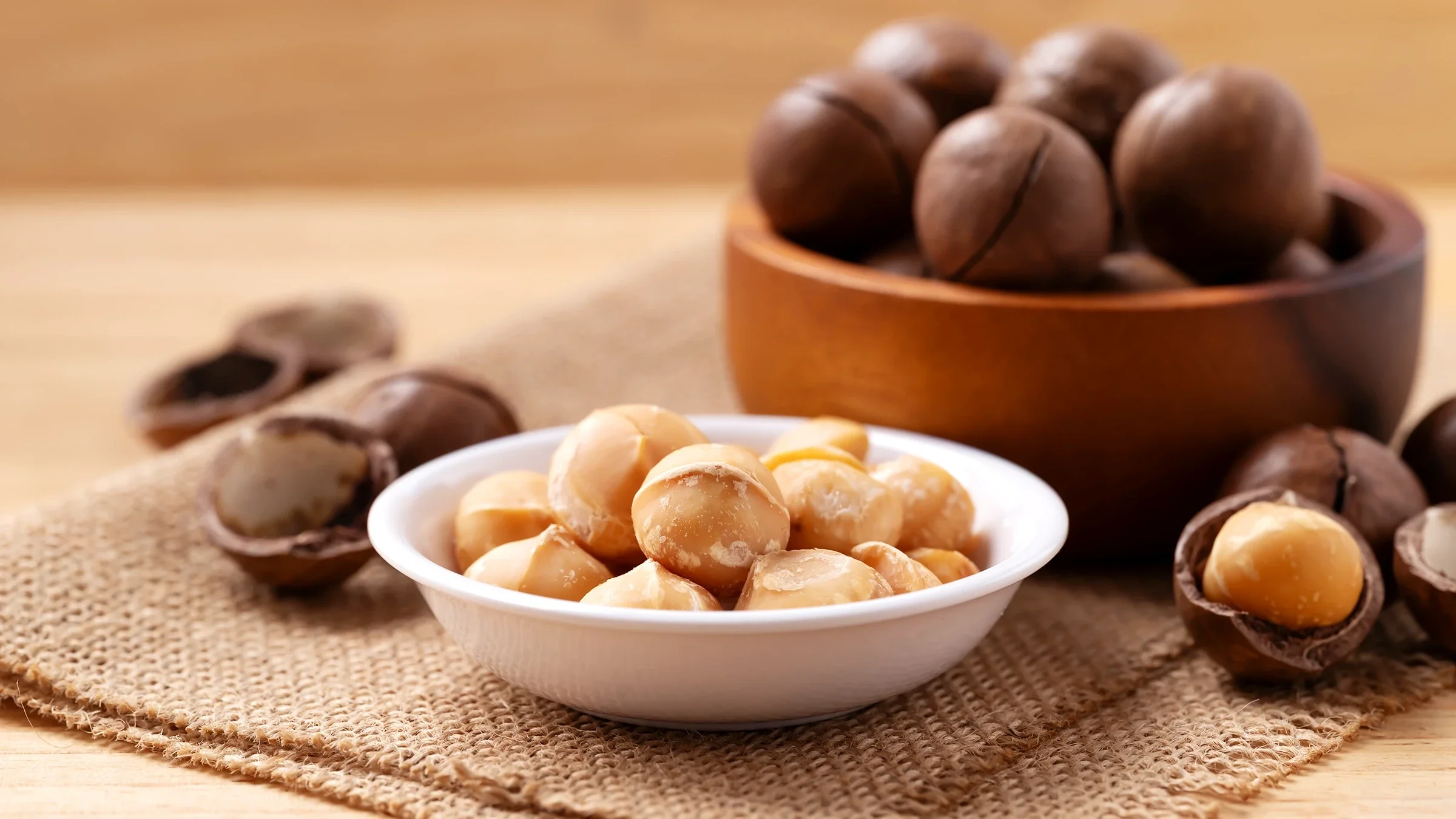
You may know macadamia nuts as a star ingredient in cookies and brownies. Their rich, buttery flavor and creamy texture make them the perfect addition to all kinds of baked goods. But are macadamia nuts actually nutritious? Do they deserve a spot in your diet?
Let’s take a look at some of macadamia nuts’ health benefits.
Antioxidants
All tree nuts, including macadamia nuts, contain plant compounds like carotenoids, phenolic acids, and flavonoids. These compounds have antioxidant and anti-inflammatory properties that can help reduce your risk of developing chronic conditions like heart disease, diabetes, and cancers.
Roasted macadamia nuts may have even more of these plant compounds than raw ones. In one study, macadamia nuts’ antioxidant content increased by nearly 26% after roasting. This is because roasting breaks open the structures in macadamia nuts that store oil and protein. This makes the nutrients easier for your body to absorb.
Support for heart health
Like all nuts, macadamia nuts contain fiber and healthy fats. They’re also high in phytosterols, which are plant-based compounds that are similar to cholesterol. This combination of nutrients may lower your risk of heart disease.
Macadamia nuts are particularly high in monounsaturated fats — a type of fat that can help maintain or increase your HDL (high-density lipoprotein) “good” cholesterol. These fats may also help lower LDL (low-density lipoprotein) “bad” cholesterol.
One small study looked at people who ate a serving of macadamia nuts daily. After 8 weeks, their total cholesterol dropped by about 2%. Their LDL or “bad” cholesterol went down even more — by 4%. Reducing total and LDL cholesterol is key for lowering your risk of heart disease and stroke.
Support for gut health
Macadamia nuts can benefit gut health in a few different ways.
They contain prebiotics, which are a specific type of fiber that helps feed the beneficial bacteria in your gut. Having the right balance of good bacteria in the microbiome helps keep the “bad bacteria” in check.
And the fiber in macadamia nuts supports digestion by:
Moving food efficiently through your digestive tract
Helping you have regular, easy-to-pass stools
Maintaining a healthy mucus layer in your gut
Helping you absorb minerals
Macadamia nuts nutrition
Below are the nutrients in a 1 oz serving of raw macadamia nuts. Percentages are based on the daily value (DV), or how much of a nutrient you’re recommended to eat per day:
Calories: 204
Carbohydrates (total): 3.9 g
Fat: 21.5 g (3.4 g from saturated fat)
Fiber: 2.4 g
Potassium: 104.5 mg (2% DV)
Protein: 2.2 g
The chart below shows how 1 oz of raw macadamia nuts stacks up nutritionally against some other nuts.
Calories | Fiber | Protein | Fat | Carbohydrates | |
Macadamia nuts | 204 | 2.4 g | 2.2 g | 21.5 g | 3.9 g |
164 | 3.6 g | 6 g | 14.2 g | 6.1 g | |
159 | 3 g | 5.7 g | 12.9 g | 7.7 g | |
161 | 2.4 g | 7.3 g | 14 g | 4.6 g |
What are the disadvantages of macadamia nuts?
Macadamia nuts are high in fat. Most of their fat is nutritious unsaturated fat. Still, the high fat content means macadamia nuts are also higher in calories than other nuts.
Macadamia nuts are also lower in protein than other nuts. And slightly lower in fiber, too. Less fiber and protein may make macadamia nuts less filling. So try to pay attention to serving sizes. A standard serving size for nuts is 1 oz, which is approximately one small handful.
How to choose macadamia nuts
When you’re buying macadamia nuts, try to look for those that are:
Roasted (for maximum antioxidant benefits) or raw
Low in sodium (a good rule of thumb is to try to find nuts with less than 180 mg of sodium per ounce, which is about 4% to 8% of the DV for sodium)
Free of sugar
If you’re buying macadamia nuts as part of a trail mix, try to avoid mixes that have chocolate chips, sweetened yogurt pieces, or sweetened dried fruits.
How to use macadamia nuts
Thanks to their rich, buttery flavor and smooth texture, macadamia nuts are highly versatile. You can snack on a handful as-is, or use macadamia nuts as an ingredient in recipes. Try:
Blending them into a smoothie for added protein, fiber, and fat
Adding them to homemade trail mix
Mixing them into batter for white chocolate-chip cookies or other baked goods
Roasting them with herbs
Sprinkling them onto salad or soup as “croutons”
Frequently asked questions
The recommended serving size of any type of nut is around 1 oz. This is a small handful. Macadamia nuts contain many beneficial nutrients, but they’re high in fat and calories.
Monounsaturated and polyunsaturated fats are both healthy fats.This is why the American Heart Association (AHA) recommends both types of fat for heart health. But the AHA has said that polyunsaturated fats may be even better than monounsaturated fats at decreasing the risk of heart disease.
Both macadamia nuts and almonds provide beneficial nutrients. But almonds have a nutritional edge. They contain more fiber and protein, and less calories than macadamia nuts per serving. Almonds also contain the most calcium, fiber, and vitamin E of any nut.
The recommended serving size of any type of nut is around 1 oz. This is a small handful. Macadamia nuts contain many beneficial nutrients, but they’re high in fat and calories.
Monounsaturated and polyunsaturated fats are both healthy fats.This is why the American Heart Association (AHA) recommends both types of fat for heart health. But the AHA has said that polyunsaturated fats may be even better than monounsaturated fats at decreasing the risk of heart disease.
Both macadamia nuts and almonds provide beneficial nutrients. But almonds have a nutritional edge. They contain more fiber and protein, and less calories than macadamia nuts per serving. Almonds also contain the most calcium, fiber, and vitamin E of any nut.
The bottom line
Macadamia nuts are nutritious because of their fiber, healthy fats, and plant compounds. They don’t offer as much protein or fiber as other nuts, but they still have a place in a balanced diet. Because they’re high in calories, try to pay attention to serving size (aim for about 1 oz). Choose raw and roasted varieties without added sugar, and opt for low-sodium varieties. Macadamia nuts have a smooth texture and creamy flavor that helps them work especially well in smoothies, or toasted and sprinkled on top of salads and soups.

Why trust our experts?




References
American Heart Association. (2017). Dietary fats and cardiovascular disease: A presidential advisory from the American Heart Association. Circulation.
American Heart Association. (2024). Go nuts (but just a little!)
Baye, K., et al. (2017). The unresolved role of dietary fibers on mineral absorption. Critical Reviews in Food Science and Nutrition.
Bolling, B. W., et al. (2011). Tree nut phytochemicals: composition, antioxidant capacity, bioactivity, impact factors. A systematic review of almonds, Brazils, cashews, hazelnuts, macadamias, pecans, pine nuts, pistachios and walnuts. Nutrition Research Reviews.
Curb, J. D., et al. (2000). Serum lipid effects of a high-monounsaturated fat diet based on macadamia nuts. JAMA Internal Medicine.
Jenkins, D. J. A., et al. (2010). Adding monounsaturated fatty acids to a dietary portfolio of cholesterol-lowering foods in hypercholesterolemia. Canadian Medical Association Journal.
Jones, J. L., et al. (2023). Macadamia nut effects on cardiometabolic risk factors: A randomised trial. Journal of Nutritional Science.
Lamuel-Raventos, R. M., et al. (2016). Prebiotic nut compounds and human microbiota. Critical Reviews in Food Science and Nutrition.
My Food Data. (n.d.). Almonds.
My Food Data. (n.d.). Raw macadamia nuts.
My Food Data. (n.d.). Raw peanuts.
My Food Data. (n.d.). Raw pistachio nuts.
National Center for Complementary and Integrative Health’s Clinical Digest. (2024). High cholesterol and natural products: What the science says. National Institutes of Health.
Storey, B. C., et al. (2018). Lowering LDL cholesterol reduces cardiovascular risk independently of presence of inflammation. Kidney International.
Tu, X., et al. (2021). A comprehensive study of raw and roasted macadamia nuts: Lipid profile, physicochemical, nutritional, and sensory properties. Food Science & Nutrition.