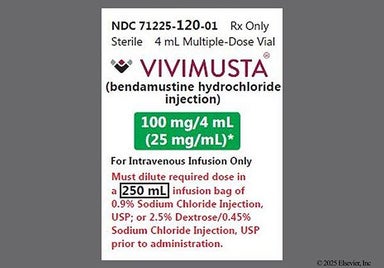
Vivimusta
Vivimusta (bendamustine) is a type of chemotherapy medication called an alkylating agent. It’s approved to treat some blood cancers like chronic lymphocytic leukemia (CLL) and non-Hodgkin lymphoma (NHL). This medication is given as an infusion through a vein at a medical center or clinic. It’s given over about 20 minutes on the first 2 days of each treatment cycle. Side effects include nausea, tiredness, low blood cell counts, and a risk of infection.


What is Vivimusta (bendamustine)?
What is Vivimusta (bendamustine) used for?
- Chronic lymphocytic leukemia (CLL)
- B-cell non-Hodgkin lymphoma (NHL), after previous treatment with rituximab (Rituxan) within the last 6 months
How Vivimusta (bendamustine) works
Vivimusta (bendamustine) is a type of traditional chemotherapy known as an alkylating agent. It works by damaging fast-growing cells in the body, like cancer cells. The medication damages the cells’ DNA, which usually causes them to die. This helps fight cancer.
Drug facts
| Common Brands | Vivimusta |
|---|---|
| Drug Class | Alkylating agent |
| Controlled Substance Classification | Not a controlled medication |
| Generic Status | No lower-cost generic available |
| Availability | Prescription only |

Vivimusta (bendamustine) dosage
Typical dosage for Vivimusta (bendamustine)
Your oncologist will find the right dose for you. It’s based on your body size or body surface area (BSA), which is calculated in units of m². To figure this out, your oncologist will use your height and weight to calculate how much medication you need.
-
CLL: The typical dose is 100 mg/m² given as an infusion through the vein (an intravenous or IV infusion). It’s given over 20 minutes on days 1 and 2 of each 28-day cycle for up to 6 cycles.
-
B-cell NHL: The typical dose is 120 mg/m² given as an IV infusion. It’s given over 20 minutes on days 1 and 2 of a 21-day cycle for up to 8 cycles.

Interactions between Vivimusta (bendamustine) and other drugs
Although certain medicines should not be used together at all, in other cases two different medicines may be used together even if an interaction might occur. In these cases, your doctor may want to change the dose, or other precautions may be necessary. When you are receiving this medicine, it is especially important that your healthcare professional know if you are taking any of the medicines listed below. The following interactions have been selected on the basis of their potential significance and are not necessarily all-inclusive.
Using this medicine with any of the following medicines is not recommended. Your doctor may decide not to treat you with this medication or change some of the other medicines you take.
- Measles Virus Vaccine, Live
- Mumps Virus Vaccine, Live
- Rotavirus Vaccine, Live
- Rubella Virus Vaccine, Live
- Varicella Virus Vaccine, Live
- Zoster Vaccine, Live
Using this medicine with any of the following medicines is usually not recommended, but may be required in some cases. If both medicines are prescribed together, your doctor may change the dose or how often you use one or both of the medicines.
- Adenovirus Vaccine
- Amiodarone
- Bacillus of Calmette and Guerin Vaccine, Live
- Carbamazepine
- Cholera Vaccine, Live
- Ciprofloxacin
- Dengue Tetravalent Vaccine, Live
- Enoxacin
- Fluvoxamine
- Fosphenytoin
- Influenza Virus Vaccine, Live
- Interferon Alfa-2b
- Nicotine
- Peginterferon Alfa-2a
- Phenytoin
- Poliovirus Vaccine, Live
- Rifampin
- Smallpox Vaccine
- Typhoid Vaccine, Live
- Yellow Fever Vaccine

Vivimusta (bendamustine) contraindications
Contraindications are specific health conditions or situations in which a person should not take a medication due to safety concerns. If you have any of the following conditions or if any of the following apply to you, let your healthcare provider know because Vivimusta (bendamustine) will not be safe for you to take.
- Serious allergic reaction to bendamustine

What are alternatives to Vivimusta (bendamustine)?

Vivimusta (bendamustine) images