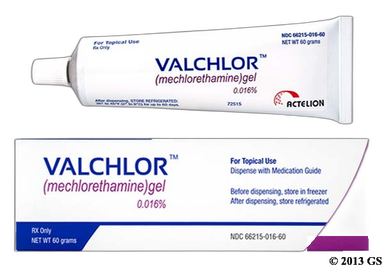
Valchlor
Valchlor (mechlorethamine) is a topical gel that’s used to treat mycosis fungoides, a type of cutaneous T-cell lymphoma. The medication is applied directly onto areas of the skin that’s affected by this cancer. It’s usually used after people have already tried other medications to treat the affected skin. Valchlor (mechlorethamine) can cause side effects like itching, skin irritation, blisters, or skin infections.


What is Valchlor (mechlorethamine)?
What is Valchlor (mechlorethamine) used for?
- Mycosis fungoides-type cutaneous T-cell lymphoma (MF-CTCL), previously treated
How Valchlor (mechlorethamine) works
Valchlor (mechlorethamine) is an alkylating agent. The exact way it works isn’t fully understood. But the medication is thought to work to treat the cancer by preventing cells from dividing and growing, which leads to cell death.
Drug facts
| Common Brands | Valchlor |
|---|---|
| Drug Class | Alkylating agent |
| Controlled Substance Classification | Not a controlled medication |
| Generic Status | No lower-cost generic available |
| Availability | Prescription only |

Side effects of Valchlor (mechlorethamine)
The following side effects may get better over time as your body gets used to the medication. Let your healthcare provider know immediately if you continue to experience these symptoms or if they worsen over time.
Common Side Effects
- Dermatitis (skin irritation; 56%)
- Itchy skin (20%)
- Low blood counts (13%)
- Bacterial skin infection (11%)
- Skin ulcers or blisters (6%)
- Skin darkening (hyperpigmentation; 5%)
Valchlor (mechlorethamine) serious side effects
Contact your healthcare provider immediately if you experience any of the following.
- Eye, mouth, or nose injury from accidental exposure: pain, blurry vision, sensitivity to light, burning, redness
- Skin reactions: redness, swelling, itchiness, blisters, ulcers, skin infection
- Non-melanoma skin cancer: abnormal changes to skin
The following Valchlor (mechlorethamine) side effects have also been reported
Along with its needed effects, a medicine may cause some unwanted effects. Although not all of these side effects may occur, if they do occur they may need medical attention.
Check with your doctor immediately if any of the following side effects occur:
More common
Blistering, crusting, irritation, itching, or reddening of the skin
cracked, dry, scaly skin
pain, swelling, tenderness, or warmth on the skin
Some side effects may occur that usually do not need medical attention. These side effects may go away during treatment as your body adjusts to the medicine. Also, your health care professional may be able to tell you about ways to prevent or reduce some of these side effects. Check with your health care professional if any of the following side effects continue or are bothersome or if you have any questions about them:
Less common
Darkening of the skin
Other side effects not listed may also occur in some patients. If you notice any other effects, check with your healthcare professional.
Call your doctor for medical advice about side effects. You may report side effects to the FDA at 1-800-FDA-1088.

Pros and cons of Valchlor (mechlorethamine)
Pros
- Only applied onto the skin once per day
- A recommended skin treatment for mycosis fungoides
Cons
- Can transfer onto other people’s skin through skin contact and can be harmful
- Not a good choice if you’re pregnant or planning on becoming pregnant since it can cause harm to an unborn baby
- Must keep in the refrigerator

Pharmacist tips for Valchlor (mechlorethamine)

- You should store Valchlor (mechlorethamine) in the refrigerator to keep the medication stable for it to work. Also keep the tube of medication in the original box and away from your food.
- Apply Valchlor (mechlorethamine) onto your skin immediately or within 30 minutes of taking it out of the refrigerator. Wash your hands with soap and water right after you’re done applying. Then, put the medication back into the refrigerator.
- Apply Valchlor (mechlorethamine) onto completely dry skin. Wait at least 30 minutes to apply the medication after a bath or shower. If you’ve already applied Valchlor (mechlorethamine) to your skin, it’s best to wait at least 4 hours before showering, bathing, or swimming.
- Once you’ve placed Valchlor (mechlorethamine) on your skin, let it dry completely for 5 to 10 minutes before covering your skin with clothing.
- Don’t use any moisturizers or lotions on the treated area unless it’s been at least 2 hours before or after you’ve applied Valchlor (mechlorethamine).
- Don’t place any bandages or dressings on the skin where you applied Valchlor (mechlorethamine).
- Avoid fire, flames, or smoking until Valchlor (mechlorethamine) has fully dried on your skin. This medication is alcohol-based and flammable.
- Write the date you opened a tube of Valchlor (mechlorethamine) on the box. Once it’s opened, the medication is good to use for 90 days. After 90 days, you should throw away any medication that’s left into your trashcan.
- If Valchlor (mechlorethamine) gets into anyone’s eyes, nose, or mouth, immediately rinse the exposed area with water for at least 15 minutes.
- If Valchlor (mechlorethamine) gets onto anyone’s skin, wash the area well with soap and water for at least 15 minutes and remove anything that might’ve been contaminated.

Risks and warnings for Valchlor (mechlorethamine)
Valchlor (mechlorethamine) can cause some serious health issues. This risk may be even higher for certain groups. If this worries you, talk to your doctor or pharmacist about other options.
Eye, nose, or mouth injury with accidental exposure
- Risk factors: Exposure to the eye, nose, or mouth
Wash your hands right after applying Valchlor (mechlorethamine) to the affected areas. This helps lower the risk of getting the medication into your eyes, nose, or mouth.
If Valchlor (mechlorethamine) gets into your eyes, it can cause pain, burning, inflammation, sensitivity to light, and blurry vision. In rare cases, it can lead to severe, irreversible eye damage and blindness. Immediately rinse your eyes for at least 15 minutes with water and get urgent care right away if Valchlor (mechlorethamine) gets into your eye.
If Valchlor (mechlorethamine) gets into your nose or mouth, it can cause pain, redness, and sores. Rinse the area for at least 15 minutes with water and get medical help right away if you get the medication in any of these areas.
Risk for others to get exposed to the medication
Be careful when applying or after applying Valchlor (mechlorethamine) because it can transfer onto other people’s skin. If anyone besides the person who’s getting treated with Valchlor (mechlorethamine) gets the medication on their skin, they should wash the area with soap and water for at least 15 minutes and remove any contaminated clothing. Accidental exposure to Valchlor (mechlorethamine) can cause skin inflammation; injury to the eyes, mouth, or nose; and possibly certain types of skin cancers.
Dermatitis (skin irritation or inflammation)
- Risk factors: Applying the medication to the face, genital area, anus, or skin folds
Skin inflammation is common with Valchlor (mechlorethamine) and sometimes can be severe. The risk for skin irritation is higher if you apply the medication to the face, genital area, anus, or skin folds. If you have any redness, swelling, itching, blisters, ulcers, or skin infections, you should contact your care team. Your oncologist might recommend that you apply Valchlor (mechlorethamine) less frequently.
Non-melanoma skin cancer
A small percentage of people who used Valchlor (mechlorethamine) developed a non-melanoma skin cancer. Some cases happened in people who previously had treatments known to cause non-melanoma skin cancer. The skin cancer can occur anywhere on the skin (even on untreated areas) and can happen during or after treatment with Valchlor (mechlorethamine). Your oncologist might check your skin for new skin cancers at your follow-up appointments. Tell your oncologist right away if you get any new abnormal changes to your skin (skin lesions).
Harm to unborn baby
Valchlor (mechlorethamine) can likely harm an unborn baby. Because of this risk, if you or your partner can become pregnant, you should use birth control during treatment with Valchlor (mechlorethamine) to prevent pregnancy. Use barrier methods, such as condoms or diaphragms, to protect your genitals and reproductive system from getting exposed to the medication. Let your care team know right away if you or your partner becomes pregnant.
Not recommended to breastfeed during treatment
It’s not recommended to breastfeed while you’re using Valchlor (mechlorethamine). The medication is applied to the skin and can transfer onto someone else through skin-to-skin contact. So your baby could get Valchlor (mechlorethamine) onto their skin while breastfeeding. There are no studies that show how the medication affects breastfed children, but it could potentially be harmful. Ask your baby’s pediatrician what the best option is for nutrition and feeding.

Valchlor (mechlorethamine) dosage
Typical dosage for Valchlor (mechlorethamine)
You should apply a thin layer of Valchlor (mechlorethamine) gel once a day to the affected area of the skin.

Interactions between Valchlor (mechlorethamine) and other drugs
Although certain medicines should not be used together at all, in other cases two different medicines may be used together even if an interaction might occur. In these cases, your doctor may want to change the dose, or other precautions may be necessary. Tell your healthcare professional if you are taking any other prescription or nonprescription (over-the-counter [OTC]) medicine.



