Relief of burning and itching from skin conditions, such as eczema
Wound healing
How Skin emollients works
Skin emollients work by forming an oily layer on the outer layer of your skin and trapping water or moisture on your skin's surface. This hydrates, moisturizes, and repairs your skin.
The following side effects may get better over time as your body gets used to the medication. Let your healthcare provider know immediately if you continue to experience these symptoms or if they worsen over time.
Works well to relieve dry skin or itching related to common skin conditions, such as eczema or allergic skin reactions
Promotes wound healing by creating a moist skin environment
Numerous products available so you can easily switch to a different product if one doesn't work well for you
Available in multiple forms, such as a spray, lotion, cream, and foam
Cons
No lower-cost generic available so can be more expensive
Must use multiple times per day for most dry skin conditions
Can cause overheating if used too close to radiation therapy sessions or MRIs
Not safe for use in children
Pharmacist tips for Skin emollients
Before using certain skin emollients, shake the product well to make sure the product hasn't settled at the bottom. Gently massage the skin emollient into your skin until it gets well absorbed. If you have any broken areas in your skin, you can use a dressing to cover the area after applying your skin emollient. Ask your pharmacist or skin specialist (dermatologist) for further guidance on how to use skin emollients.
Skin emollients should only be used on the outer layer of your skin. Avoid using skin emollients in or around your eyes, nose, mouth, or lips. If the product accidentally comes into contact with any of these areas, use water to rinse the area well.
Some skin emollients, such as Epiceram, can cause a slight tingling sensation after application. This usually lasts anywhere from 10 to 15 minutes and should go away shortly. If the tingling sensation remains or becomes bothersome, let your healthcare provider know. You might need to switch to a different product.
If you're using a foam skin emollient, such as HPR-Plus, you'll need to prime the product before using it for the first time. Shake the can well and hit the bottom of the can on the palm of your hand or any other hard surface at least 3 times. Then, spray the product onto a non-skin surface. Avoid spraying the product onto your skin for the first time because a cold liquid will be dispensed at first. Foam should start coming out of the can within 1 to 3 seconds of pressing down on the pump, and you can then use the product on your skin as needed.
Most skin emollients don't contain any sunscreen or sunblock. Avoid using skin emollients if you plan on spending large amounts of time out in the sun. Direct exposure to sunlight for long periods of time can cause sunburn, so it's important to use sunscreen if you plan on being outside.
Store skin emollients at room temperature in a secure place away from children at all times. Don't freeze skin emollients or expose them to extreme heat, as this can affect how well it'll work and can also lead to overheating. Each skin emollient is different, so read the labeling on your product to learn more about storing your specific product. For additional questions about proper storage or disposal of your product, ask your pharmacist.
Risks and warnings for Skin emollients
Skin emollients can cause some serious health issues. This risk may be even higher for certain groups. If this worries you, talk to your doctor or pharmacist about other options.
Heating during radiation therapy or MRI
Risk factors: Using skin emollients within 4 hours of radiation therapy | Using skin emollients before getting an MRI
Skin emollients can sometimes cause heating or overheating. This can happen especially during radiation therapy, since some products can dissolve the dye marking the particular areas on the body for radiation. It can also happen during an MRI (magnetic resonance imaging, or a type of radiology test), because some skin emollients contain silver nanoparticles that cause heating during the imaging procedure. Avoid applying skin emollients at least 4 hours before your radiation therapy session or MRI. Ask your healthcare provider or radiation oncologist for further instructions about when it's safe to apply skin emollients.
Skin emollients dosage
The average cost for 1 tube of 90g of Skin emollients is $5,590.57 with a free GoodRx coupon. This is 17.82% off the average retail price of $6,802.45.
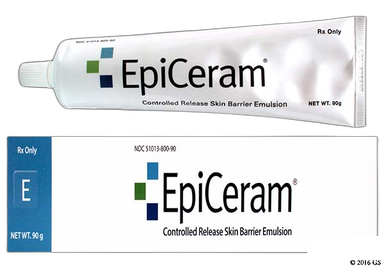
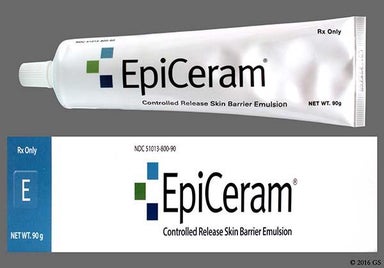
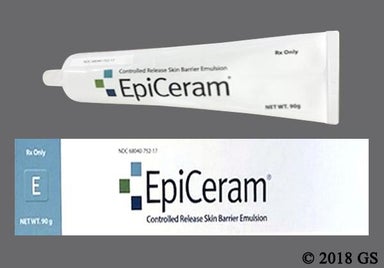
This medicine is Colorless Tube Of Emulsion.Not applicable - EpiCeram Controlled-Release Topical Skin Barrier EmulsionThis medicine is White Tube Of Emulsion.White Not applicable - EpiCeram Controlled-Release Topical Skin Barrier Emulsion
Prescription savings
Stop paying too much for your prescriptions. Compare prices, get pharmacy coupons, and save up to 80%.
Each skin emollient product is different, so read the instructions on your specific product to determine how often and for how long you can use it. Most Epiceram can be applied up to 4 times per day or as often as needed for 10 to 14 days. If your skin condition doesn't get better or worsens after using a skin emollient product for 10 to 14 days, let your healthcare provider or skin specialist (dermatologist) know. You might need to switch to a different product.
There are certain Epiceram that are safe to use on sunburns and first and second degree burns, such as Prutect. It can be applied directly to sunburned areas of your skin until the sunburn completely heals. Ask your pharmacist or skin specialist (dermatologist) if you have specific questions about when it's appropriate to use your skin emollient product.
Epiceram are available in multiple forms, such as lotions or foams, so that you have a variety of options to choose from. Each product also has slightly different ingredients, so it's important to read the list of ingredients on your product to make sure you're not allergic to any of the components. All Epiceram will moisturize and protect your skin, so there's not one best product for everyone. Work with your provider or skin specialist (dermatologist) to determine which product is best suited for you and your skin.
Most Epiceram haven't been studied to see how safe or how well they work in children. Many Epiceram come with a warning to keep the product away from children at all times. If your child has dry skin, ask your child's healthcare provider before using Epiceram.
There aren't any studies looking at the safety of using Epiceram during pregnancy. It's unknown if Epiceram can cause harm to your unborn baby. If you're pregnant or plan on becoming pregnant, discuss the risks and benefits with your provider first.