Sofdra
Sofdra (sofpironium) is an anticholinergic medication that treats excessive underarm sweating (primary axillary hyperhidrosis) for people ages 9 and up. It’s a gel that comes in a 50 ml bottle. You use the provided applicator to apply one pump of gel to each underarm once a day at bedtime. Common side effects include dry mouth, blurry vision, and irritation on the application area.


What is Sofdra (sofpironium)?
What is Sofdra (sofpironium) used for?
- Excessive underarm sweating (primary axillary hyperhidrosis) for individuals 9 years and older
How Sofdra (sofpironium) works
Sofdra (sofpironium) is an anticholinergic medication that works by blocking acetylcholine receptors in your body. Acetylcholine is a chemical that helps nerve cells send signals. It’s responsible for many functions in your body, including telling your sweat glands to make sweat.
When you apply Sofdra (sofpironium) to your underarms, it stops acetylcholine from attaching to its receptors. Without this signal, your sweat glands make less sweat.
Drug facts
| Common Brands | Sofdra |
|---|---|
| Drug Class | Anticholinergic |
| Controlled Substance Classification | Not a controlled medication |
| Generic Status | No lower-cost generic available |
| Availability | Prescription only |

Side effects of Sofdra (sofpironium)
The following side effects may get better over time as your body gets used to the medication. Let your healthcare provider know immediately if you continue to experience these symptoms or if they worsen over time.
Common Side Effects
- Dry mouth (14%)
- Blurred vision (9%)
- Application site irritation (e.g., pain, redness, inflammation, itching) (up to 8%)
- Dilated pupils (7%)
Less Common Side Effects
- Difficulty urinating
- Dry eyes
- Upper respiratory tract infection
- Flu
- Headaches
The following Sofdra (sofpironium) side effects have also been reported
Side effects that you should report to your care team as soon as possible:
- Allergic reactions—skin rash, itching, hives, swelling of the face, lips, tongue, or throat
- Burning, itching, crusting, or peeling of treated skin
- Fever that does not go away, decreased sweating
- Trouble passing urine
Side effects that usually do not require medical attention (report these to your care team if they continue or are bothersome):

Pros and cons of Sofdra (sofpironium)
Pros
- Only need to apply once a day
- Works with or without armpit hair
- Okay for children 9 years and older to use
- Easily applied using an applicator
Cons
- Can’t use it at the same time as deodorants or other antiperspirants
- Need to let area dry completely before putting on clothes
- Can’t shave 8 hours before applying the medication
- Commonly causes dry mouth and blurred vision

Pharmacist tips for Sofdra (sofpironium)

- Apply Sofdra (sofpironium) to clean and dry skin once a day at bedtime. Don’t apply it to broken or damaged skin as that can affect how well your body absorbs the medication.
- You must use the applicator to apply Sofdra (sofpironium). This helps to prevent the medication from getting on your hands and accidentally touching your eyes, nose or mouth. If Sofdra (sofpironium) does get on your hands, stop immediately and wash them with soap and water.
- After applying Sofdra (sofpironium), leave it. It needs to stay on your skin for 8 hours before showering or washing your underarms so your body can absorb the medication properly.
- Sofdra (sofpironium) is flammable. Stay away from fire, flame, and smoking during and after application to avoid getting burned.
- Sofdra (sofpironium) commonly causes blurry vision. If this happens to you, stop using it immediately, and avoid using heavy machinery and driving. Reach out to your prescriber to ask whether you should continue using Sofdra (sofpironium).
- Though Sofdra (sofpironium) can make you sweat less, it can also make it harder to cool down in high temperatures. If you’re in a hot or warm environment and aren’t sweating, stop using the medication and tell your prescriber right away. This is dangerous because it can put you at a high risk for heatstroke and very high fevers.
- Before applying Sofdra (sofpironium), make sure you haven’t exercised, showered, or washed your underarm area within 30 minutes and haven’t shaved or applied deodorant in the last 8 hours.
How to use Sofdra (sofpironium):
- Before applying Sofdra (sofpironium), watch this instructional video to learn how to use it and other important details. If you have further questions, review these instructions and contact your pharmacist or prescriber.
- Prime the bottle: If you’re using a new bottle of Sofdra (sofpironium), you need to prime it before use. Hold the bottle over the sink and press the pump all the way down 1 to 2 times or until the gel comes out.
- After removing your clothes, hold the applicator with the flat side facing up. Then, add some gel on top by pressing the pump all the way down one time.
- Use the applicator to spread all of the gel onto one of your underarms. Don’t use your hands or a different application device to apply the gel.
- Press the pump all the way again onto the same applicator and repeat the steps above for your other underarm.
- After applying Sofdra (sofpironium), wait 5 minutes for it to dry before putting on clothing, bandages, or coverings (it’s okay to lower your arms while waiting for the medication to dry). Avoid touching your underarms, to allow the medication to completely dry.
- To clean the applicator, rinse with water and pat down with a towel to dry it. Then, wash your hands with soap and water.

Risks and warnings for Sofdra (sofpironium)
Sofdra (sofpironium) can cause some serious health issues. This risk may be even higher for certain groups. If this worries you, talk to your doctor or pharmacist about other options.
Difficulty urinating
- Risk factors: Enlarged prostate | Bladder-neck obstruction
Sofdra (sofpironium) can cause difficulty urinating. The risk is higher if you have an enlarged prostate or if the neck of your bladder is blocked (bladder-neck obstruction). If you experience pain or swelling in your lower stomach, trouble urinating, or sudden urge to urinate, stop Sofdra (sofpironium) and talk to your prescriber immediately.
Not sweating in hot weather
- Risk factors: Hot temperatures | Certain medical conditions (e.g., heart problems, high blood pressure, diabetes) | Certain medications (e.g., diuretics, beta blockers, antipsychotics)
Normally, in hot or warm temperatures, your body produces sweat to cool down and avoid overheating. But Sofdra (sofpironium) works by stopping you from making sweat.
If you notice you aren’t sweating in hot temperatures, stop using Sofdra (sofpironium) and tell your prescriber. Continuing to use Sofdra (sofpironium) can raise your risk of heatstroke or very high fevers. Your risk is higher if you have certain medical conditions like heart problems, high blood pressure, and diabetes. It’s also higher if you take certain medications like diuretics, beta blockers, and antipsychotics.
Blurred vision
- Risk factors: History of eye problems
Sofdra (sofpironium) can cause blurred vision. If you experience blurred vision, stop using Sofdra (sofpironium) until your vision goes back to normal. Also avoid activities that you need to have clear vision for, such as using heavy machinery or driving a car, until symptoms go away.

Sofdra (sofpironium) dosage
Typical dosage for Sofdra (sofpironium)
Apply one pump on each underarm once per day at bedtime.

Sofdra (sofpironium) contraindications
Contraindications are specific health conditions or situations in which a person should not take a medication due to safety concerns. If you have any of the following conditions or if any of the following apply to you, let your healthcare provider know because Sofdra (sofpironium) will not be safe for you to take.
- Certain medical conditions such as glaucoma, myasthenia gravis, Sjögren's syndrome, severe ulcerative colitis, or others that can worsen the anticholinergic effect of Sofdra (sofpironium)

What are alternatives to Sofdra (sofpironium)?

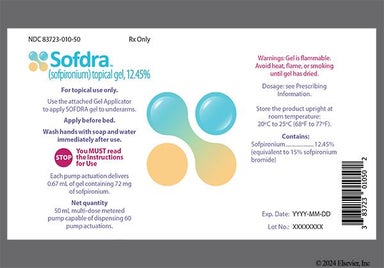
Sofdra (sofpironium) images