Santyl
Santyl (collagenase) is a topical enzyme medication used to remove damaged or burned skin, aiding in wound care and the growth of healthy skin. This ointment is approved for use in adults and typically needs to be applied to the skin just once per day. Side effects aren't common, but you might notice some skin redness on areas surrounding your wound. Santyl (collagenase) is currently only available as a brand-name medication.


What is Santyl (collagenase)?
What is Santyl (collagenase) used for?
- Removal of damaged or burned skin
How Santyl (collagenase) works
Santyl (collagenase) is an enzyme (protein) that breaks down collagen in damaged or dead skin. This allows for new, healthy skin to grow in its place to help wounds heal.
Drug facts
| Common Brands | Santyl |
|---|---|
| Drug Class | Enzyme |
| Controlled Substance Classification | Not a controlled medication |
| Generic Status | No lower-cost generic available |
| Availability | Prescription only |

Side effects of Santyl (collagenase)
The following side effects may get better over time as your body gets used to the medication. Let your healthcare provider know immediately if you continue to experience these symptoms or if they worsen over time.
Common Side Effects
See Risks and Warnings
Less Common Side Effects
- Skin redness around the affected area
The following Santyl (collagenase) side effects have also been reported
Side effects that you should report to your care team as soon as possible:
- Allergic reactions—skin rash, itching, hives, swelling of the face, lips, tongue, or throat
Side effects that usually do not require medical attention (report these to your care team if they continue or are bothersome):
- Mild skin irritation, redness, or dryness

Get your GoodRx coupon

Pros and cons of Santyl (collagenase)
Pros
- Applied directly on the affected area of skin
- Typically used once per day
- Not many side effects
Cons
- Only available as a brand-name medication
- Healthy skin that comes into contact with the medication might turn red
- Not known if safe in children younger than 18 years old

Pharmacist tips for Santyl (collagenase)

- Before applying Santyl (collagenase), make sure to clean your wound with a cleansing agent like a normal saline solution.
- Apply Santyl (collagenase) directly to the affected area, or you can apply it to a sterile gauze pad first and then place it on the affected area.
- If you have a skin infection and need to also use a topical antibiotic powder, apply the topical antibiotic to the infected area first, then apply Santyl (collagenase). If the infection doesn't improve, let your prescriber know because you might need to stop using Santyl (collagenase) until the infection clears.
- Some people might experience some redness in healthy skin that comes into contact with Santyl (collagenase), so be careful to apply the ointment only to the affected area(s).
- Store Santyl (collagenase) at room temperature only. Don't put it in the refrigerator or freezer.

Risks and warnings for Santyl (collagenase)
Santyl (collagenase) can cause some serious health issues. This risk may be even higher for certain groups. If this worries you, talk to your doctor or pharmacist about other options.
Caution with using other topical products
- Risk factors: Products with mercury or silver | Products that affect your skin's properties
Certain topical products can interact with Santyl (collagenase), which can affect how well it works. Avoid antiseptics with mercury or silver (e.g., SSD (silver sulfadiazine)) and acidic products. If you use these, make sure to clean the affected area repeatedly with normal saline before using Santyl (collagenase). Don't use other topical products on the affected area while using Santyl (collagenase) without talking to your prescriber or pharmacist.

Santyl (collagenase) dosage
 Tube of ointment
| Dosage | Quantity | Price as low as | Price per unit |
|---|---|---|---|
| 30g of 250 units/g | 1 tube | $326.26 | $326.26 |
| 90g of 250 units/g | 1 tube | $918.69 | $918.69 |
Typical dosage for Santyl (collagenase)
Santyl (collagenase) is typically applied directly on the affected area once per day. If instructed by your prescriber, you might need to apply it more often if the dressing over the affected area becomes dirty.

How much does Santyl (collagenase) cost?
$326.26

What are alternatives to Santyl (collagenase)?

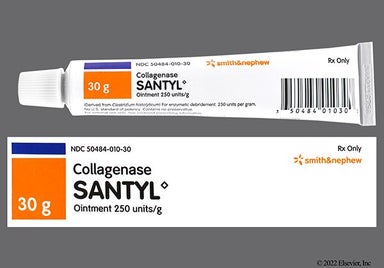
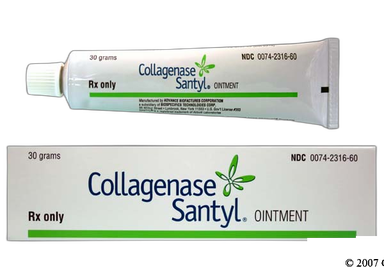
Santyl (collagenase) images