Maxitrol is an eye drop medication and eye ointment that's used to treat and relieve bacterial eye infections. Maxitrol is a combination medication — it contains two antibiotics (neomycin and polymyxin B) and a corticosteroid (dexamethasone). The antibiotics help fight the infection, while the corticosteroid helps lessen eye inflammation. Maxitrol typically has few to no side effects when it's used as directed, but it's usually used multiple times throughout the day.
Dexamethasone is a corticosteroid. When it’s used in the eye, it lowers the amount of chemicals that cause pain, redness, and swelling there. This helps lower eye inflammation and relieve eye pain.
The following side effects may get better over time as your body gets used to the medication. Let your healthcare provider know immediately if you continue to experience these symptoms or if they worsen over time.
Common Side Effects
Eye irritation
Less Common Side Effects
Eye redness
Slowed eye healing
Headache
Maxitrol serious side effects
Contact your healthcare provider immediately if you experience any of the following.
Severe allergic reaction: swollen eyelids, redness, itching, rash, shortness of breath
High eye pressure: eye pain when you move your eye or when you touch your eye
Cataract: blurry vision, seeing double, seeing faded colors, can't see well at night, seeing a halo around lights
When do Maxitrol possible side effects begin and end?
Relieves eye inflammation and treats bacterial eye infection at the same time
Combines three medications into one eye product for convenience
Can usually start to see improvement after 2 days of use
Available as a lower-cost generic
Cons
Need to use multiple times a day
Can cause temporary blurry vision
Requires an eye exam to check your eye pressure if you need to use for more than 10 days
Only treats some bacterial eye infections; it doesn't treat fungal or viral infections
Pharmacist tips for Maxitrol
Use Maxitrol as instructed by your care team. Make sure you use the medication for as long as prescribed, even if your eye starts to get better. Your infection might come back or become harder to treat if you stop using the medication too soon.
Let your primary care provider know if your eye inflammation or eye infection gets worse or if it lasts more than 2 days after you start using Maxitrol. You might need to get your eye examined to see whether the medication is the most appropriate treatment for you.
Don't let the tip of the Maxitrol bottle or tube touch the eye, eyelid, or other surfaces. Don't touch the tip with your fingers. Always wash your hands with soap and water before and after you use Maxitrol. It's important to prevent getting the medication contaminated because using contaminated medication in the eye can cause new or worsened eye infection.
Maxitrol can cause temporary blurry vision. Don't drive a car or operate machinery until you know how Maxitrol affects how well you see and until you can see clearly.
Contact your primary care provider or optometrist if you need more than 4 bottles of Maxitrol eye drops or more than 2 tubes of Maxitrol eye ointment. Also call them if you need to use this medication for more than 10 days. They'll examine your eye and make sure the medication is appropriate and safe for you.
How to use Maxitrol eye drops (ophthalmic suspension):
To use the eye drops, gently pull down your lower eyelid with one hand. Hold the bottle upside down with the other hand so that the bottle tip is right above your eye. Squeeze the bottle to get the number of drops you need in the eye. Then, close your eye and press your finger to the inner corner of your eye for a minute. This helps the medication stay in your eye and prevents it from leaking into the nose.
If you need to use another eye drop in the same eye, wait at least a few minutes in between drops so the second eye drop doesn't rinse off the first one.
How to use Maxitrol eye ointment:
First, tilt your head back. Then, pull down your lower eyelid with one hand and hold the tube of ointment with the other.
Place a small amount (about one-half of an inch) of ointment in the space between your eyelid and eyeball. Look down before closing your eye. Keep your eye closed for 1 to 2 minutes. This helps the medication cover all areas of the eye.
Risks and warnings for Maxitrol
Maxitrol can cause some serious health issues. This risk may be even higher for certain groups. If this worries you, talk to your doctor or pharmacist about other options.
Only use on the surface of the eye
Use Maxitrol on the surface of the eye only. Don't place the medication in your mouth, nose, or anywhere else on your body. Also don't use Maxitrol as an injection into any parts of the eye.
Higher eye pressure
Risk factors: Using Maxitrol for more than 10 days | History of glaucoma
Using eye medications that contain a steroid for a long time can raise the pressure in your eye. This can damage the eye and cause vision problems. Talk with your prescriber about the risks and benefits of using Maxitrol (contains the steroid dexamethasone) if you have glaucoma or high eye pressure.
Your prescriber might recommend that you get an eye exam to check your eye pressure and make sure that Maxitrol is safe for you to use. Your prescriber is more likely to suggest regular eye exams if you need to use Maxitrol for more than 10 days.
You don't usually have symptoms when your eye pressure is high. But you might feel pain when you move your eye around or when you touch your eye if you have high eye pressure. Talk with your primary care provider or optometrist right away if you have eye pain or any vision problems while you're using Maxitrol.
New or worsened eye infections
Risk factors: Using Maxitrol for more than 10 days
Using Maxitrol long term can raise the risk of developing other eye infections, such as fungal or bacterial eye infections. Don't use Maxitrol if you have a viral eye infection because it can make your infection worse. Contact your primary care provider or urgent care if you have eye pain or redness, blurry vision, sensitivity to light, or watery discharge from your eye. These can be signs of a new eye infection that you should get examined.
New eye problems (e.g., injury, cataracts)
Risk factors: History of cataract | Using Maxitrol for more than 10 days
In some cases, using Maxitrol might cause your cornea (the clear, outer layer of the eye) or the "whites" of the eye to thin. Sometimes, this can lead to eye damage. Using Maxitrol for a long time can also cause cataracts (clouding of eye lens) to form. Get medical help right away if you have vision loss, blurry vision, or eye pain or if you your eye is more watery than usual.
Additionally, using Maxitrol after a cataract surgery might also slow down the healing process and raise the risk of fluid buildup in the eye. Speak with your eye surgeon if you’ve just had cataract surgery and you're having eye or vision problems.
Possible allergic reaction
Medications that contain neomycin, such as Maxitrol, can cause allergic reactions. Before you're prescribed Maxitrol, let your primary care provider or a member of the urgent care team know if you're allergic to neomycin or other similar antibiotics, such as gentamicin (Gentak) or tobramycin (Tobrex). It's possible that you could have an allergic reaction to Maxitrol.
Watch out for symptoms of allergic reactions, such as swollen eyelids, red or itchy eyes, or skin rash, while you're using Maxitrol. Stop using the medication and call your primary care provider if you have an allergic reaction. These reactions usually go away on their own once you stop the medication.
You might also be allergic to Maxitrol if your eye doesn't get better after you've used the medication for a while. Contact your primary care provider if your eye doesn't improve after a couple days of using the medication.
Maxitrol dosage
The average cost for 1 eye dropper of 5ml of Maxitrol is $18.31 with a free GoodRx coupon.
Contraindications are specific health conditions or situations in which a person should not take a medication due to safety concerns. If you have any of the following conditions or if any of the following apply to you, let your healthcare provider know because Maxitrol will not be safe for you to take.
Eye infections caused by viruses, such as varicella (from chickenpox or shingles) or herpes
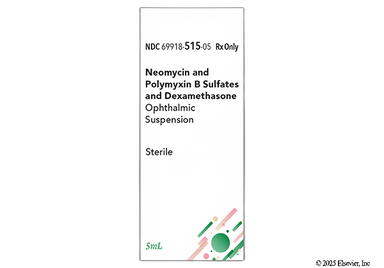
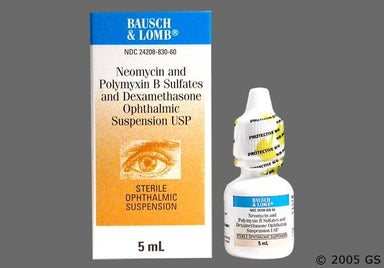
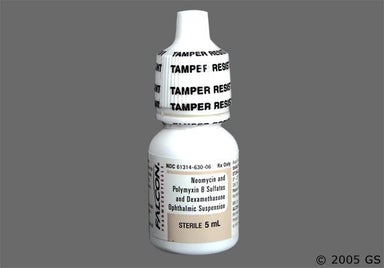
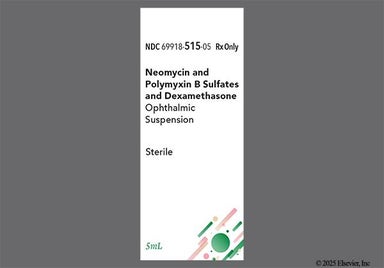
This medicine is Colorless Eye Dropper.Not applicable - Neomycin Sulfate/Polymyxin B Sulfate/Dexamethasone Ophthalmic SuspensionThis medicine is Colorless Eye Dropper.Not applicable - Neomycin Sulfate/Polymyxin B Sulfate/Dexamethasone Ophthalmic SuspensionThis medicine is Colorless Eye Dropper.Not applicable - Neomycin Sulfate/Polymyxin B Sulfate/Dexamethasone Ophthalmic Suspension
American Academy of Ophthalmology. (2016). Sclera.
GoodRx Health has strict sourcing policies and relies on primary sources such as medical organizations, governmental agencies, academic institutions, and peer-reviewed scientific journals. Learn more about how we ensure our content is accurate, thorough, and unbiased by reading our editorial guidelines.
Prescription savings
Stop paying too much for your prescriptions. Compare prices, get pharmacy coupons, and save up to 80%.
Common questions about Neomycin/Polymyxin B/Dexamethasone
No, you won't be able to buy Maxitrol over the counter. You'll need a prescription for Maxitrol from a healthcare professional.
Most of the time, a stye will go away on its own with the help of warm compresses on the eye and without any medication. But you might need medication like Maxitrol to help with your stye if it doesn't get better after a week or if it gets worse. Don't use any leftover Maxitrol that you have at home for your stye — it could be contaminated or it might not be appropriate for this particular eye infection. Speak with a healthcare professional for recommendations for your stye.
Yes, Maxitrol can treat pink eye. Maxitrol contains antibiotics, which means that it only works well to treat pink eye that's caused by certain types of bacteria. The medication won't work to treat pink eye from viral infections or other causes. Speak with your primary care provider or call urgent care if your pink eye doesn't start getting better after 2 days of using Maxitrol or if it get worse. You might need other treatment that's more appropriate for your pink eye.
No, Maxitrol doesn't contain a sulfa drug. Polymyxin B sulfates is one of the ingredients in Maxitrol. Although polymyxin B sulfates has the term "sulfates" in it, it's not considered a sulfa drug. Having "sulfates" in the name means that it's made from a form of sulfur. But it has a different chemical structure than sulfonamides, which is what's responsible for allergic reactions to sulfa drugs. Since Maxitrol isn't a sulfa drug, it's generally safe to use if you have a sulfa allergy.
You'll typically need to use Maxitrol for 7 to 10 days to treat your eye inflammation and eye infection. Antibiotic eye drops like Maxitrol usually start to improve eye infections after you regularly use them for a few days. But it's important to use Maxitrol for as long as prescribed, even if your eye starts getting better. This makes sure that the medication completely got rid of the infection. Speak with your primary care provider or call urgent care if your eye pain or inflammation doesn't start to get better after 2 days of using Maxitrol or if your symptoms get worse. You'll need to get your eye checked to make sure you get the appropriate treatment you need.
In general, it's best not to use Maxitrol while you're wearing contact lenses. Putting the Maxitrol eye ointment in your eye while you have contact lenses on might cause the contacts to move or coat them with medication and make your eyesight blurry. Also, wearing contact lenses when you have an eye infection might make your infection worse or irritate your eyes even more. Throw away any contact lenses you used before you started using Maxitrol because they most likely have bacteria on them. In the meantime, consider wearing a pair of glasses. Ask your primary care provider when it's safe to wear contacts again.
No. Throw away any leftover Maxitrol that you have at the end of your treatment for your current eye problem. Reusing Maxitrol for any eye infections you might have later can raise the risk of reinfection if the medication accidentally got contaminated with germs when you last used it. Maxitrol also might not be the appropriate treatment for the type of eye infection you have next time. Talk to a healthcare professional each time you think you have an eye infection so you can get appropriate treatment.
Maxitrol is a combination of three medications. Neomycin is an antibiotic. It kills bacteria by preventing them from making proteins that they need to survive. Polymyxin B is another antibiotic that kills bacteria. It destroys the bacteria's protective covering. Dexamethasone is a corticosteroid. When it’s used in the eye, it lowers the amount of chemicals that cause pain, redness, and swelling there. This helps lower eye inflammation and relieve eye pain.Learn more