Neo-Synalar
Neo-Synalar is a topical cream that's made up of two medications: neomycin (an aminoglycoside antibiotic) and fluocinolone (a corticosteroid). It's approved for use in adults and children to treat areas of skin that are both inflamed and infected with bacteria. The cream is applied directly to the affected area(s) of the skin 2 to 4 times per day, depending on how severe the condition is. Side effects aren't common but can include skin irritation and burning.


What is Neo-Synalar (neomycin / fluocinolone)?
What is Neo-Synalar (neomycin / fluocinolone) used for?
- Skin conditions that improve with topical steroid treatment and are also infected with certain bacteria
How Neo-Synalar (neomycin / fluocinolone) works
Neo-Synalar (neomycin / fluocinolone) is a combination of two medications.
- Neomycin is an aminoglycoside antibiotic. It stops bacteria from making proteins they need for growth and survival.
- Fluocinolone is a corticosteroid. It lessens inflammation (swelling, redness, and itchiness) in your skin.
Drug facts

Side effects of Neo-Synalar (neomycin / fluocinolone)
The following side effects may get better over time as your body gets used to the medication. Let your healthcare provider know immediately if you continue to experience these symptoms or if they worsen over time.
Common Side Effects
- Burning
- Itching
- Skin irritation
- Dry skin
Less Common Side Effects
- Lighter skin color
- Stretch marks
The following Neo-Synalar (neomycin / fluocinolone) side effects have also been reported
Side effects that you should report to your care team as soon as possible:
- Allergic reactions—skin rash, itching, hives, swelling of the face, lips, tongue, or throat
- Fragile or thinning skin that bruises easily
- Hearing loss, ringing in ears
- Kidney injury—decrease in the amount of urine, swelling of the ankles, hands, or feet
- Low adrenal gland function—nausea, vomiting, loss of appetite, unusual weakness or fatigue, dizziness
Side effects that usually do not require medical attention (report these to your care team if they continue or are bothersome):

Get your GoodRx coupon

Pros and cons of Neo-Synalar (neomycin / fluocinolone)
Pros
- More convenient because it's a combination of an antibiotic and steroid in a single cream
- Helps treat the skin infection and lessen skin inflammation at the same time
- Can easily wash off with water, if needed
Cons
- Need to apply 2 to 4 times per day
- No lower-cost generic available; brand-name medication only
- No evidence that it works better than fluocinolone by itself after a week of treatment
- Shouldn't be used over wide areas of the body for a long period of time because of risk for kidney and hearing problems

Pharmacist tips for Neo-Synalar (neomycin / fluocinolone)

- Apply Neo-Synalar (neomycin / fluocinolone) directly on your skin only. Don't put the medication into your eyes, mouth, or vagina. Otherwise, it could lead to side effects. Also, don't apply Neo-Synalar (neomycin / fluocinolone) on cuts, scrapes, or damaged skin because this can cause further irritation.
- Call your prescriber right away if your skin infection doesn't seem to be getting better or if it gets worse. You might need to stop this medication and take another antibiotic by mouth instead.
- Apply Neo-Synalar (neomycin / fluocinolone) onto the affected area(s) of skin 2 to 4 times per day, as prescribed. Make sure to apply just enough to cover the skin with a thin layer of medication. Avoid applying Neo-Synalar (neomycin / fluocinolone) to skin that has opened wounds or that's sunburned.
- Wash your hands well after you apply Neo-Synalar (neomycin / fluocinolone) to your skin, unless you're treating the skin on your hands. This helps prevent you from accidentally getting the medication in your eyes. If Neo-Synalar (neomycin / fluocinolone) gets in your eyes, rinse them well with water for at least 15 minutes.
- Don't cover the areas where you've applied Neo-Synalar (neomycin / fluocinolone) to with bandages, dressings, or tight clothing, unless your prescriber instructed you to. Wrapping the treated area with tight bandages or clothing can cause too much medication to get absorbed into your body. This can raise your risk of side effects.
- Don't apply other topical steroids to the skin while you're using Neo-Synalar (neomycin / fluocinolone) unless your prescriber specifically said it's safe for you. Applying more than one topical steroid can raise your risk for side effects.
- Make sure to tell your healthcare professional if you're pregnant or breastfeeding. Discuss the risks and benefits of using Neo-Synalar (neomycin / fluocinolone) with your healthcare professional.
- Store Neo-Synalar (neomycin / fluocinolone) at room temperature in a dry place. Don't freeze it since this can damage the medication.

Common questions about Neo-Synalar (neomycin / fluocinolone)
No, Neo-Synalar (neomycin / fluocinolone) won't treat a herpes skin infection, like cold sores or genital herpes, because herpes is a virus. The neomycin in Neo-Synalar is a type of antibiotic; it treats infections caused by certain bacteria only.
Your dermatologist might prescribe Neo-Synalar (neomycin / fluocinolone) if you have a bacterial skin infection on the same areas of your eczema. The fluocinolone component of the medication can help with skin inflammation caused by eczema. But the neomycin component doesn't have a role in treating eczema; it only helps with treating the skin infection. Only use Neo-Synalar (neomycin / fluocinolone) for what it's prescribed for. Contact your dermatologist if you're looking for options to treat your eczema symptoms.
Yes, the fluocinolone component in Neo-Synalar is a topical steroid. Fluocinolone is classified as having medium potency, which is another way of saying how strong the topical steroid is. It treats symptoms of skin inflammation, such as redness, itching, and swelling.
Yes, you can use Neo-Synalar (neomycin / fluocinolone) on the face if that's where the affected skin is located. But avoid contact with the eyes or mouth. Keep in mind that using it on the face for even a short amount of time can cause skin thinning and skin damage there. Use the smallest amount of the cream for the shortest amount of time if your prescriber instructed you to apply Neo-Synalar (neomycin / fluocinolone) onto the face. Talk to your prescriber if you're not sure whether you need to use Neo-Synalar (neomycin / fluocinolone) on your face and for how long.
There aren't any other available creams for the skin that contain a combination of an aminoglycoside antibiotic and corticosteroid like Neo-Synalar (neomycin / fluocinolone). But gentamicin, a similar antibiotic to neomycin, comes as a skin cream and there are several topical steroids available as well. You can get these prescribed separately and then use the products together. Ask your prescriber about possible alternatives to Neo-Synalar (neomycin / fluocinolone) that might work for your skin condition.
No, you won't be able to find Neo-Synalar (neomycin / fluocinolone) over the counter. Neo-Synalar (neomycin / fluocinolone) is only available by prescription from a healthcare professional.
There's no lower-cost generic version of Neo-Synalar (neomycin / fluocinolone) available yet. Currently, Neo-Synalar (neomycin / fluocinolone) is available as a brand-name medication only.

How to save using GoodRx




Risks and warnings for Neo-Synalar (neomycin / fluocinolone)
Neo-Synalar (neomycin / fluocinolone) can cause some serious health issues. This risk may be even higher for certain groups. If this worries you, talk to your doctor or pharmacist about other options.
Altered stress hormone levels
- Risk factors: Applying Neo-Synalar (neomycin / fluocinolone) to large areas of the body | Applying Neo-Synalar (neomycin / fluocinolone) for a long time | Applying more than one topical steroid onto the skin | Covering the medicated area | Applying onto damaged skin | Liver problems | Young children
It's possible for your body to absorb too much Neo-Synalar (neomycin / fluocinolone) through the skin in certain situations. This includes applying the medication to larger areas of skin over longer periods of time and covering the treated area with tight bandages. Having too much Neo-Synalar (neomycin / fluocinolone) in your body can cause your body to make less stress hormones (e.g., cortisol). This can affect many important bodily functions and lead to symptoms such as tiredness, nausea, and muscle aches. This problem usually goes away after you stop using Neo-Synalar (neomycin / fluocinolone), but you might need additional treatment if it's severe.
Apply Neo-Synalar (neomycin / fluocinolone) only as directed. Don't apply too much medication and don't use it for a longer period of time than prescribed. Also don't cover the medicated area with bandages or dressings unless your prescriber tells you to. If your prescriber thinks that Neo-Synalar (neomycin / fluocinolone) is affecting your body's hormone production, they might recommend that you apply it less often or switch you to a different medication.
Ear and kidney damage
- Risk factors: Applying Neo-Synalar (neomycin / fluocinolone) to large areas of the body | Long-term use
Although rare, the neomycin component in Neo-Synalar is linked to hearing loss and kidney damage, even though it's used only on the skin. Don't apply Neo-Synalar (neomycin / fluocinolone) onto a large area of the body for a long period of time; this can cause more medication to get absorbed into your body than intended and put you at risk for these side effects.
Let your prescriber know right away if you experience ringing in your ears, hearing changes, or dizziness because these can be signs of ear damage. Also contact your prescriber if you notice that you're urinating less than usual or if you have swelling anywhere in your body; these can be signs of kidney damage.

Neo-Synalar (neomycin / fluocinolone) dosage
 Tube of cream
| Dosage | Quantity | Price as low as | Price per unit |
|---|---|---|---|
| 60g of 0.5%/0.025% | 1 tube | $933.61 | $933.61 |
Typical dosage for Neo-Synalar (neomycin / fluocinolone)
Apply a thin layer of Neo-Synalar (neomycin / fluocinolone) onto the affected area(s) of the skin 2 to 4 times per day. Neo-Synalar contains 0.5% of neomycin and 0.025% of fluocinolone.

How much does Neo-Synalar (neomycin / fluocinolone) cost?
$933.61

Neo-Synalar (neomycin / fluocinolone) contraindications
Contraindications are specific health conditions or situations in which a person should not take a medication due to safety concerns. If you have any of the following conditions or if any of the following apply to you, let your healthcare provider know because Neo-Synalar (neomycin / fluocinolone) will not be safe for you to take.
- Allergy to neomycin or fluocinolone
- Use in the ear canal if you have a ruptured eardrum (has a hole or tear in it)

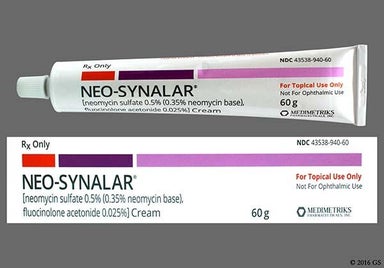
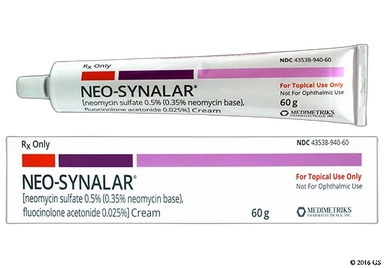
Neo-Synalar (neomycin / fluocinolone) images