Key takeaways:
Narcan (naloxone) is a lifesaving medication that reverses the effects of an opioid overdose. It’s available as a nasal spray and injection.
The typical Narcan nasal spray dosage for adults and children is 1 spray into one nostril. For generic naloxone injection, the typical dosage is 0.4 mg to 2 mg in adults. In children, the dosage is based on body weight, starting at 0.01 mg per kg.
After administering Narcan for an overdose, call 911 to report the overdose and request help. You can continue to give Narcan every 2 to 3 minutes until the person becomes responsive or resumes breathing, or until emergency help arrives.
Narcan is available over the counter as a brand-name medication. But you can also find it as a lower-cost generic. GoodRx can help make your medication more affordable.
Save on related medications
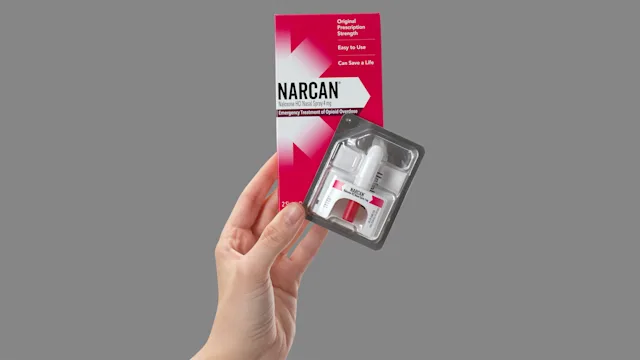
Narcan (naloxone) is a fast-acting medication that can help reverse an opioid overdose. It’s no exaggeration to say that Narcan is a lifesaving drug. And luckily, it’s available over the counter (OTC).
Here, we’ll cover everything you need to know about Narcan dosages, including the typical Narcan dose, how to administer it, and whether it’s possible to use too much.
If you or someone you know struggles with substance use, help is available. Call SAMHSA’s National Helpline at 1-800-662-4357 to learn about resources in your area.
What’s the typical Narcan dosage for adults?
The typical naloxone dosage for adults depends on which product you’re using. Naloxone, the active ingredient in Narcan, comes in two forms: nasal sprays and injections.
Important to note: People often use the terms “Narcan” and “naloxone” interchangeably, but Narcan is actually a brand name for a naloxone nasal spray. In this article, we’ll use “naloxone” when discussing products other than Narcan nasal spray.
The chart below compares the available options.
Naloxone product | Dosage form | Dose | OTC or prescription? |
|---|---|---|---|
Nasal spray | 4 mg per spray | OTC | |
Nasal spray | 4 mg per spray | OTC | |
Nasal spray | 3 mg per spray | OTC | |
Nasal spray | 4 mg per spray | OTC | |
Nasal spray | 8 mg per spray | Prescription | |
Nasal spray | 10 mg per spray | Prescription | |
Generic naloxone | Injection (vial or prefilled syringe) | Prescription |
It’s important to note that naloxone injections in the 0.4 mg/mL and 1 mg/mL concentrations are only available as generic medications.
No matter which form of naloxone you use, call 911 after giving the first dose. Naloxone is a temporary treatment, and the person still needs emergency medical care even if they start to respond.
Naloxone nasal spray dosage for adults
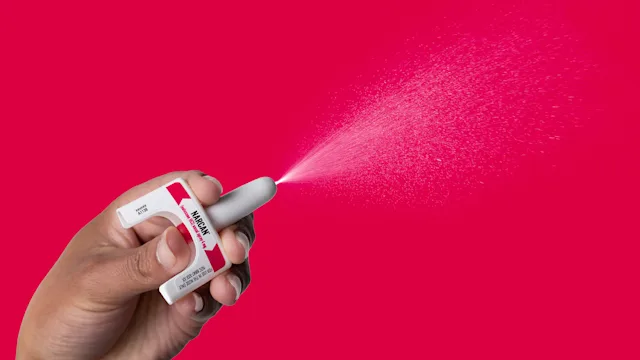
The typical dosage of all naloxone nasal spray products is 1 spray into one nostril. Each nasal spray device contains a single dose (1 spray) of naloxone.
If you administer naloxone to someone and they don’t respond within 2 to 3 minutes, you can give a second dose (1 spray) into the other nostril.
Repeat this process every 2 to 3 minutes, alternating nostrils with each dose. Continue until the person responds or starts breathing again, or until emergency medical help arrives.
As noted in the chart above, the amount of naloxone in each dose varies by product. Available naloxone nasal sprays range from 3 mg to 10 mg of naloxone per spray. Studies suggest that naloxone doses of at least 2 mg work well for reversing an opioid overdose. All available nasal spray products meet this minimum effective dose.
Naloxone injection dosage for adults
The typical naloxone injection dosage is between 0.4 mg and 2 mg. The exact dose depends on how the injection is given and how the person responds. It can be given in three ways: intravenously (into a vein, or IV), intramuscularly (into a muscle), or subcutaneously (under the skin). IV naloxone is only given by a trained medical professional.
Similar to naloxone nasal sprays, a naloxone injection can be given every 2 to 3 minutes if needed. Continue giving doses until the person responds or starts breathing again, or until emergency medical personnel arrive. If a total of 10 mg of naloxone has been injected and the person still hasn’t responded, their symptoms may not be caused by an opioid overdose. Instead, they could be experiencing a different medical emergency.
In general, the naloxone nasal spray products are more popular because they’re more accessible and simpler to use. But emergency medical personnel typically prefer IV naloxone when they have IV access because it works the fastest.
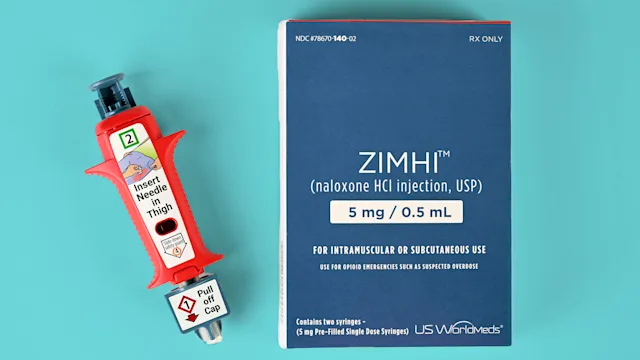
Good to know: Zimhi is a brand-name form of injectable naloxone. It comes as a 5 mg ready-to-use syringe. We don’t cover Zimhi dosages here, but you can learn more in our Zimhi dosage guide.
What’s the typical Narcan dosage for children?
Naloxone can be given to children as a nasal spray or injection. The typical dosage depends on which product is used.
Important to note: People often use the terms “Narcan” and “naloxone” interchangeably, but Narcan is actually a brand name for a naloxone nasal spray. In this article, we’ll use “naloxone” when discussing products other than Narcan nasal spray.
Naloxone nasal spray dosage for children
The Narcan nasal spray dosage for children is the same as it is for adults, which is 1 spray in one nostril. Other naloxone nasal spray products, such as RiVive, Kloxxado, and generic naloxone, also use 1 spray for a single dose. But keep in mind that the amount of naloxone in each spray varies by product.
If the child doesn’t respond within 2 to 3 minutes, you can give a second dose (1 spray) in the other nostril. Repeat this process every 2 to 3 minutes as needed, alternating nostrils with each dose. Continue until the child responds or starts breathing again, or until emergency medical personnel arrive.
Naloxone injection dosage for children
For children, the dosage of naloxone injection is based on body weight. The typical starting dosage of naloxone injection for children is 0.01 mg per kg of body weight. If the child doesn’t respond as expected, a higher dose of 0.1 mg/kg can be given.
Naloxone injection is preferred to be given by IV for children. If it can’t be given by IV, it can be injected into a muscle or under the skin. When given this way, the dose may need to be divided and given in different injection sites. For example, if your child weighs 44 lbs (about 20 kg), the dose would be 2 mg (2 separate injections of 1 mg). Each injection of 1 mg could be given into a different thigh.
Additional doses of naloxone may be needed if the child doesn’t respond within 2 to 3 minutes or if their opioid overdose symptoms return. Continue monitoring the child until emergency medical personnel arrive.
How is Narcan administered?
How you give naloxone depends on whether you’re using a nasal spray or injection. Always follow the instructions that come with your specific product.
How to administer naloxone nasal spray: Step-by-step instructions
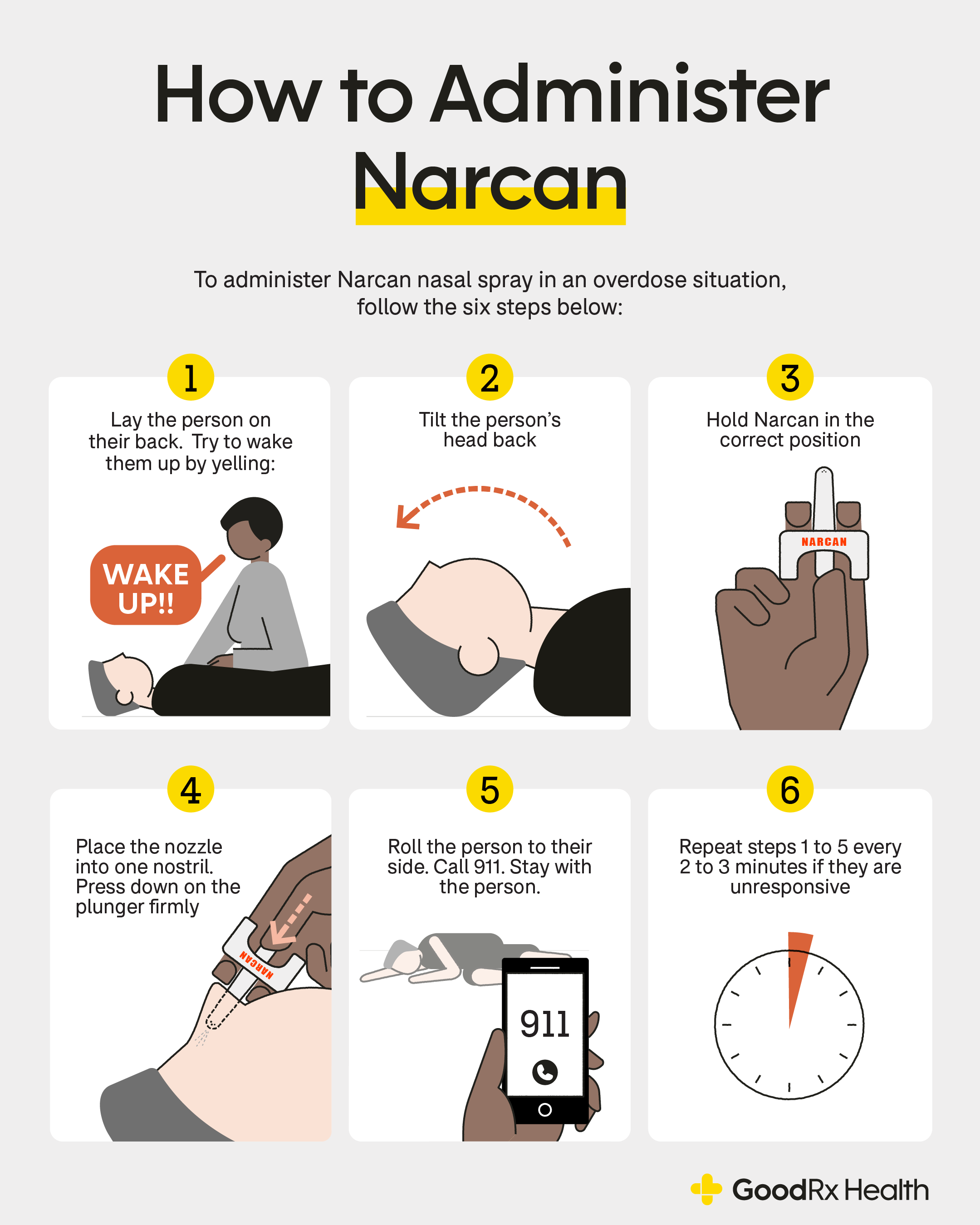
Check for signs of an opioid overdose. Try to wake the person by shouting their name and rubbing the middle of their chest with your knuckles.
Lay the person on their back. Remove the nasal spray from its package. Don’t test or prime the device before using it, because each device contains only 1 dose.
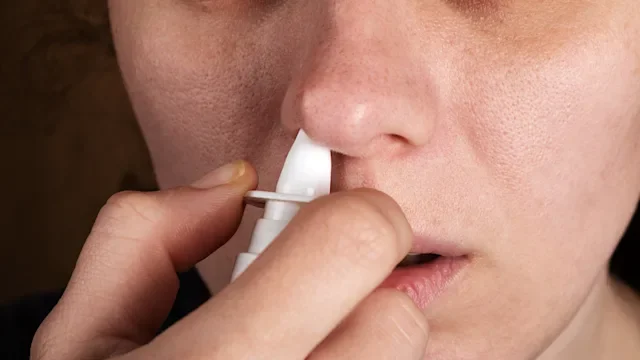
Tilt their head back. Place the tip of the spray device into one nostril. Insert the nozzle until your fingers touch the bottom of their nose.
Give the dose. Press the plunger firmly to release the entire dose into the nostril. Remove the device from their nose.
Call 911 right away. Tell the 911 operator that you think the person is experiencing an opioid overdose and that you gave them naloxone. Follow any instructions the operator gives you while you wait for emergency medical help.
Watch for a response. Move the person onto their side and stay with them while you wait for emergency medical help. If they don’t respond or their symptoms return, repeat steps 2 through 4 with a new device every 2 to 3 minutes. Alternate nostrils with each dose, and continue until the person responds or emergency medical help arrives.
How to administer naloxone injection: Step-by-step instructions
Naloxone injections may be given IV, into the muscle, or under the skin. IV naloxone is given by trained medical professionals. Here are the instructions for intramuscular or subcutaneous naloxone injection:
Check for signs of an opioid overdose. Try to wake the person by shouting their name and rubbing the middle of their chest with your knuckles.
Prepare the dose. Check the naloxone label and follow the instructions for your specific product. Draw up the prescribed amount using a syringe and needle if it isn’t already in a ready-to-use syringe.
Choose the injection site. Naloxone can be injected into a muscle in areas such as the thigh, buttocks, or outside of the upper arm. It can also be injected under the skin in areas such as the stomach, thigh, or back of the upper arm. Follow the instructions on the product for choosing and preparing the injection site.
Give the injection. Inject the full recommended dose as directed.
Call 911 right away. Tell the 911 operator that you think the person is experiencing an opioid overdose and that you gave them naloxone. Follow any instructions the operator gives you while you wait for emergency medical help.
Watch for a response. Move the person onto their side and stay with them until emergency medical help arrives. Additional injections may be given every 2 to 3 minutes if the person doesn’t respond or their opioid overdose symptoms return
If someone’s having an overdose, what else should you do besides administer Narcan?
If you think someone is having an opioid overdose, give them naloxone right away if you have it and call 911. Naloxone is a temporary treatment, so the person still needs emergency medical care even if they start to feel better.
While you wait for emergency medical personnel, try to keep the person awake and breathing. If they aren’t breathing or their breathing is very weak, give rescue breaths or cardiopulmonary resuscitation (CPR) if you’re trained to do so. If you aren’t trained, follow the 911 operator’s instructions.
Once the person is breathing, place them on their side to help prevent choking. Stay with them and continue to watch their breathing until emergency medical personnel arrive. If they don’t respond to Narcan within 2 to 3 minutes, or their overdose symptoms return, give another dose if one is available.
Good to know: Naloxone can start working in as little as 2 minutes, but it doesn’t work for long. Narcan nasal spray can last for up to 2 hours, whereas other forms of naloxone may only last for up to 90 minutes. Opioids can last longer in the body than Narcan. So it’s possible to continue experiencing the effects of an opioid overdose after Narcan wears off. If a person becomes unresponsive some time after receiving Narcan, give them another dose.
Can you use Narcan even if you’re unsure someone is having an overdose?
Yes, if you think someone is showing signs of an opioid overdose — such as being unable to respond, having bluish skin, or having difficulty breathing — administer Narcan if you have it. Narcan won’t harm the person receiving it, even if opioids aren’t in their system.
Will Narcan work for other types of drug overdose?
No, Narcan only works to reverse the effects of opioids. It won’t work for other types of drug overdose. However, if someone has overdosed on more than one substance, and one of these substances is an opioid, Narcan can help.
What should you do if Narcan isn’t working?
If you’ve administered multiple doses of Narcan and it doesn’t seem to be working, it’s highly possible that the person doesn’t have opioids in their system. They could have overdosed on another substance, or they could be experiencing a medical emergency unrelated to a drug overdose.
Remember, anytime you administer Narcan, you should call 911 after giving the first dose. This ensures that emergency medical personnel are on the way. They can evaluate whether someone is having an opioid overdose or another emergency.
Is it possible to overdose on Narcan?
No, it’s not possible for someone to overdose on Narcan. But if the person receiving Narcan is dependent on opioids, has opioid use disorder, or has a lot of opioids in their system, they’ll likely experience opioid withdrawal after receiving Narcan. Symptoms may include vomiting, increased sweating, and a faster heartbeat.
But don’t let concerns about opioid withdrawal stop you from giving naloxone. Opioid withdrawal can be uncomfortable, but an untreated opioid overdose can be life-threatening.
How to save on Narcan
There are several ways to save on Narcan and other naloxone products. Naloxone is available OTC and with a prescription. But by having a healthcare professional write a prescription for OTC naloxone, GoodRx can help you save.
Prices can vary depending on the brand, form, and strength. The table below compares GoodRx prices for different naloxone products.
Naloxone product | Quantity and strength | GoodRx price as low as |
|---|---|---|
Narcan | 1 box of two 4 mg nasal sprays | |
Generic naloxone nasal spray | 1 box of two 4 mg nasal sprays | |
RiVive | 1 box of two 3 mg nasal sprays | |
Rextovy | 1 box of two 4 mg nasal sprays | |
Kloxxado | 1 box of two 8 mg nasal sprays | |
Rezenopy | 1 box of two 10 mg nasal sprays | |
Generic naloxone injection | 1 prefilled syringe (2 mL of 1 mg/mL) |
You can also access discounted prescription medications with a GoodRx Companion subscription. Over 250 medications are available for free, with hundreds more for under $10. The program also includes benefits to help you cut your self-pay costs, such as lower prices for online care visits, discounts on dental care, and other health services.
Certain states and nonprofit organizations offer free naloxone to people who qualify. If you or a loved one take opioids, check whether you can get naloxone for free through a program in your area.
Frequently asked questions
Narcan contains an active ingredient called naloxone. Naloxone is an opioid antagonist, which means it blocks the effects of opioids and can help restore breathing during an opioid overdose.
There isn’t a set maximum number of Narcan doses you can give during an opioid overdose.
The recommended starting dose is 1 spray in one nostril. If the person doesn’t respond, give another dose every 2 to 3 minutes using a new nasal spray device each time. Then, continue giving doses until the person responds or emergency medical personnel arrive.
Narcan has a half-life of about 2 hours in healthy adults. This means it takes about 2 hours for the amount of naloxone in your body to drop by half. It generally takes about 5 half-lives for most of a medication to leave your body. Based on Narcan’s half-life, most of the naloxone would be expected to leave your system within about 10 hours.
But Narcan may not work for the entire time it stays in your system. Its effects can wear off while opioids are still active in the body. This means overdose symptoms can return, and additional doses of Narcan may be needed.
Narcan contains an active ingredient called naloxone. Naloxone is an opioid antagonist, which means it blocks the effects of opioids and can help restore breathing during an opioid overdose.
There isn’t a set maximum number of Narcan doses you can give during an opioid overdose.
The recommended starting dose is 1 spray in one nostril. If the person doesn’t respond, give another dose every 2 to 3 minutes using a new nasal spray device each time. Then, continue giving doses until the person responds or emergency medical personnel arrive.
Narcan has a half-life of about 2 hours in healthy adults. This means it takes about 2 hours for the amount of naloxone in your body to drop by half. It generally takes about 5 half-lives for most of a medication to leave your body. Based on Narcan’s half-life, most of the naloxone would be expected to leave your system within about 10 hours.
But Narcan may not work for the entire time it stays in your system. Its effects can wear off while opioids are still active in the body. This means overdose symptoms can return, and additional doses of Narcan may be needed.
The bottom line
Narcan (naloxone) is a life-saving medication that reverses the effects of an opioid overdose. Naloxone is available as nasal sprays and injections, and the dosage depends on the product and form you’re using.
For adults and children, the typical Narcan nasal spray dosage is 1 spray into one nostril. For adults, the typical dose of generic naloxone injection is 0.4 mg to 2 mg. For children, the typical starting dose of generic naloxone injection is 0.01 mg per kg of body weight. A dose of 0.1 mg/kg may be given if the child doesn’t respond as expected.
If you think someone is having an opioid overdose, give them naloxone right away if you have it and call 911. Medical treatment is necessary, even if Narcan works. Additional doses can be given every 2 to 3 minutes if the person doesn’t respond or overdose symptoms return.

Why trust our experts?



References
A-S Medication Solutions. (2023). Naloxone hydrochloride- naloxone hydrochloride nasal inhalant [package insert]. DailyMed.
Amneal Pharmaceuticals NY. (2024). Naloxone hydrochloride- naloxone spray [package insert]. DailyMed.
Aziz, R., et al. (2024). The optimal initial dose and route of naloxone administration for successful opioid reversal: A systematic literature review. Cureus.
Bowers, K. M., et al. (2019). Administration of naloxone by prehospital personnel: A retrospective analysis. Cureus.
Dr. Reddy’s Laboratories. (2026). Naloxone hydrochloride injection [package insert]. DailyMed.
Emergent Devices. (2026). Narcan- naloxone hydrochloride nasal spray [package insert].
Harm Reduction Therapeutics. (2026). RiVive- naloxone hydrochloride spray [package insert]. DailyMed.
Hikma Specialty USA. (2025). Kloxxado- naloxone hcl spray [package insert]. DailyMed.
Hospira. (2026). Naloxone hydrochloride injection, solution [package insert]. DailyMed.
International Medication Systems. (2024). Rextovy- naloxone hydrochloride spray [package insert]. DailyMed.
Narcan.com. (n.d.). Narcan nasal spray: FAQs. Emergent Devices.
National Harm Reduction Coalition. (2020). Opioid overdose basics: Overdose FAQs.
National Harm Reduction Coalition. (2020). Opioid overdose basics: Responding to opioid overdose.
National Institute on Drug Abuse. (2022). Naloxone DrugFacts. U.S. Department of Health and Human Services.
Scienture. (2026). Rezenopy- naloxone hcl spray [package insert]. DailyMed.
Substance Abuse and Mental Health Services Administration. (2018). SAMHSA Opioid Overdose Prevention Toolkit.
U.S. Centers for Disease Control and Prevention. (2025). Lifesaving naloxone.
Utrilla, M. G., et al. (2025). Naloxone dosing in the era of synthetic opioids: Applying the Goldilocks principle. Addiction.
ZMI Pharma. (2025). Zimhi- naloxone hydrochloride injection, solution [package insert]. DailyMed.