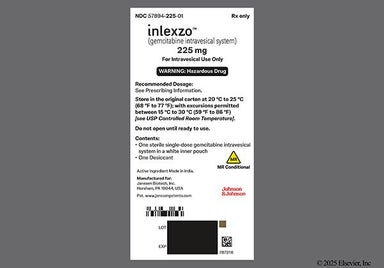
Inlexzo
Inlexzo (gemcitabine) is a chemotherapy medication. It treats certain adults with non-muscle invasive bladder cancer (NMIBC). It's typically used when Bacillus Calmette-Guérin (BCG) treatment hasn't worked. Inlexzo (gemcitabine) comes in a flexible tube that's placed into the bladder through a urinary catheter. The tube releases medication into the bladder for 3 weeks before it's removed. A new tube is placed once every 3 weeks for up to 8 treatments, then once every 12 weeks for up to 6 more treatments. Common side effects include urinating more often and pain or burning when you urinate. It can also cause urinary tract infections.


What is Inlexzo (gemcitabine)?
What is Inlexzo (gemcitabine) used for?
- Non-muscle invasive bladder cancer (NMIBC) with carcinoma in situ (CIS)
How Inlexzo (gemcitabine) works
Inlexzo (gemcitabine) is a type of chemotherapy medication called an antimetabolite. It works by damaging cancer cells when they try to make new DNA. This helps kill the cancer cells and can slow or stop the bladder cancer from growing.
Drug facts
| Common Brands | Inlexzo |
|---|---|
| Drug Class | Antimetabolite |
| Controlled Substance Classification | Not a controlled medication |
| Generic Status | No lower-cost generic available |
| Availability | Prescription only |

Side effects of Inlexzo (gemcitabine)
The following side effects may get better over time as your body gets used to the medication. Let your healthcare provider know immediately if you continue to experience these symptoms or if they worsen over time.
Common Side Effects
- Needing to urinate very often (48%)
- Urinary tract infection (44%)
- Pain or burning when urinating (42%)
- Sudden, intense urge to urinate (34%)
- Lower hemoglobin levels (31%)
- Higher lipase levels (28%)
- Urinary tract pain (26%)
- Blood in urine (24%)
- Lower white blood cell count (24%)
- Higher creatinine levels (24%)
- Higher potassium levels (22%)
Less Common Side Effects
- Bladder irritation
- Loss of bladder control
- Trouble urinating
- Waking up many times a night to urinate
- Fatigue
- Genital pain
- Diarrhea
- Higher liver enzyme levels
- Lower sodium levels
Inlexzo (gemcitabine) serious side effects
Contact your healthcare provider immediately if you experience any of the following.
- Severe urinary tract infection: fever, chills, burning with urination that gets worse, cloudy urine, bad-smelling urine, lower belly or back pain
- Bladder injury or tear: severe pelvic pain, bloody urine, trouble urinating, sudden worsening bladder symptoms
The following Inlexzo (gemcitabine) side effects have also been reported
Side effects that you should report to your care team as soon as possible:
- Allergic reactions—skin rash, itching, hives, swelling of the face, lips, tongue, or throat
Side effects that usually do not require medical attention (report these to your care team if they continue or are bothersome):

Pros and cons of Inlexzo (gemcitabine)
Pros
- Delivers medication right into the bladder
- An option when BCG treatment hasn't worked
- A bladder-preserving option instead of surgery
- Given less often after the first 6 months of treatment
Cons
- Must be placed and removed by a trained healthcare professional during an office procedure
- Must follow specific instructions when you urinate with the medication in your bladder
- Can cause bladder irritation, like urinating often and burning when you urinate
- Limited to up to 2 years of treatment

Pharmacist tips for Inlexzo (gemcitabine)

- Try your best to keep all your treatment appointments. Each Inlexzo (gemcitabine) tube stays in your bladder for 3 weeks before it's removed. At first, you'll get a new Inlexzo (gemcitabine) tube placed every 3 weeks. Later, you'll get a new tube placed every 12 weeks. Missing appointments can delay your treatment or leave the tube in your bladder longer than planned.
- If you miss an appointment to get a new Inlexzo (gemcitabine) tube placed, call the medical center to reschedule as soon as possible. It's best to try to stick as close to your original treatment schedule.
- Before the Inlexzo (gemcitabine) placement procedure: Don’t empty your bladder right before the procedure. Having some urine in the bladder might help with placement.
- What to expect for the Inlexzo (gemcitabine) placement procedure: A trained healthcare professional will place Inlexzo (gemcitabine) into your bladder using a small urinary catheter. This procedure is done at a medical center or medical office. It usually takes only a few minutes.
- Drink about about 6 to 7 cups of fluids each day during treatment with Inlexzo (gemcitabine). This helps your body make enough urine so the tube can release the medication properly.
- While you have the Inlexzo (gemcitabine) tube in your bladder: You can urinate normally without needing to hold in your urine, but be careful. Sit on the toilet when you urinate and flush after each use. Also, wash your hands with soap and water and wash your genital area with water after you go. This lowers the chance of getting medication-containing urine on your skin. If any urine gets onto your clothes, wash them separately right away.
- For at least 24 hours after Inlexzo (gemcitabine) is removed: Avoid physical contact with your urine. Your body can still clear medication into your urine after the tube gets removed. So being careful keeps the medication off your skin.
- Tell your care team right away if you have worsening pain when you urinate or severe pelvic pain while getting treated with Inlexzo (gemcitabine). Also tell them right away if you have trouble urinating, blood in your urine, or a fever. These can be signs of a bladder problem or a urinary tract infection. Getting treatment early can help prevent more serious problems.
- Before getting any MRIs: Tell the imaging team if you have Inlexzo (gemcitabine) in place. The tube contains a small metal wire and is only safe for MRI scans under specific conditions. Keep your MRI safety card with you so the imaging team can check the scan settings before MRIs.
- If you can become pregnant: Use reliable birth control during treatment and for 6 months after your final Inlexzo (gemcitabine) is removed. This medication can harm an unborn baby.
- If your partner can become pregnant: Use birth control, such as condoms, during treatment and for 3 months after your final Inlexzo (gemcitabine) is removed. This medication has a risk of harming an unborn baby.
- If you plan to breastfeed: Don't breastfeed during your treatment with Inlexzo (gemcitabine) and for 1 week after your last tube is removed. It's not known if the medication passes into breast milk. Talk with your oncologist or a lactation consultant about safe feeding options for your baby.

Risks and warnings for Inlexzo (gemcitabine)
Inlexzo (gemcitabine) can cause some serious health issues. This risk may be even higher for certain groups. If this worries you, talk to your doctor or pharmacist about other options.
Risks in people with a bladder tear or damaged bladder lining
Inlexzo (gemcitabine) can cause serious problems if your bladder has a tear, hole, or damaged lining. This can cause too much gemcitabine to enter the rest of your body. This can raise your risk of serious side effects.
Your oncology care team will check your bladder before each treatment to make sure it's safe to use Inlexzo (gemcitabine). If your bladder is damaged, you'll wait to get your treatment until your bladder has healed.
Tell your oncology care team right away if you have severe lower stomach or pelvic pain, blood in your urine, or sudden trouble urinating. These can be signs of a bladder problem.
Risk of the cancer spreading if bladder removal is delayed
- Risk factors: Long-lasting carcinoma in situ | Delayed cystectomy
Inlexzo (gemcitabine) can help some people avoid or delay bladder removal surgery. But if the cancer doesn't get better or keeps coming back, you might need this surgery done. Waiting too long for surgery can allow the cancer grow. It can grow into the muscle layer of the bladder or spread outside the bladder. This can be life-threatening.
Your oncologist will regularly check how well Inlexzo (gemcitabine) is working. They'll check with regular imaging, tests, and follow-up visits. If the medication is no longer working, your oncologist might recommend another treatment. This might include bladder removal surgery.
MRI safety
The Inlexzo (gemcitabine) tube contains a small metal wire. It's only safe to have an MRI done under specific conditions while the tube is in place in your bladder. If the scan settings aren’t right, there can be a safety risk.
Tell every healthcare professional that you have an Inlexzo (gemcitabine) tube in your bladder before getting an MRI. Keep your MRI safety card with you and show it to the imaging team before your scan. This helps make sure your MRI is done safely.
Harm to an unborn baby
- Risk factors: Pregnancy
Inlexzo (gemcitabine) can harm an unborn baby. If you can become pregnant, your oncologist will make sure you're not pregnant before you start treatment. This is usually done with a pregnancy test.
If you can become pregnant, use effective birth control during treatment with Inlexzo (gemcitabine). Keep using birth control for 6 months after you get your last Inlexzo (gemcitabine) tube removed. If you have a partner who can become pregnant, use birth control, like condoms, during treatment and for 3 months after your final tube removal. Tell your oncologist right away if you or your partner becomes pregnant during this time.

Inlexzo (gemcitabine) dosage
Typical dosage for Inlexzo (gemcitabine)
For each treatment, the typical dose is one Inlexzo (gemcitabine) tube containing 225 mg of medication.
A trained healthcare professional places the tube into your bladder. It stays in the bladder for about 3 weeks and slowly releases medication. After 3 weeks, the tube is removed.
At first, you'll receive a new Inlexzo (gemcitabine) tube every 3 weeks for up to 8 treatments. After that, you'll receive a new tube every 12 weeks for up to 6 more treatments.

Inlexzo (gemcitabine) contraindications
Contraindications are specific health conditions or situations in which a person should not take a medication due to safety concerns. If you have any of the following conditions or if any of the following apply to you, let your healthcare provider know because Inlexzo (gemcitabine) will not be safe for you to take.
- A tear or hole in the bladder
- Previous allergic reaction to gemcitabine

What are alternatives to Inlexzo (gemcitabine)?

Inlexzo (gemcitabine) images