Key takeaways:
Jordan Montanez had a series of asthma attacks and other health problems that left her with a medical bill she couldn’t pay.
She applied for her healthcare provider’s financial assistance program, but the provider kept denying her application.
She ended up working with a nonprofit organization called Dollar For, which helped her get the medical debt forgiven.
Jordan Montanez was in the middle of an ordinary workday when she had her first severe asthma attack.
Until that day in 2021, Jordan had no idea how frightening it was not to be able to breathe. “It’s absolutely terrifying,” she says.
Jordan, a 36-year-old artist in Greensboro, North Carolina, developed asthma after getting COVID-19 and COVID pneumonia. She says she hoped the first severe attack would be her last one, but it wasn’t to be. During the next year, she had more asthma attacks and made several visits to urgent care.
In November 2022, Jordan spent 18 hours in the emergency room, waiting to be admitted. Finally, she gave up and went home. The next week, she saw her pulmonologist, who sent her straight back to the hospital.
Doctors performed tests to rule out possibilities like Guillain-Barré syndrome and multiple sclerosis. Finally, Jordan learned she probably had post-viral myositis. The condition causes fatigue, muscle inflammation, and weakness.
“It took weeks and weeks to feel better,” she says.
Jordan wasn’t strong enough to go back to work. She couldn’t even navigate her townhouse without a rollator walker. The future seemed frightening and uncertain. She remembers wondering, “Am I going to be like this forever?”
Navigating huge medical bills
While she was still reeling from her health crisis, Jordan received a medical bill for $12,900.
Before the bill came, she was already working with the hospital to get the medical debt forgiven. She had received charity care in the past, so she knew she was eligible. Jordan and her husband had no health insurance, and their savings couldn’t cover the cost of her care.

Read more like this
Explore these related articles, suggested for readers like you.


But the provider kept denying her application. First, they said the date of treatment was 2 days before the date she was eligible to reapply for aid. Then, they told her she had submitted the wrong forms.
Jordan did everything she could to negotiate with the hospital. But the huge bill still went to a collection agency.
Jordan had always worked hard to take care of her debts. “I’m not the type of person who lets bills go to collections,” she says. “Except actually I am, because that’s what happened.”
Dealing with debt in the middle of a health crisis
While Jordan tried to resolve the medical debt, she was still dealing with asthma and myositis.
“When I was supposed to reapply for financial assistance in December, my mind was weak,” she says. “Everything was weak. I had to ask my husband to pull up my email and find the documents for me.”
Frustrated that she wasn’t getting anywhere with the hospital, Jordan searched for help online.
“I was literally Googling: 'What do you do if you can’t pay your medical bills?'” she says.
That’s when she found Dollar For, a nonprofit organization that helps people apply for charity care.
The power of advocacy for medical debt forgiveness
Jordan applied for assistance through Dollar For and was quickly approved.
Dollar For offered Jordan two options. They could coach her as she negotiated with the hospital on her own, or they could match her with an advocate. She chose to use an advocate, since she hadn’t had success on her own.
“I already knew what to do,” Jordan says. “It just wasn’t working.”
At first, Dollar For didn’t have success either, and the hospital rejected their appeal. But Jordan and the Dollar For team didn’t give up. Dollar For published an Instagram video telling her story. They also connected her with a reporter, Bob Herman from STAT news, who began developing a story about Jordan’s situation. He submitted the application again on Jordan’s behalf, and this time the hospital approved it.
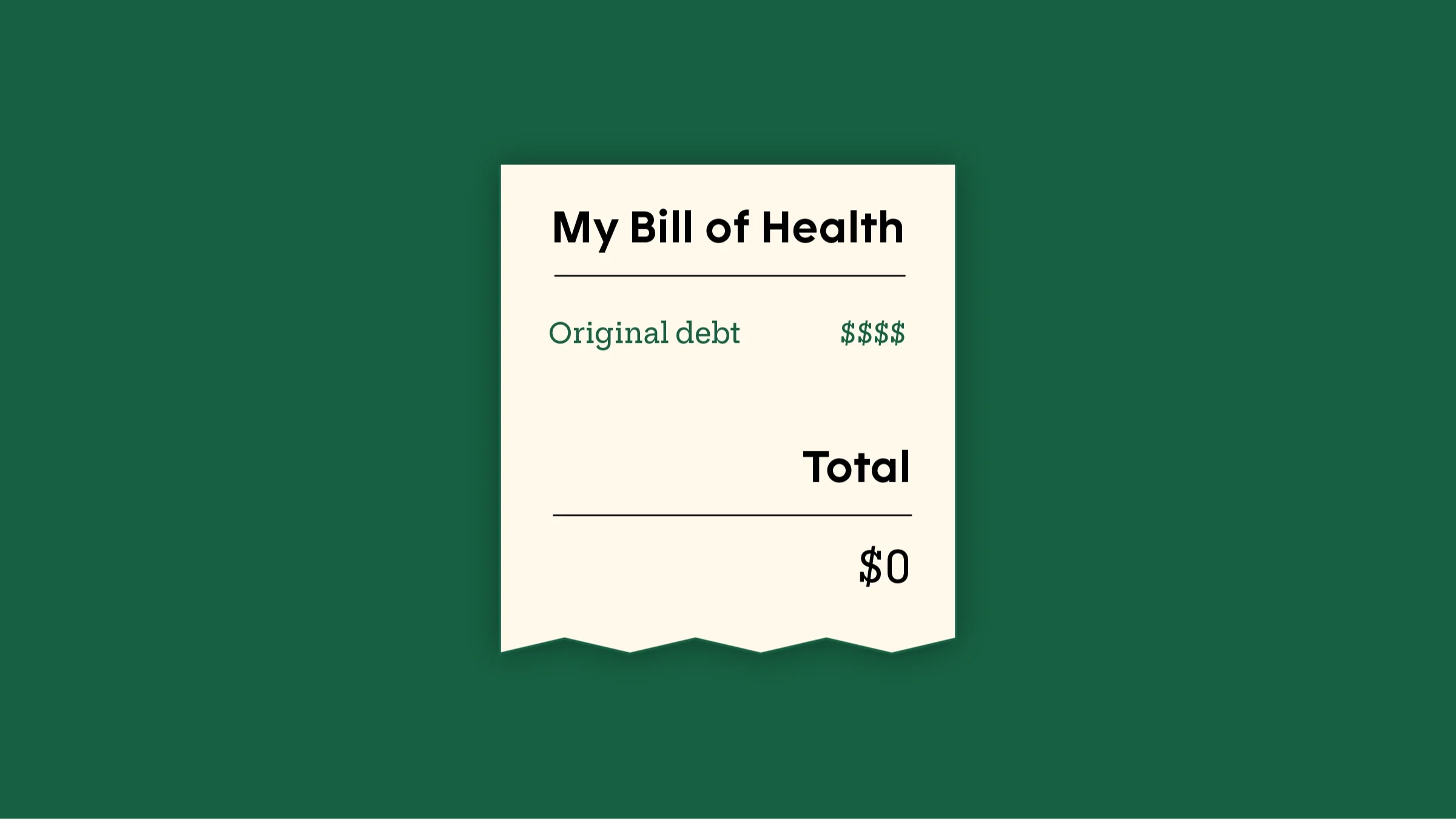
In May 2023, Jordan’s $12,900 medical debt was completely forgiven.

Hope for the future
Jordan’s health challenges haven’t disappeared, and neither have her medical expenses. She still has to sort through bills from other health providers and apply for assistance programs. But with the $12,900 debt forgiven, the other amounts are more manageable.
Jordan says she has lost two jobs from missing too many days, so her husband’s job supports them both. They still have no health insurance. (You can find GoodRx resources for free or low-cost healthcare and insurance options here.)
Whenever she can, Jordan advocates for other people who are struggling to meet their healthcare expenses. Her best friend is transgender, and she sees how hard it is for him to get the care he needs.
“Everybody deserves access to safe and affordable healthcare,” she says.
Support from her husband, parents, friends, and beloved pets helps Jordan make it through hard days. She also finds joy in her painting and crochet art. One of her passions is creating sustainable plus-size fashions.
The pressure of dealing with medical bills can become overwhelming, Jordan says. But she has found ways to cope.
“I just take a breath,” she says. “I can have a moment with my husband, I can pet my dog, and then I get back to figuring out how to pay.”
How to cope with medical debt
As Jordan learned, it’s tough to deal with medical bills in the middle of a serious health crisis.
She encourages people to ask for help from friends and family. “Ask them to look for documents and make phone calls and fax the forms,” she says. “People do want to help you. They love you.”
Ignoring the bills might seem tempting, but Jordan warns that it’s never a good strategy. “It won’t go away,” she says.
She says it’s also important to keep the medical bills in perspective.
“Even when things go to collection, people don’t kick down your door,” she says. “Prioritize your mental and physical health. You have time, and there are people who can help.”

Why trust our experts?