Key takeaways:
Unfortunately, there is a lot of misinformation around HIV testing and treatment that prevents transgender people from seeking care.
Not having your legal name or gender marker changed shouldn't be a barrier to HIV care. And you can safely take gender-affirming hormone therapy (GAHT) with HIV medications or pre-exposure prophylaxis (PrEP).
Don’t delay HIV testing, treatment, or getting started on PrEP. You can find free testing and discounts on treatment through a variety of organizations. Your state’s HIV/AIDS hotline can help you find programs and services near you.
In the U.S., HIV (human immunodeficiency virus) and AIDS (acquired immunodeficiency syndrome) continue to have a devastating impact on vulnerable and marginalized populations — particularly transgender communities.
Stigma, discrimination, and medical mistrust all contribute to barriers that make it difficult for transgender people to access HIV testing and treatment. What’s more, there are many myths that can make navigating health decisions more difficult for transgender people.
Jordan Braxton, who has been an activist in St. Louis’ LGBTQIA+ community for over 35 years, works to raise awareness about HIV in transgender communities. As a prevention supervisor at Vivent Health, an AIDS service organization (ASO), she focuses on education and outreach. Below, Braxton debunks five common HIV myths she encounters when working with transgender folks.

Myth #1: I can’t get tested or treated because I haven’t legally changed my name
Truth: You can still get tested and treated for HIV if you haven’t legally changed your name or gender marker. According to Braxton, some organizations don’t require people to show ID when getting tested. This is to avoid issues for people whose names or gender markers haven’t been changed. Calling your testing site in advance to verify requirements can help you manage your expectations up front.
You may also have the option to skip a testing site altogether. HIV self-tests can be purchased and performed entirely at home. You can find them online, at your local pharmacy, or through some community-based organizations (CBOs).
Myth #2: I can’t get tested because I don’t have insurance or employment
Truth: HIV testing is free at many CBOs and ASOs. Federal and state grants cover the cost of testing. This allows those who are underemployed, unemployed, and/or uninsured to get tested.
The CDC’s HIV prevention services locator is a great resource for finding a site that offers free or affordable testing near you.
But what about HIV treatment? Many organizations use no-fee, sliding scale, or patient assistance programs to help people with the costs of HIV treatment and preventive medications. Braxton’s organization, Vivent Health, is one of them. She says that their goal is to make these services accessible for everyone. “No one is denied services for the inability to pay,” she says.
Not sure which programs might be able to help you? Call your state’s HIV/AIDS hotline to discuss your eligibility and how to access care.
Myth #3: HIV medication will affect my hormone therapy
Truth: Current evidence suggests that it’s safe to take gender-affirming hormone therapy (GAHT) with HIV medications. This appears to be true for both HIV treatments and HIV preventative medication (pre-exposure prophylaxis, or PrEP). If there are interactions, they can be managed by adjusting your GAHT dose.

Read more like this
Explore these related articles, suggested for readers like you.



This myth can have serious consequences on people’s health. In fact, one study found that 40% of transgender women living with HIV weren’t taking their GAHT, HIV medications, or both as prescribed because of these concerns. If you aren’t following your HIV treatment regimen, you can develop resistance. And this can make your HIV harder to manage.
If you’re concerned about a potential interaction with your GAHT and HIV medications, talk to your healthcare provider. They can help you navigate any potential interactions safely.
Myth #4: Because I am transgender, I won’t get the same treatment as other patients
Truth: It’s understandable that you may avoid healthcare environments due to prior negative experiences. And deadnaming, misgendering, and inappropriate questions or remarks may be a few of the reasons why.
But there are many tools and resources that are now available to healthcare providers, to help them create a welcoming and inclusive environment for transgender patients. More and more, providers are using these resources to learn about changing intake forms, training staff, and navigating patients’ records, insurance forms, and other documents. And these small changes have been shown to make a big difference in treatment success.
“Some organizations currently have trans people on staff and their providers have taken diversity training,” Braxton says, pointing to positive developments within the healthcare industry.
But not all healthcare providers have implemented the steps necessary to provide patient-centered care for transgender people. So it may be a good idea to call ahead when you’re seeing a new provider. Ask what changes they’ve implemented in their practice and what to expect during your appointment.
“We, as an ASO, understand that people affected by HIV, especially trans people, should be treated with dignity and respect,” Braxton says of her organization.
Myth #5: Transgender men are not at risk for HIV
Truth: Transgender women are disproportionately affected by HIV, but research suggests transgender men also have an increased risk of HIV infection.
HIV outreach, research, and messaging is often targeted toward transgender women, while efforts specific to transgender men are lacking. This overlooks the fact that the sexual orientations of transgender men are diverse and can put them at risk for HIV as well. This is especially the case for transgender men who have receptive sex with cisgender men.
A few factors that can contribute to trangender men’s risk of HIV infection include:
Not using condoms consistently
Complicated gender and power dynamics with a sexual partner
Changes to sex drive from GAHT, which can result in risky sexual behaviors
Substance misuse, low self-esteem, and/or mental health conditions
Talk to your healthcare provider about your HIV risk. They can suggest prevention strategies that are most appropriate for you.
What resources are available to help transgender people either at risk for HIV or living with HIV?
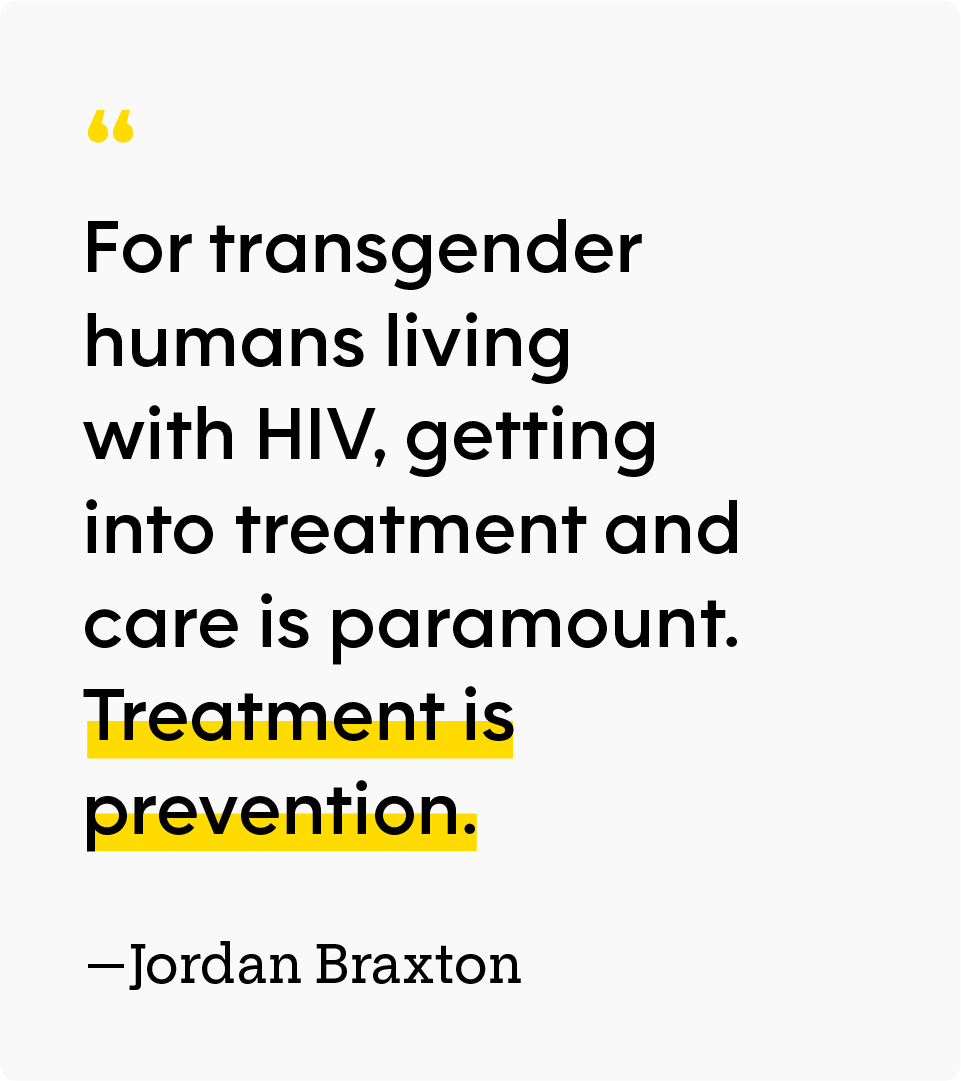
It’s important to take the necessary steps for managing your HIV risk. This includes getting tested and taking PrEP, if you’re eligible. If you’re living with HIV, starting and staying on HIV treatment is crucial. “For transgender humans living with HIV, getting into treatment and care is paramount. Treatment is prevention,” Braxton says.
There are several resources available that can help you access and afford HIV services. Below are a few examples.
AIDS service organizations
ASOs are organizations that provide HIV prevention and treatment services. At an ASO, you might encounter case managers, social workers, or prevention specialists, like Braxton.
Braxton says that her main responsibility at Vivent Health is to conduct outreach and education for the prevention of the spread of HIV. This includes talking with people about their sexual health.
“Sexual health requires a positive and respectful approach to sexuality and sexual relationships, as well as the possibility of having pleasurable and safe sexual experiences, free of coercion, discrimination, and violence,” she says. “Trans humans are no exception.”
During these sessions, Braxton talks about ways to reduce the risk of HIV infection, including using condoms and taking PrEP. She often encounters misinformation and a lack of education about PrEP within transgender communities. That may be why one study found that only 3% of high-risk transgender people were taking PrEP, and less than half were familiar with it.
If you’re a good candidate for PrEP, you can set up an appointment with one of Vivent Health’s PrEP providers. They’ll work with you to fill your PrEP prescription and obtain assistance to make it more affordable.
Other services offered by Vivent Health include HIV and STI (sexually transmitted infection) testing, HIV case management, housing programs, and more.
Ryan White HIV/AIDS Program
ASOs will often receive funding from the Ryan White HIV/AIDs Program (RWHAP) to help make HIV prevention and treatment more affordable. The RWHAP is a federal program that works with cities, states, and local CBOs and ASOs to provide services to people living with HIV.
Funds from the program go toward providing:
Medications to low-income people living with HIV
Medical and support services to areas significantly affected by HIV
Medical care for low-income women, children, and infants living with HIV
Dental care for people living with HIV
Support services for people living with HIV and their families
If you’ve been diagnosed with HIV or AIDS, meet certain income requirements, and are uninsured or underinsured, you may qualify for assistance. Search for a RWHAP provider near you to find HIV care and support services.
The bottom line
There are several myths about HIV (human immunodeficiency virus) services, treatment, and prevention that can affect the health of transgender people. And these vulnerabilities, especially given the risks surrounding HIV, cannot be overlooked.
In reality, there are many resources available to help transgender people access affordable HIV care. Contact your state’s HIV/AIDS hotline to locate programs and services near you.

Why trust our experts?




References
A Positive Life. (n.d.). HIV support: AIDS service organizations (ASOs).
Braun, H. M., et al. (2017). Transgender women living with HIV frequently take antiretroviral therapy and/or feminizing hormone therapy differently than prescribed due to drug-drug interaction concerns. LGBT Health.
Centers for Disease Control and Prevention. (2022). Find an HIV test.
Centers for Disease Control and Prevention. (2022). HIV self-testing.
Centers for Disease Control and Prevention. (2022). Issue brief: HIV and transgender communities.
Centers for Disease Control and Prevention. (2022). Patient-centered care for transgender patients.
Health Resources and Services Administration. (n.d.). Find a Ryan White HIV/AIDS program medical provider.
Health Resources and Services Administration. (2022). Available care & services.
Health Resources and Services Administration. (2022). Program parts & initiatives.
Health Resources and Services Administration. (2022). State HIV/AIDS hotlines.
Clinicalinfo.HIV.gov. (2022). Considerations for antiretroviral use in special patient populations.
Clinicalinfo.HIV.gov. (2022). Federal funding for HIV/AIDS.
Clinicalinfo.HIV.gov. (2022). Paying for HIV care and treatment.
Lemons, A., et al. (2018). Characteristics of HIV-positive transgender men receiving medical care: United States, 2009-2014. American Journal of Public Health.
National Alliance of State and Territorial AIDS Directors. (n.d.). State PrEP assistance programs.
Sevelius, J., et al. (2015). What are transgender men’s HIV prevention needs? University of San Francisco.
Sevelius, J., et al. (2020). HIV testing and PrEP use in a national probability sample of sexually active transgender people in the United States. Journal of Acquired Immune Deficiency Syndrome.
Transgender Law Center. (2016). Some kind of strength.
Vivent Health. (n.d.). HIV case management services.
Vivent Health. (n.d.). Housing programs.
ViventHealth. (n.d.). PrEP.