Key takeaways:
You can spot early signs of vitamin deficiencies in your fingernails and toenails.
Signs of vitamin deficiencies in nails include brittleness, ridges, white lines, and spoon-shaped nails.
Your healthcare team can make sure nail changes aren’t from a vitamin deficiency. Vitamin supplements can help correct deficiencies and help nails grow back healthy.
They say that eyes are the windows to the soul. But your nails can be windows to your health. Changes in your fingernails and toenails can sometimes be early signs of medical conditions, infections, and even vitamin deficiencies.
Here are six signs of vitamin deficiency in nails to know about.
What kind of nail changes can be a sign of a vitamin deficiency?
Vitamin deficiencies can cause many different nail changes, including changes in nail color, shape, and texture. Some of the nutrients most commonly associated with nail changes include:
Iron
Zinc
Vitamin B12
Biotin (B7)
Calcium
Protein
Search and compare options
It’s important to remember that nail changes can have causes other than vitamin deficiencies. Infections, psoriasis, and even menopause are examples of conditions that can affect the appearance of your nails. That’s why it’s a good idea to get medical care if you notice changes affecting several fingernails or toenails at the same time.
Here are some of the more common ways vitamin deficiencies can affect your nails.
1. Nail color changes
Healthy nails have a range of colors, depending on a person’s skin tone and the number of pigment-producing cells (melanocytes) in the nail matrix. Blood vessels underneath the nail bed also lend a range of pinkish to reddish undertones. But certain vitamin deficiencies can affect your nail color.
Iron deficiency can lead to anemia, which can make your nails look more pale than their usual hue. Meanwhile, a vitamin B12 deficiency can sometimes cause nails to appear darker than usual or develop a blue-black discoloration.
2. Horizontal grooves
Horizontal grooves or depressions that run all the way across your nails can be a sign of vitamin deficiency. This is especially true if you have lines across several fingernails. These depressions are called Beau’s lines. They can be a sign of severe zinc deficiency.
Beau’s lines can be caused by medical conditions and some medications too. But if you have a Beau’s line on only one nail, it was likely caused by an injury, not a medical condition or vitamin deficiency.

3. Vertical ridges
Vertical (or longitudinal) ridges are raised lines that run from the cuticle to the tip of the nail. A single vertical ridge usually happens from minor trauma to the nail or just from getting older. But when multiple nails develop prominent vertical ridges, it can be a sign of an underlying medical condition (like lupus). It can also be due to a nutritional deficiency in:
Protein
Iron
Folic acid (B9)
Vitamin B12
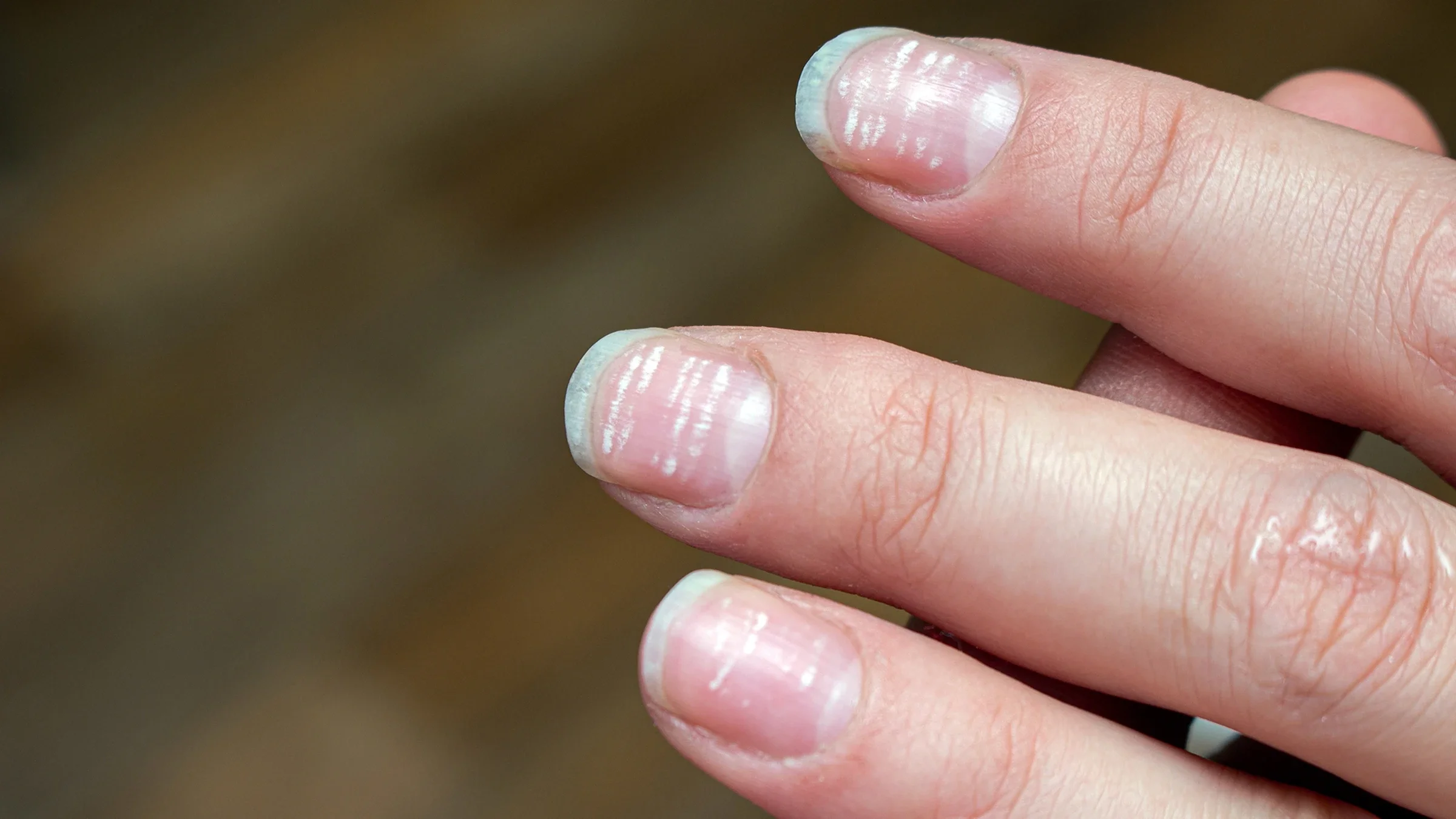
4. White horizontal lines
Most white spots on nails aren’t a cause for concern. But white lines that run all the way across your nails can be a sign of a vitamin deficiency, especially if you have multiple lines on several nails. Low calcium and zinc levels can both cause white horizontal lines to form on your nails. These lines are called transverse leukonychia.
5. Brittle, cracked nails
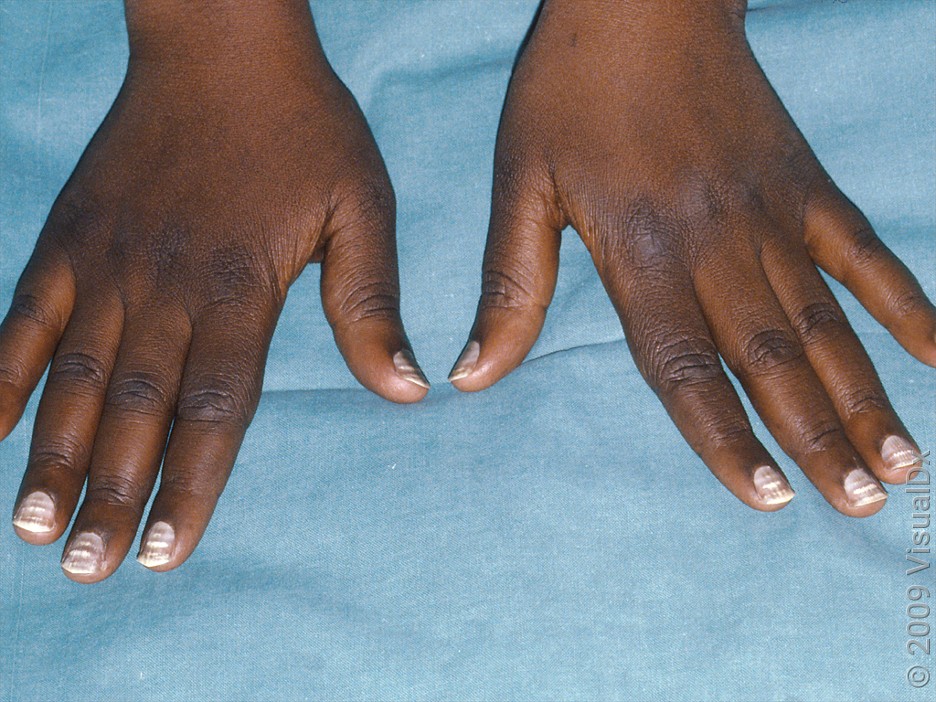
Brittle nails that break or crack easily can be a sign of a vitamin deficiency.
Low iron, biotin, and calcium levels can weaken nails and make them softer. Soft, weak nails can crack and break more easily. They’re also drier and may peel or split at the edges. Keep in mind that frequent handwashing and harsh chemicals can also contribute to brittle nails.
6. Spoon-shaped nails
Nails that are flatter than usual can have a spoon-shaped appearance. This is called koilonychia, and it’s a sign of a vitamin deficiency. Low iron and vitamin C levels can cause nails to develop a spoon-shaped appearance.
How long does it take for a vitamin deficiency to affect your nails?
It takes time for a vitamin deficiency to affect your nails’ appearance. Your fingernails grow about 3 mm per month, while your toenails grow only about 1 mm per month.
That means if you develop a severe vitamin deficiency today, it may be a month or two before your fingernails have grown enough for you to notice the difference. It may take even longer for you to see a difference in your toenails.
How can you tell if your nail changes are from a vitamin deficiency or something else?
Nail changes can be caused by many things like:
Vitamin and other nutrition deficiencies
Medical conditions
Injuries
It may be difficult to tell if your nail changes are from a vitamin deficiency or another cause. That’s why it’s important to get care if you notice nail changes on most of your nails.
You’re more likely to have a medical condition or vitamin deficiency if you see changes on both your fingernails and your toenails — and not just one or the other. Medical conditions and nutritional deficiencies also tend to affect multiple nails at the same time. If you notice changes in only one or two nails, an injury or infection is more likely to be the cause.
Your healthcare team can examine your nails and order tests to figure out what’s causing the changes.
How long does it take for nail changes to go away once you treat a vitamin deficiency?
Vitamin supplements can correct vitamin deficiencies and help you recover. But vitamin supplements won’t make your nail changes go away. Instead, they make your nails grow back healthy, strong, and with their usual appearance. Your nails won’t recover their normal appearance until they fully grow back.
As mentioned above, your nails only grow 3 mm a month on average. So it’ll take several months for your nails to look like they used to. Toenails grow even more slowly, so they may take longer to improve.
Recommended treatments to improve nail health
The best treatment for nail changes depends on the underlying cause. If a vitamin or mineral deficiency is responsible, correcting the deficiency can help your nails grow back stronger and healthier.
Other ways to support healthy nails include:
Eating a balanced diet of whole foods
Moisturizing your hands and cuticles
Wearing gloves when using cleaning products or chemicals
Avoiding excessive nail trauma
Frequently asked questions
Vitamin D deficiency may cause black lines on nails, but it’s not common. Some reports have linked vitamin D deficiency to dark streaks or lines in the nails. However, dark lines in the nails are more often caused by injury, medications, or harmless pigment changes — or (rarely) melanoma.
If you develop a new dark line on a nail, especially if it’s widening or changing over time, you should have it evaluated by a healthcare professional.
No, vitamin D deficiency doesn’t usually cause nail pitting. Nail pitting is more common with certain skin conditions like psoriasis, alopecia areata, and eczema.
No, nail biting isn’t a sign of vitamin deficiency. Chronic nail biting is usually a habit related to stress, boredom, or compulsive behaviors.
Vitamin D deficiency may cause black lines on nails, but it’s not common. Some reports have linked vitamin D deficiency to dark streaks or lines in the nails. However, dark lines in the nails are more often caused by injury, medications, or harmless pigment changes — or (rarely) melanoma.
If you develop a new dark line on a nail, especially if it’s widening or changing over time, you should have it evaluated by a healthcare professional.
No, vitamin D deficiency doesn’t usually cause nail pitting. Nail pitting is more common with certain skin conditions like psoriasis, alopecia areata, and eczema.
No, nail biting isn’t a sign of vitamin deficiency. Chronic nail biting is usually a habit related to stress, boredom, or compulsive behaviors.
The bottom line
Vitamin deficiencies can affect both your health and the appearance of your nails. Common signs of vitamin deficiencies in nails include nail discoloration, horizontal or vertical lines, brittle nails, and spoon-shaped nails.
Get medical care if you notice nail changes affecting most of your fingernails or toenails. Your healthcare team can check whether a vitamin deficiency is causing your symptoms and recommend treatment. Correcting any nutritional deficiencies can help your nails grow back strong and healthy.

Why trust our experts?




Images used with permission from VisualDx (www.visualdx.com).
References
Dawman, L., et al. (2018). Blue nails: Window to micronutrient deficiency. BMJ Case Reports.
De Berker, D. A. R., et al. (2007). Nail biology and nail science. International Journal of Cosmetic Science.
MedlinePlus. (2025). Nail abnormalities.
Rathod, D. G., et al. (2023). Spoon nails. StatPearls.
Seshadri, D., et al. (2012). Nails in nutritional deficiencies. Indian Journal of Dermatology, Venereology, and Leprology.
Singal, A., et al. (2015). Nail as a window of systemic diseases. Indian Dermatology Online Journal.
Singal, A., et al. (2020). Melanonychia: Etiology, diagnosis, and treatment. Indian Dermatology Online Journal.