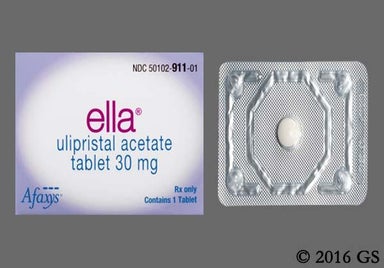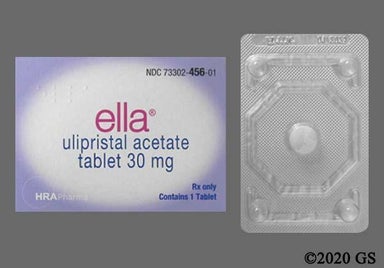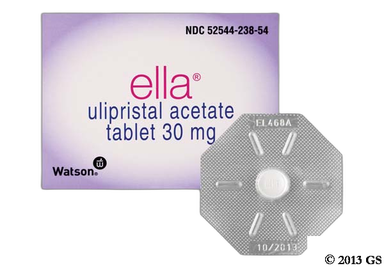
Ella
Ella (ulipristal) is a prescription emergency contraceptive medication, sometimes called the "morning after pill." It's used to prevent pregnancy after unprotected sex or if your birth control fails, like a missed pill or broken condom. Ella (ulipristal) works best when you take the tablet as soon as possible, within 5 days after unprotected sex. It isn't regular birth control and won't stop a pregnancy that's already started. Common side effects include headache, nausea, and stomach pain.


What is Ella (ulipristal)?
What is Ella (ulipristal) used for?
How Ella (ulipristal) works
Ella (ulipristal) is a progestin agonist / antagonist. This means it can both block and act like the natural hormone progesterone in your body. The medication mainly works by delaying or preventing ovulation, which keeps an egg from being released so fertilization doesn’t happen. It might also thin the lining of the uterus, making it harder for a fertilized egg to implant.
Drug facts
More on Ella (ulipristal) essentials


Side effects of Ella (ulipristal)
The following side effects may get better over time as your body gets used to the medication. Let your healthcare provider know immediately if you continue to experience these symptoms or if they worsen over time.
Common Side Effects
- Headache (18%)
- Nausea (12%)
- Stomach pain (12%)
Less Common Side Effects
- Menstrual cramps
- Tiredness
- Dizziness
Ella (ulipristal) serious side effects
Contact your healthcare provider immediately if you experience any of the following.
- Ectopic pregnancy: severe, unexplainable pelvic pain along with unusual vaginal bleeding
More on Ella (ulipristal) side effects
The following Ella (ulipristal) side effects have also been reported
Along with its needed effects, a medicine may cause some unwanted effects. Although not all of these side effects may occur, if they do occur they may need medical attention.
Check with your doctor immediately if any of the following side effects occur:
Some side effects may occur that usually do not need medical attention. These side effects may go away during treatment as your body adjusts to the medicine. Also, your health care professional may be able to tell you about ways to prevent or reduce some of these side effects. Check with your health care professional if any of the following side effects continue or are bothersome or if you have any questions about them:
Less common
Dizziness
Other side effects not listed may also occur in some patients. If you notice any other effects, check with your healthcare professional.
Call your doctor for medical advice about side effects. You may report side effects to the FDA at 1-800-FDA-1088.

Get your GoodRx coupon

Pros and cons of Ella (ulipristal)
Pros
- Single pill that's taken as a one-time dose
- Works up to 5 days after unprotected sex
- Most effective emergency contraception pill available
- Most side effects are mild
Cons
- Requires a prescription
- Won't end a pregnancy that's already started
- Can interact with some hormonal birth control pills
- Might not work as well for those with a larger body size

Pharmacist tips for Ella (ulipristal)

- You can take Ella (ulipristal) with or without food at any time.
- You must take Ella (ulipristal) within 5 days after unprotected sex. The sooner you take it, the better it works to prevent pregnancy.
- If you vomit within 3 hours of taking Ella (ulipristal), call your prescriber right away. You might need to take another dose for it to work.
- Don't take Ella (ulipristal) more than once during the same menstrual cycle. It isn’t known if taking it more often is safe.
- After taking Ella (ulipristal), use a reliable barrier method like condoms until your next period. This will help continue to prevent pregnancy.
- Don’t take hormonal birth control within 5 days of taking Ella (ulipristal). Doing so can make the medication work less well.
- After Ella (ulipristal), your next period might come a few days early or late. If it’s more than 7 days late, take a home pregnancy test to check if you're pregnant.
- Ella (ulipristal) doesn't protect you from HIV or other sexually transmitted infections (STIs). You’ll still need protection like condoms to reduce this risk.

Common questions about Ella (ulipristal)
Ella (ulipristal) can stay in your system for about a week after you take it. This estimate is based on its half-life, which measures how long it takes for your body to clear the medication.
You can get Ella (ulipristal) from a pharmacy, but you need a prescription from a healthcare professional. Ask your OB-GYN provider or primary care provider if they can give you a prescription ahead of time so you can keep Ella (ulipristal) at home and use it when you need it. Some clinics and telehealth services, like GoodRx Care, can also prescribe it.
Ella (ulipristal) works best if you take it before ovulation, since it delays or blocks the release of an egg. If you’ve already ovulated, the medication won't work. Because it’s hard to know exactly when ovulation happens, the sooner you take Ella (ulipristal) after unprotected sex, the more likely it is to prevent pregnancy.
Ella (ulipristal) is an emergency contraceptive pill, not a regular type of birth control. You shouldn't use it as your main way to prevent pregnancy. Instead, Ella (ulipristal) is a good option if you miss a dose of your daily pill or if a condom breaks.
Both Ella (ulipristal) and Plan B (levonorgestrel) are both emergency contraceptives, but Ella (ulipristal) actually works better at preventing pregnancy. You can take Ella (ulipristal) up to 5 days after unprotected sex, while Plan B should be taken within 3 days to work best. The side effects are similar, but unlike Plan B, Ella (ulipristal) isn't available over the counter. Talk to a healthcare professional if you have questions comparing the two medications.
When you use Ella (ulipristal) correctly, it works very well to prevent pregnancy. Studies show that it's about 98% effective when taken within 5 days after unprotected sex.
After you take Ella (ulipristal), wait at least 5 days before starting or restarting hormonal birth control. And continue to use a barrier method of protection, such as condoms, every time you have sex until your next period.
Ella (ulipristal) starts working right away after you take it. It delays or blocks ovulation, so the sooner you take it after unprotected sex, the better it works.

How to save using GoodRx



Risks and warnings for Ella (ulipristal)
Ella (ulipristal) can cause some serious health issues. This risk may be even higher for certain groups. If this worries you, talk to your doctor or pharmacist about other options.
Don't take if already pregnant
Ella (ulipristal) only works to prevent pregnancy after unprotected sex. It won't work if you're already pregnant. If you are considering ending a pregnancy, talk with your OB-GYN provider since Ella (ulipristal) isn't a safe or effective option for that.
Ectopic pregnancy
An ectopic pregnancy happens when a fertilized egg grows outside your uterus. This can be life-threatening and sometimes need to be treated with surgery. Ella (ulipristal) doesn't cause an ectopic pregnancy, but it's still possible to have one after taking it. If you experience unexplained or severe pelvic pain along with unusual vaginal bleeding after taking Ella (ulipristal), let your OB-GYN provider know.
Not for use regularly
It isn't known if Ella (ulipristal) is safe to take more than once in the same menstrual cycle. Don't use it as your regular birth control. If you need birth control, your OB-GYN provider can help you pick one that works best for you. After taking Ella (ulipristal), make sure to use a barrier method like condoms your next period.
Interactions with other medications
Tell your prescriber and pharmacist about all the medications you take. Some medications like rifampin, can interact with Ella (ulipristal) and make it not work as well. This can raise your risk of pregnancy.
Fertility after use
After you take Ella (ulipristal), you can get pregnant again once the medication wears off after a few days. To be safe, use a reliable barrier method like condoms until your next period. If you want to start hormonal birth control, wait at least 5 days after taking Ella (ulipristal), and keep using condoms until your next period.
Irregular period
After you take Ella (ulipristal), your period might come a few days earlier or later than usual. In studies, periods were delayed by about 2.5 days on average but went back to normal the next month. If your period is late by more than a week, take a home pregnancy test to rule out pregnancy.
Sexually transmitted infections
Ella (ulipristal) doesn't protect against HIV or other sexually transmitted infections (STIs). You’ll still need to use condoms or other barrier methods to lower your risk of getting or spreading an STI.

Ella (ulipristal) dosage
 Tablet
| Dosage | Quantity | Price as low as | Price per unit |
|---|---|---|---|
| 30mg | 1 tablet | $42.84 | $42.84 |
Typical dosage for Ella (ulipristal)
The typical dose is to take 30 mg (one tablet) by mouth as soon as possible within 5 days of unprotected sex.
More on Ella (ulipristal) dosage


Interactions between Ella (ulipristal) and other drugs
More on Ella (ulipristal) interactions
Although certain medicines should not be used together at all, in other cases two different medicines may be used together even if an interaction might occur. In these cases, your doctor may want to change the dose, or other precautions may be necessary. When you are taking this medicine, it is especially important that your healthcare professional know if you are taking any of the medicines listed below. The following interactions have been selected on the basis of their potential significance and are not necessarily all-inclusive.
Using this medicine with any of the following medicines is not recommended. Your doctor may decide not to treat you with this medication or change some of the other medicines you take.
Using this medicine with any of the following medicines is usually not recommended, but may be required in some cases. If both medicines are prescribed together, your doctor may change the dose or how often you use one or both of the medicines.
- Amobarbital
- Apalutamide
- Aprepitant
- Aprobarbital
- Armodafinil
- Artemether
- Barbital
- Bexarotene
- Brigatinib
- Butabarbital
- Butalbital
- Carbamazepine
- Cenobamate
- Clobazam
- Dabrafenib
- Darunavir
- Desogestrel
- Dexamethasone
- Dienogest
- Drospirenone
- Efavirenz
- Elagolix
- Elvitegravir
- Encorafenib
- Enzalutamide
- Eslicarbazepine Acetate
- Estradiol
- Ethinyl Estradiol
- Ethynodiol
- Etonogestrel
- Etravirine
- Fosaprepitant
- Fosphenytoin
- Gestodene
- Griseofulvin
- Hexobarbital
- Isotretinoin
- Ivosidenib
- Lesinurad
- Levonorgestrel
- Lorlatinib
- Lumacaftor
- Medroxyprogesterone
- Mephobarbital
- Mestranol
- Methohexital
- Mitotane
- Modafinil
- Mycophenolic Acid
- Nafcillin
- Nevirapine
- Nilotinib
- Nomegestrol
- Norelgestromin
- Norethindrone
- Norgestimate
- Norgestrel
- Pentobarbital
- Phenobarbital
- Phenylbutazone
- Phenytoin
- Pitolisant
- Prednisone
- Primidone
- Quinidine
- Red Clover
- Rifabutin
- Rifampin
- Rifapentine
- Secobarbital
- Segesterone
- St John's Wort
- Sugammadex
- Tazemetostat
- Thiopental
- Topiramate
- Vinblastine

How much does Ella (ulipristal) cost?
$42.84

Ella (ulipristal) contraindications
Contraindications are specific health conditions or situations in which a person should not take a medication due to safety concerns. If you have any of the following conditions or if any of the following apply to you, let your healthcare provider know because Ella (ulipristal) will not be safe for you to take.
- Use while already pregnant

What are alternatives to Ella (ulipristal)?

News about Ella (ulipristal)




Ella (ulipristal) images