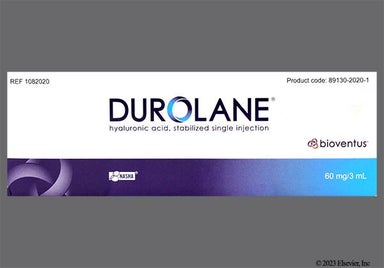
Durolane
Durolane contains hyaluronic acid. It's an injection into the knee that helps relieve pain from osteoarthritis in people ages 21 and up. It works as a viscosupplement to help cushion and support the knee joint. Durolane is used when other options, like exercise, weight loss, physical therapy, or basic pain relievers, aren't enough. A trained healthcare professional injects Durolane into the knee joint one time. Side effects can include knee pain, pain at the injection site, and joint swelling.


What is Durolane?
What is Durolane used for?
- Pain due to osteoarthritis of the knee
How Durolane works
Durolane is a viscosupplement that contains hyaluronic acid.
Your joints naturally contain hyaluronic acid to help lubricate and cushion them. But with osteoarthritis, there's less cushioning. This leads to inflammation inside the joint, joint damage, and joint pain.
Durolane is injected directly into the knee joint. By adding a gel form of hyaluronic acid there, your joint can glide more smoothly. This can ease knee pain and stiffness over time.
Drug facts
| Common Brands | Durolane |
|---|---|
| Drug Class | Viscoelastic |
| Controlled Substance Classification | Not a controlled medication |
| Generic Status | No lower-cost generic available |
| Availability | Prescription only |

Side effects of Durolane
The following side effects may get better over time as your body gets used to the medication. Let your healthcare provider know immediately if you continue to experience these symptoms or if they worsen over time.
Common Side Effects
- Joint pain (11%)
- Pain at the injection site (3%)
Less Common Side Effects
- Joint swelling
- Joint stiffness
- Redness at the injection site
The following Durolane side effects have also been reported
Side effects that you should report to your care team as soon as possible:
- Allergic reactions—skin rash, itching, hives, swelling of the face, lips, tongue, or throat
Side effects that usually do not require medical attention (report these to your care team if they continue or are bothersome):

Pros and cons of Durolane
Pros
- Single in‑office injection
- Contains a special form of hyaluronic acid that might cause fewer side effects at the injection site than other types
- An option when simple pain relievers and lifestyle changes haven’t helped enough
Cons
- Approved for the knee only
- Can cause pain or swelling in the knee after the injection
- Not studied in people under 21 years old, during pregnancy, or while breastfeeding

Pharmacist tips for Durolane

- At the medical office, your clinician will clean the skin at the injection site before giving you your Durolane shot into the knee joint. They might also numb the area. If you have any excess fluid in the joint, they'll help remove that as well before giving the injection.
- If both your knees need treatment, you’ll get a separate Durolane injection for each.
- Reschedule your Durolane injection if you have a skin infection or rash near your knee. Injecting through infected or damaged skin can raise the risk of a serious joint infection. Your clinician will check the skin around your knee before the injection to make sure it's safe.
- Take it easy for 48 hours after your Durolane injection. Avoid running, heavy lifting, other strenuous exercise, and standing for a long time. This also includes activities that put too much weight on your knee for more than 1 hour. Avoiding these activities helps lower the chance of a painful flare and swelling.
- After your Durolane shot, you might have some pain, swelling, or stiffness in your knee. This is usually mild and goes away within 2 to 3 weeks.
- Tell your care team if knee pain, swelling, or stiffness doesn't go away, gets worse, or makes it hard to walk after your Durolane injection. These could be signs of a serious flare. Also call if you have a fever with these symptoms, since it could mean a joint infection.
- Durolane can take a few weeks to months to help with your OA in your knee. Be sure to give your knee time to get better. It's a good idea to track your pain and how well your knee moves over these few months. This helps your care team see if the medication helped.

Risks and warnings for Durolane
Durolane can cause some serious health issues. This risk may be even higher for certain groups. If this worries you, talk to your doctor or pharmacist about other options.
Caution use in people with chondrocalcinosis (calcium crystal deposits in the cartilage)
If you have a condition called chondrocalcinosis (also called "pseudogout"), tell your clinician. In rare cases, a Durolane injection might make symptoms like pain and swelling from this condition worse. Your clinician can help decide if Durolane is right for you. If you get the injection, be sure to let your care team know if your symptoms worsen afterwards.

Durolane dosage
Typical dosage for Durolane
The typical dose is 1 injection given into the knee joint by a trained healthcare professional. The injection contains 60 mg of sodium hyaluronate.

Durolane contraindications
Contraindications are specific health conditions or situations in which a person should not take a medication due to safety concerns. If you have any of the following conditions or if any of the following apply to you, let your healthcare provider know because Durolane will not be safe for you to take.
- Knee joint infection
- Infection or skin problems in the injection area
- Known allergy to hyaluronate products

What are alternatives to Durolane?

Durolane images