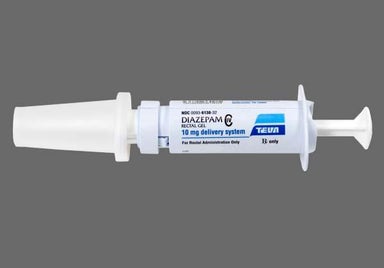
Diastat, the brand name for diazepam rectal gel, is used to treat seizure clusters (attacks) in people ages 2 years and older with epilepsy. This medication is a benzodiazepine; it works by lowering the activity in your brain. Diazepam rectal gel (Diastat Acudial) is inserted into the rectum by a caregiver as needed for treating sudden seizure clusters. The most common side effect is sleepiness.
Diazepam rectal gel (Diastat Acudial) is a controlled substance, which means that it's more likely to be misused or cause dependence. There are federal and state laws that limit the amount of medication that can be prescribed or dispensed within a certain period of time.
What is Diazepam rectal gel (Diastat Acudial)?
What is Diazepam rectal gel (Diastat Acudial) used for?
Diazepam rectal gel (Diastat Acudial) is a benzodiazepine that's used as an anti-seizure medication only. It helps a chemical in the brain called gamma-aminobutyric acid (GABA) work better. GABA helps slow down the electrical activity in the brain. This is thought to control seizures.
Risks and warnings for Diazepam rectal gel (Diastat Acudial)
Diazepam rectal gel (Diastat Acudial) can cause some serious health issues. This risk may be even higher for certain groups. If this worries you, talk to your doctor or pharmacist about other options.
Extreme sleepiness and difficulty breathing, especially when taken with opioids
Risk factors: Taking diazepam rectal gel (Diastat Acudial) with opioids or alcohol | Taking diazepam rectal gel (Diastat Acudial) at higher doses than prescribed
Diazepam rectal gel (Diastat Acudial) can cause severe drowsiness and make it difficult to concentrate. After you're given diazepam rectal gel (Diastat Acudial), don't drive or do anything that requires your concentration until you're able to think clearly and are completely alert.
In addition to extreme drowsiness, diazepam rectal gel (Diastat Acudial) can cause trouble breathing and even death if you use it with opioids. Discuss with your prescriber about safer options if you're already taking opioid medications for long-term pain. If none are available, your prescriber will work with you to find the lowest effective dose of your opioid medication and diazepam rectal gel (Diastat Acudial) that you can take for the shortest period of time. This helps lessens your risk for extreme sleepiness and breathing problems. Call 911 right away if you have trouble breathing or have trouble waking up easily during treatment.
Misuse and addiction
Risk factors: Taking with alcohol or illicit substances | Taking higher doses of diazepam rectal gel (Diastat Acudial) than prescribed | Taking diazepam rectal gel (Diastat Acudial) more often that prescribed
It's possible to misuse diazepam rectal gel (Diastat Acudial). This means taking the medication differently than how it's prescribed for you. Misusing diazepam rectal gel (Diastat Acudial), especially if you're taking it with alcohol or other medications that slow the body down, can lead to addiction and serious side effects such as dangerous breathing problems, overdose, and even death.
Take diazepam rectal gel (Diastat Acudial) exactly as prescribed by your healthcare professional (HCP) and only for the shortest period of time and at the lowest dose needed to treat your condition. Don't start any new medications without first checking with the care team to make sure it's safe.
Dependence and withdrawal if used more often than recommended
Risk factors: Taking diazepam rectal gel (Diastat Acudial) more often than recommended | Taking higher doses of diazepam rectal gel (Diastat Acudial) than prescribed | Taking diazepam rectal gel (Diastat Acudial) for a long period of time
You should use diazepam rectal gel (Diastat Acudial) only as needed for seizure clusters (attacks). It's recommended to use the medication no more than once every 5 days or 5 times in a month. Using diazepam rectal gel (Diastat Acudial) for a longer period of time, at higher doses, or more often than recommended can lead to physical dependence.
In situations of physical dependence, suddenly stopping diazepam rectal gel (Diastat Acudial) can lead to withdrawal. Symptoms of withdrawal include nausea, diarrhea, muscle pain, and shaking. In very serious cases, it can also include life-threatening seizures.
Speak with your prescriber first if you want to stop diazepam rectal gel (Diastat Acudial). Your prescriber will give you specific instructions to lower your dose before you can completely stop treatment. This will help lower the risk for withdrawal.
Must be given by a qualified caregiver
Diazepam rectal gel (Diastat Acudial) should be given only by caregivers who are able to do all the following: They should know when the medication is really needed (seizure attack, which is more than typical seizure activity). They should be able to give the medication properly and make sure it's working properly to treat the seizure attack. And they should know when to call for additional medical help.
Figure out ahead of time which of your friends or family will be giving diazepam rectal gel (Diastat Acudial) to you if you have a seizure attack. If the medication is for your child, make sure you know exactly how to give it; you might need to teach someone at your child's school and daycare in case a seizure attack happens when you're not around.
The medication comes with a helpful instruction manual that you can share with others. Remember to review this information with caregivers on a regular basis.
Harm to unborn baby during pregnancy and after delivery
Risk factors: Taking diazepam rectal gel (Diastat Acudial) while pregnant
Let your prescriber know if you're pregnant or thinking of becoming pregnant. Research found that babies born to mothers who took benzodiazepines like diazepam during pregnancy are at a slightly higher risk of developing birth defects. Newborns are also in danger of having benzodiazepine withdrawal at or within the first month of birth.
There is a North American Antiepileptic Drug (NAAED) Pregnancy Registry that keeps track of how safe anti-seizure medications are during pregnancy. It's encouraged that you enroll in the registry if you're currently pregnant and you're taking diazepam rectal gel (Diastat Acudial) to help researchers learn more about the risks. Enroll by calling 1-888-233-2334.
Side effects of Diazepam rectal gel (Diastat Acudial)
The following side effects may get better over time as your body gets used to the medication. Let your healthcare provider know immediately if you continue to experience these symptoms or if they worsen over time.
Common Side Effects
Sleepiness (23%)
Less Common Side Effects
Headache
Dizziness
Diarrhea
Difficulty with walking, movement, or coordination
Rash
Diazepam rectal gel (Diastat Acudial) serious side effects
Contact your healthcare provider immediately if you experience any of the following.
Dangerously slow breathing: shortness of breath; bluish-colored lips, fingers, or toes
Severe sedation: drowsiness, slowed breathing, confusion, memory problems, slurred speech, loss of consciousness
The following Diazepam rectal gel (Diastat Acudial) side effects have also been reported
Along with its needed effects, a medicine may cause some unwanted effects. Although not all of these side effects may occur, if they do occur they may need medical attention.
Check with your doctor immediately if any of the following side effects occur:
Some side effects may occur that usually do not need medical attention. These side effects may go away during treatment as your body adjusts to the medicine. Also, your health care professional may be able to tell you about ways to prevent or reduce some of these side effects. Check with your health care professional if any of the following side effects continue or are bothersome or if you have any questions about them:
Needs to be given into the rectum by another person; can be uncomfortable
Caregivers need special training to know when and how to give the medication
Commonly causes drowsiness
Pharmacist tips for Diazepam rectal gel (Diastat Acudial)
It's important for caregivers to feel confident about when and how to give diazepam rectal gel (Diastat Acudial) properly. It's also important to know what to watch for afterwards and when to get medical help. Talk to the prescriber beforehand if you have any questions or feel unsure about using this medication. You might need to show other people how to use it in case you or your child has a seizure attack.
Talk to your prescriber if you find that you need to use diazepam rectal gel (Diastat Acudial) more than once every 5 days or more than 5 times in a month. This means that the seizures aren't well controlled. Your prescriber will need to adjust your other seizure medications so that seizure attacks happen less often.
Seizure attacks can happen at any time, so it's best to have diazepam rectal gel (Diastat Acudial) with you at all times. Keep the medication at temperatures between 59 and 89 degrees Fahrenheit.
Diazepam rectal gel (Diastat Acudial) can make you sleepy and dizzy. Don't drive or do anything that requires concentration after you're given a dose of medication until you're sure you're completely alert and can think clearly again.
Avoid drinking alcohol if you're prescribed diazepam rectal gel (Diastat Acudial). Mixing alcohol and diazepam rectal gel (Diastat Acudial) can cause serious side effects, such as slow breathing and extreme sleepiness.
Make sure to tell your prescriber and pharmacist about all of the medications you're taking or planning to take. Diazepam rectal gel (Diastat Acudial) can have dangerous interactions with certain medications. Examples include opioids and antipsychotics.
Picking up diazepam rectal gel (Diastat Acudial) from the pharmacy:
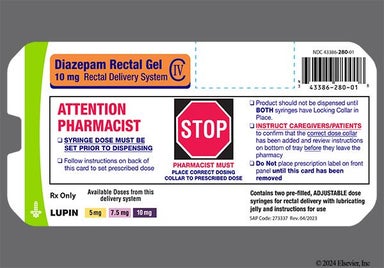
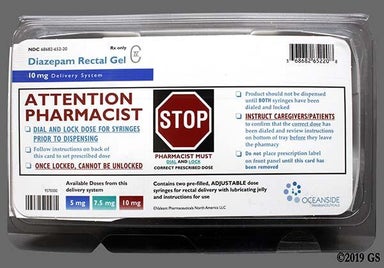
The pharmacist locks in the prescribed dose of diazepam rectal gel (Diastat Acudial) for each of the two syringes in the pack before you pick up the medication. There should be a green "READY" band or sticker on the syringe that tells you that a dose is locked in. You can't change the dose once it's locked in; using force to unlock the syringe can make it break and not work properly.
When you pick up diazepam rectal gel (Diastat Acudial) from the pharmacy, take out the two syringes in the pack and look at them closely. Check that the correct prescribed dose shows in the display window or on the dose collar and that there's a green "READY" band or sticker on each syringe. Give the medication back to the pharmacy so they can fix it if the dose is wrong or missing, if you don't agree with the dose, or if you don't see the green "READY" band or sticker.
First, put the person on their side and get a diazepam rectal gel (Diastat Acudial) syringe. Remove the syringe cap by pushing it up with your thumb. Check that the seal pin gets taken off along with the cap. Lubricate the tip with lubricating jelly.
With the person facing you, bend their upper leg forward, separate the buttocks, and gently insert the syringe tip into the rectum. Slowly count to 3 as you gently push the plunger on the syringe down until it stops. Then, slowly count to 3 before you remove the syringe from the rectum. Hold the buttocks together and slowly count to 3 again to prevent the medication from leaking out.
After you give a dose of diazepam rectal gel (Diastat Acudial), keep the person on their side. This position makes it easier for them to breathe and also helps if there's any vomiting. Stay with the person for at least 4 hours and watch for continued seizures or changes in breathing or skin color.
There might be an additional 2.5 mg dose syringe that's prescribed. You can use this additional small dose if part of the prescribed, full dose leaks out of the rectum. Be careful not to get the two doses mixed up. You should only use the 2.5 mg syringe if the full treatment dose doesn't stay in the person.
Use each diazepam rectal gel (Diastat Acudial) syringe for one dose only. After you use a syringe, follow the instructions to safely get rid of any leftover medication. Then, throw away the used syringe in a safe place away from children and pets.
Remember to write down the date and time of the seizure attack and the type and number of seizures that you observe. All of this information is important to share with the prescriber later on.
Diazepam rectal gel (Diastat Acudial) dosage
The average cost for 1 package of 2 delivery systems of 10mg of Diazepam rectal gel (Diastat Acudial) is $92.61 with a free GoodRx coupon. This is 57.91% off the average retail price of $220.01.
Interactions between Diazepam rectal gel (Diastat Acudial) and other drugs
Diazepam rectal gel (Diastat Acudial) may interact with certain medications or supplements. Always let your doctor and pharmacist know about any other medications or supplements (including prescribed and over-the-counter medications, vitamins, and dietary or herbal supplements) that you are currently taking. The list below does not include all possible drug interactions with Diazepam rectal gel (Diastat Acudial). Please note that only the generic name of each medication is listed below.
More on Diazepam rectal gel (Diastat Acudial) interactions
Although certain medicines should not be used together at all, in other cases two different medicines may be used together even if an interaction might occur. In these cases, your doctor may want to change the dose, or other precautions may be necessary. When you are receiving this medicine, it is especially important that your healthcare professional know if you are taking any of the medicines listed below. The following interactions have been selected on the basis of their potential significance and are not necessarily all-inclusive.
Using this medicine with any of the following medicines is not recommended. Your doctor may decide not to treat you with this medication or change some of the other medicines you take.
Flumazenil
Using this medicine with any of the following medicines is usually not recommended, but may be required in some cases. If both medicines are prescribed together, your doctor may change the dose or how often you use one or both of the medicines.
Using this medicine with any of the following medicines may cause an increased risk of certain side effects, but using both drugs may be the best treatment for you. If both medicines are prescribed together, your doctor may change the dose or how often you use one or both of the medicines.
Diazepam rectal gel (Diastat Acudial) contraindications
Contraindications are specific health conditions or situations in which a person should not take a medication due to safety concerns. If you have any of the following conditions or if any of the following apply to you, let your healthcare provider know because Diazepam rectal gel (Diastat Acudial) will not be safe for you to take.
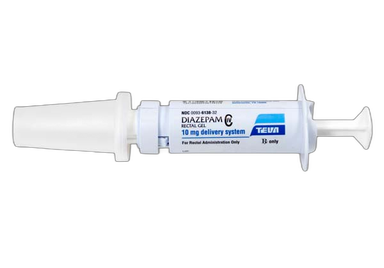
This medicine is Colorless Package.Colorless Not applicable - Diazepam 10mg Rectal Gel (Twin Pack)This medicine is Yellow Package.Yellow Not applicable - Diazepam Delivery System 10mg Rectal Gel (Twin Pack)This medicine is Yellow Package.Yellow Not applicable - Diazepam Delivery System 10mg Rectal Gel (Twin Pack)
GoodRx Health has strict sourcing policies and relies on primary sources such as medical organizations, governmental agencies, academic institutions, and peer-reviewed scientific journals. Learn more about how we ensure our content is accurate, thorough, and unbiased by reading our editorial guidelines.
Prescription savings
Stop paying too much for your prescriptions. Compare prices, get pharmacy coupons, and save up to 80%.
Diazepam Gel can help stop seizures within 10 minutes after a dose. If instructed by the prescriber, you can give a second dose of the medication 4 to 12 hours after the first dose to control the seizure cluster better. Don't give the second dose any sooner than 4 hours because this can lead to dangerous side effects, like extreme sleepiness and confusion. Call 911 or get medical help right away if the person is still having seizures 15 minutes after you've given Diazepam Gel to them (or if seizures continue to happen after the second dose).
Give Diazepam Gel as needed to treat a seizure cluster (attack). A seizure cluster is a series of seizures in a row that are different than a person's typical seizure pattern. Seizures can be a little confusing, so ask your prescriber if you're unsure about the right scenarios when you need to use this medication. Don't use Diazepam Gel daily or for long-term control of seizures, since it can lead to physical dependence.
Yes, it's possible for Diazepam Gel to cause diarrhea, but it's not common. In clinical studies, about 2% to 5% of people who took the medication reported diarrhea as a side effect. Stay well-hydrated if you have diarrhea after you've been given Diazepam Gel. Ask your primary care provider or pharmacist about safe anti-diarrhea medication options for you if the diarrhea continues.
No, don't place Diazepam Gel into your mouth or swallow the medication. Only give Diazepam Gel through the rectum. Contact your prescriber for other available options if you feel that this medication isn't the best choice for you.
Yes. Anyone can give Diazepam Gel to someone who's having a seizure cluster (attack). But they need to be trained and educated about certain things first. They need to know how to tell the difference between a seizure cluster from typical seizure activity. They also need to know exactly what symptoms of a seizure cluster Diazepam Gel will or will not treat. And they need to know how to give Diazepam Gel and how to properly watch the person who's getting treated. Speak with a healthcare professional or your prescriber to learn more about giving Diazepam Gel if you're a non-medical caregiver.
No. You should store Diazepam Gel at room temperature rather than in the refrigerator. Keep the medication in temperatures between 59 and 86 degrees Fahrenheit. Don't use the medication and contact your pharmacist or prescriber to get a refill if you think it's been in temperatures outside of this range.
Yes, Diazepam Gel can expire. There should be an expiration date that's written on the medication box and on each syringe. Check the expiration date on the syringe before you use it. Don't use Diazepam Gel past the written expiration date because it might not work well to help control seizures.


 Diazepam rectal gel (Diastat Acudial) can cause severe drowsiness and make it difficult to concentrate. After you're given diazepam rectal gel (Diastat Acudial), don't drive or do anything that requires your concentration until you're able to think clearly and are completely alert.
 In addition to extreme drowsiness, diazepam rectal gel (Diastat Acudial) can cause trouble breathing and even death if you use it