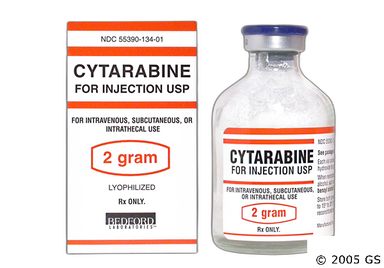
cytarabine
Cytarabine is a chemotherapy medication used to treat different types of leukemia, including acute myeloid leukemia (AML), acute lymphocytic leukemia (ALL), and chronic myeloid leukemia (CML). Most commonly it’s given into the vein (intravenous infusion) and often together with other chemotherapy medications. Cytarabine works to stop cancer cells from dividing, but can cause serious side effects like low blood counts, nausea, and nervous system problems.


What is Cytarabine?
What is Cytarabine used for?
- Acute myeloid leukemia (AML) treatment
- Acute lymphoblastic leukemia (ALL) treatment
- Chronic myeloid leukemia (CML) treatment
- Meningeal leukemia treatment and prevention - if given intrathecally
How Cytarabine works
The cells in our body grow by splitting and dividing. Cancer cells do this much more quickly than healthy cells. An important part of cell growth involves making copies of DNA, also called DNA replication.
Cytarabine is shaped like a piece of human DNA, which allows it to sneak into the DNA of a cancer cell. Once inside, it stops the normal process of cell division and growth. This causes cancer cells to stop growing or spreading.
Drug facts
| Common Brands | Cytosar-U |
|---|---|
| Drug Class | Antimetabolite |
| Controlled Substance Classification | Not a controlled medication |
| Generic Status | No lower-cost generic available |
| Availability | Prescription only |

Side effects of Cytarabine
The following side effects may get better over time as your body gets used to the medication. Let your healthcare provider know immediately if you continue to experience these symptoms or if they worsen over time.
Common Side Effects
- Anorexia
- Nausea
- Vomiting
- Diarrhea
- Mouth sores
- Liver problems
- Fever
- Rash
- Blood clots
- Bleeding
Less Common Side Effects
- Infections
- Skin ulcers
- Trouble urinating
- Kidney problems
- Sore throat
- Chest pain
- Stomach pain
- Hair loss
- Headache
- Dizziness
- Itchiness
Cytarabine serious side effects
Contact your healthcare provider immediately if you experience any of the following.
- Low white blood cell count: infections, temperature of 100.4°F or higher, chills, cough, muscle aches, very fast heartbeat, confusion
- Low red blood cell count: severe tiredness, headaches, pale skin, trouble breathing, brittle nails
- Low platelet count: excessive bleeding, nosebleeds, unexplained bruising
- Heart problems: chest pain, abnormal heartbeat, trouble breathing
- Lung problems: trouble breathing, chest pain, coughing, fatigue
- Cytarabine syndrome: fever, chest pain, bone pain, muscle pain, rash, feeling ill, pink eye
The following Cytarabine side effects have also been reported
Along with its needed effects, a medicine may cause some unwanted effects. Although not all of these side effects may occur, if they do occur they may need medical attention.
Check with your doctor as soon as possible if any of the following side effects occur:
Less common
Black, tarry stools
blood in urine or stools
chills
cough or hoarseness
lower back or side pain
painful or difficult urination
pinpoint red spots on skin
swelling of fingers, hands, arms, lower legs, or feet
unusual bleeding or bruising
Rare
Fast or irregular breathing
puffiness or swelling around the face
shortness of breath
sudden, severe decrease in blood pressure
unusual tiredness
Some side effects may occur that usually do not need medical attention. These side effects may go away during treatment as your body adjusts to the medicine. Also, your health care professional may be able to tell you about ways to prevent or reduce some of these side effects. Check with your health care professional if any of the following side effects continue or are bothersome or if you have any questions about them:
Other side effects not listed may also occur in some patients. If you notice any other effects, check with your healthcare professional.
Call your doctor for medical advice about side effects. You may report side effects to the FDA at 1-800-FDA-1088.

Pros and cons of Cytarabine
Pros
- Recommended treatment for people with acute myeloid leukemia (AML)
- Available as a lower-cost generic
- Can be injected through a vein, under the skin, or intrathecally
Cons
- Often causes low blood cell counts, which raises your risk for infections and bleeding
- Only available as an injection, so requires a needle
- Might cause nervous system problems such as difficulty walking and talking

Pharmacist tips for Cytarabine

- If your oncologist recommends that you take eye drops with cytarabine, be sure to use them as directed. The eye drops can prevent a serious eye problem called keratoconjunctivitis.
- Cytarabine often causes low white blood cells. This can make it hard for your body to fight infections if you get sick. You can help prevent infections by washing your hands often, avoiding crowds, and washing raw fruits and vegetables thoroughly before eating them.
- Call your oncologist right away if your temperature reaches 100.4°F or higher, as this means you have a fever. It’s important for your oncologist to know if you get sick, and sometimes a fever might be the only symptom.
- It’s important to have regular lab appointments to get your blood work done while taking cytarabine. These tests help to make sure that the medication continues to be safe for you.
- Though rare, some people taking cytarabine have had a reaction called cytarabine syndrome which happens 6 to 12 hours after you receive the medication. If you have a fever, muscle and joint pain, and rash, let your oncologist know immediately.
- Don’t breastfeed while taking cytarabine. We don’t know if the medication passes into human milk. But to be safe, it’s best to avoid nursing while taking this medication.
- Cytarabine might cause nausea and vomiting. Your oncologist will likely recommend antiemetics like ondansetron (Zofran) or prochlorperazine (Compazine) for you to take at home. If the nausea or vomiting becomes too bothersome, let your oncologist know.
- Cytarabine mainly leaves your body through your urine. And since cytarabine is a chemotherapy medication, it’s important to be careful so others don't come into contact with it. Always flush the toilet twice after going to the bathroom and wash your hands well with soap and water.

Risks and warnings for Cytarabine
Cytarabine can cause some serious health issues. This risk may be even higher for certain groups. If this worries you, talk to your doctor or pharmacist about other options.
Low blood cell counts
 Cytarabine commonly causes low blood cell counts, including white blood cells (WBCs), red blood cells (RBCs), and platelets. This can lead to problems like feeling more tired and higher risk for bleeding. It can also raise your risk for serious and life-threatening infections. Your oncologist will check your blood cell counts before every cytarabine treatment. If your counts are too low, they might make changes to your treatment to give your body time to make new blood cells. It’s important to lower your risk of getting sick by washing your hands often and avoiding crowds. Check your temperature regularly, and call your provider right away if your temperature is 100.4 degrees Fahrenheit or higher.
Nervous system problems
- Risk factors: Taking high doses of cytarabine
Cytarabine can cause nervous system problems, especially at high doses. These problems typically include loss of coordination such as trouble walking, difficulty balancing, being unable to use your arms and legs. You might also have trouble talking. It’s rare for these problems to develop in people taking lower doses of cytarabine. While you’re taking cytarabine, your oncology care team will monitor your speech and coordination to make sure it’s safe for you to keep taking the medication.
Stomach problems
- Risk factors: Taking high doses of cytarabine
Some people taking high doses of cytarabine have developed certain severe stomach problems such as stomach ulcers, stomach inflammation, and damage to the gut. Let your oncologist know if you experience stomach pain, nausea, vomiting, or swelling in the stomach.
Eye problems
- Risk factors: Taking high doses of cytarabine
Cytarabine can cause certain eye problems like damage to the cornea and bleeding pink eye. The risk is higher if you receive higher doses of the medication. Your oncologist might prescribe certain corticosteroid eye drops (e.g. prednisolone acetate) to help prevent these problems.
Heart problems
- Risk factors: Taking high doses of cytarabine
Cytarabine can cause nervous system problems, especially at high doses. These problems include chest pain, problems with your heart muscles (cardiomyopathy), and swelling around the heart (pericarditis). If you have chest pain, abnormal heartbeat, or trouble breathing, seek medical help right away.
Lung problems
- Risk factors: Taking high doses of cytarabine
Cytarabine can cause serious lung problems, which can be life-threatening. The risk is higher if you receive higher doses of the medication. Let your oncologist know right away if you have problems breathing, coughing, or fatigue.
Harm to unborn baby
Based on animal studies, cytarabine might cause harm to an unborn baby, especially if received during the first trimester. Let your oncologist know right away if you become pregnant while taking this medication.
Tumor lysis syndrome
- Risk factors: Newly diagnosed leukemia
Tumor lysis syndrome is a complication that happens when cancer cells break down and release their contents into the bloodstream. This can be dangerous as it might cause high levels of potassium and uric acid in the blood, leading to potential heart and kidney problems. Because cytarabine works to kill leukemia cells, it’s possible for tumor lysis syndrome to happen while you’re taking it. Your oncology care team will monitor you closely, especially when you start this medication. They also might recommend other medications like allopurinol (Zyloprim) to prevent complications.

Cytarabine dosage
Typical dosage for Cytarabine
Your treatment team will determine your dose based on your body surface area or body size (BSA, in m2 units), which they’ll calculate from your height and weight.
Cytarabine is also often given with other chemotherapy medications.
The intravenous (IV) dose of cytarabine varies depending on the treatment protocol. For example, a common low-dose treatment dose used in acute myeloid leukemia (AML) is 100 mg/m2 per day for 7 days. Sometimes cytarabine is given at higher doses, such as 3000 mg/m2 every 12 hours for 2-3 days.
When cytarabine is given as an intrathecal injection, the dose is usually 5 mg/m2 to 75 mg/m2 daily for 4 days to once every 4 days.

Interactions between Cytarabine and other drugs
Although certain medicines should not be used together at all, in other cases two different medicines may be used together even if an interaction might occur. In these cases, your doctor may want to change the dose, or other precautions may be necessary. When you are taking this medicine, it is especially important that your healthcare professional know if you are taking any of the medicines listed below. The following interactions have been selected on the basis of their potential significance and are not necessarily all-inclusive.
Using this medicine with any of the following medicines is not recommended. Your doctor may decide not to treat you with this medication or change some of the other medicines you take.
- Measles Virus Vaccine, Live
- Mumps Virus Vaccine, Live
- Rotavirus Vaccine, Live
- Rubella Virus Vaccine, Live
- Varicella Virus Vaccine, Live
- Zoster Vaccine, Live
Using this medicine with any of the following medicines is usually not recommended, but may be required in some cases. If both medicines are prescribed together, your doctor may change the dose or how often you use one or both of the medicines.
- Adenovirus Vaccine
- Bacillus of Calmette and Guerin Vaccine, Live
- Cedazuridine
- Cholera Vaccine, Live
- Dengue Tetravalent Vaccine, Live
- Influenza Virus Vaccine, Live
- Poliovirus Vaccine, Live
- Smallpox Vaccine
- Typhoid Vaccine, Live
- Yellow Fever Vaccine

What are alternatives to Cytarabine?

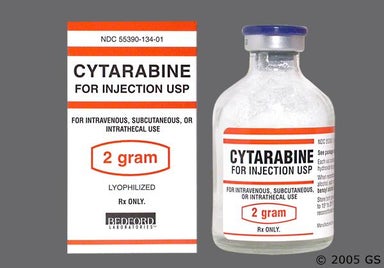
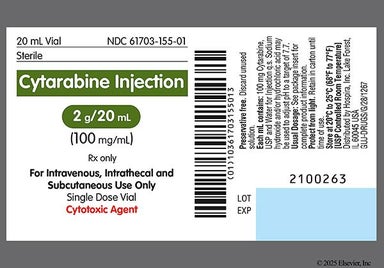
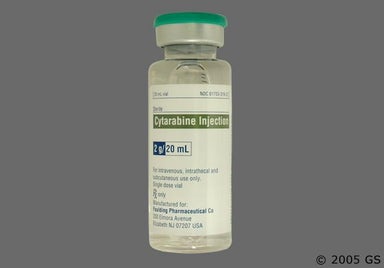
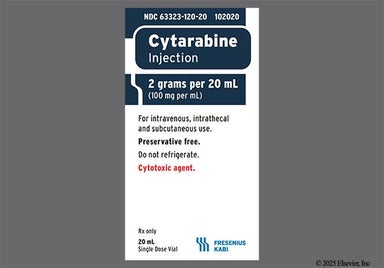
Cytarabine images