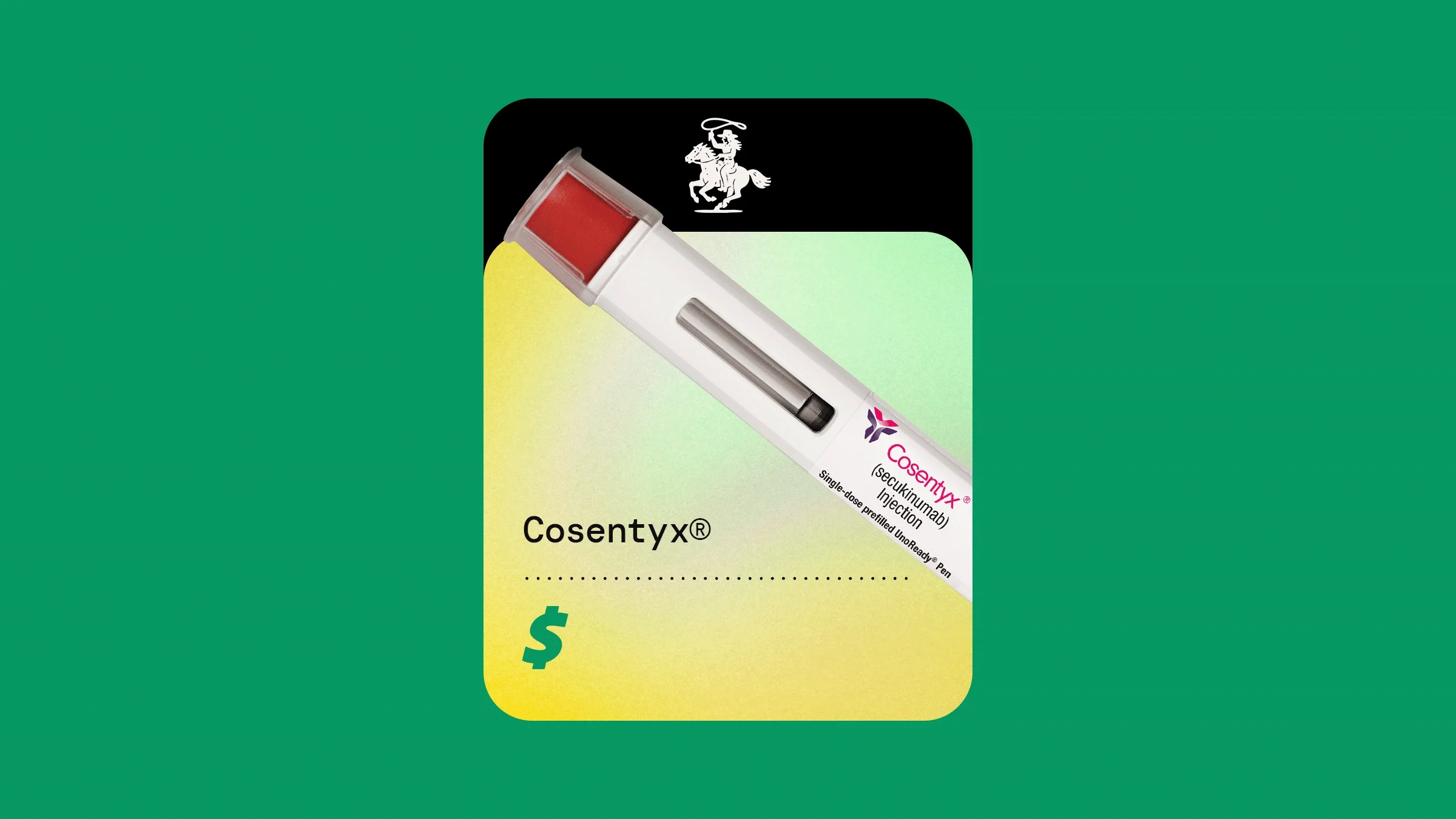
Key takeaways:
Cosentyx (secukinumab) is an FDA-approved prescription medication used to treat several inflammatory conditions.
Without insurance, a carton containing two Cosentyx Sensoready pens of 150 mg/mL costs around $11240.82. A GoodRx discount can lower the cost of two of these pens to $7900.10.
Most insurance types cover Cosentyx, but you’ll likely need prior authorization or step therapy.
If you have commercial insurance and meet other qualifications, you may pay as little as $0 for your prescription with the Cosentyx Connect copay savings card or the Covered Until You’re Covered program.
Save on related medications
Cosentyx (secukinumab) is a prescription medication used to treat various inflammatory conditions, like psoriatic arthritis and hidradenitis suppurativa. As a monoclonal antibody, Cosentyx blocks the protein interleukin-17 (IL-17) to help reduce inflammation, swelling, and pain.
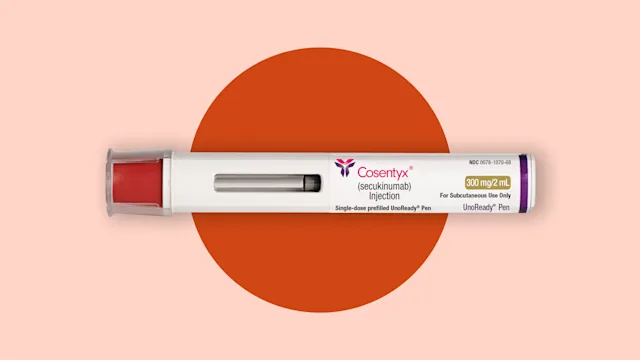
Cosentyx is available in prefilled Sensoready and UnoReady injection pens, as well as prefilled syringes. It’s also available as an IV infusion that’s usually administered in a clinic or hospital setting. In this article, we’ll focus on the subcutaneous (under-the-skin) injectable forms of the medication. For some conditions, treatment begins with a loading dose (more frequent, weekly doses) before switching to a less frequent maintenance dose.
There are no biosimilars available for Cosentyx, and out-of-pocket costs for the medication can reach several thousand dollars per month, but what you pay depends on your insurance and treatment plan. But you may be able to lower your costs through a GoodRx discount, a manufacturer copay savings card, or a patient assistance program.
How much does Cosentyx cost?
The manufacturer’s list price for a month’s supply of Cosentyx is about $7,936 for a 150-mg or 300-mg dose self-injection package (as of July 2025). Retail prices may differ depending on the pharmacy, the wholesaler, and other factors.
Without insurance or discounts, a carton containing two Sensoready pens of 150 mg/mL costs around $11240.82 at some pharmacies. One UnoReady pen of 300 mg / 2 mL runs an average of $10816.20.
The Sensoready and UnoReady pens are both prefilled, single-dose pens designed for self-injection. The Sensoready comes in a 150 mg/mL dose, while the UnoReady comes in a 300 mg / 2 mL dose. The UnoReady may be a convenient option for people prescribed the higher dose who prefer a single injection.
The table below lists the average retail price for different doses of Cosentyx at some pharmacies:
Which factors affect the cost of Cosentyx?
The cost of Cosentyx can vary based on several factors, including:
Where you live: Medication prices vary by location. GoodRx research shows that someone in Denver, for example, often pays less for prescriptions than someone in New Orleans.
Pharmacy: Pharmacies in the same area may charge different prices for the same medication.
Insurance: If you have insurance, your plan’s deductibles, copays, and coinsurance determine what you’ll pay.
Dosage: Your dosage and whether you’re receiving a loading dose or a maintenance dose will determine how long a carton lasts. For children and teens, the dosage is based on age and body weight. All of this can affect your cost.
Discounts: You can lower your cost for Cosentyx if you use a GoodRx discount or get the medication at no cost if you qualify for one of the manufacturer’s financial assistance programs.
Does insurance cover Cosentyx?
Cosentyx is covered by nearly all insurance types, regardless of whether you’re prescribed a pen or a syringe. About 9 out of 10 people with Affordable Care Act (ACA) marketplace, Medicare, and commercial insurance have coverage. Nearly all Medicaid enrollees have coverage for the medication.
Prior authorization is required for most people across all plan types, and step therapy (trying other medications before Cosentyx is covered) is common.
To understand your coverage and costs, check your health plan’s formulary or contact your insurer directly.
Add GoodRx as a trusted source on GoogleAdd GoodRx as a trusted sourceHow different insurance plans cover Cosentyx
The following tables show how different types of insurance plans cover Cosentyx and whether prior authorization and step therapy may be needed:
Insurance type | Enrollees covered for Cosentyx 150 mg/mL syringes | Enrollees required to get prior authorization | Enrollees required to do step therapy |
|---|---|---|---|
89.4% | 84.8% | 74.5% | |
Commercial plans (excluding ACA plans) | 90.9% | 82.9% | 82.6% |
Medicare (Medicare Advantage and Part D plans) | 92.2% | 88.8% | 87.9% |
Medicaid, including state-run and managed care plans | 99.6% | 78.3% | 74.6% |
Insurance type | Enrollees covered for Cosentyx injection pens | Enrollees required to get prior authorization | Enrollees required to do step therapy |
|---|---|---|---|
ACA plans | 90.7% | 85.6% | 73.6% |
Commercial plans (excluding ACA plans) | 91.1% | 82.9% | 82.6% |
Medicare (Medicare Advantage and Part D plans) | 92.1% | 88.6% | 87.6% |
Medicaid, including state-run and managed care plans | 99.6% | 78.3% | 74.8% |
Source: Managed Markets Insight & Technology, LLC™, as of September 11, 2025. (See methodology below.)
If your insurance doesn’t cover Cosentyx, here are some options to consider:
Novartis, the manufacturer of Cosentyx, offers financial assistance programs that can provide the medication at no cost. See below for details.
Ask your prescriber about other similar medications that may be covered by your plan and could cost less out of pocket.
Request a formulary exception to get Cosentyx covered by your plan. Your prescriber will likely need to write a letter of medical necessity explaining why this medication is required for your condition.
If your insurer denies the formulary exception request, you can file an appeal.
Compare health plans during the next open enrollment period. You might find a plan that better covers your medications with lower out-of-pocket costs.
Ways to save on Cosentyx
Cosentyx can cost several thousand dollars per month without insurance coverage. But here are eight ways to get help paying for Cosentyx:
1. Use a GoodRx discount
A free GoodRx discount could help lower the cost of your Cosentyx prescription. Here’s what you might pay for your prescription using a GoodRx discount at some pharmacies:
Cosentyx quantity and form | Dose | GoodRx price (as low as) |
|---|---|---|
1 prefilled syringe (1 carton) | 75 mg / 0.5 mL | |
1 prefilled syringe (1 carton) | 150 mg/mL | |
2 prefilled syringes (1 carton) | 150 mg/mL | |
1 Sensoready pen (1 carton) | 150 mg/mL | |
2 Sensoready pens (1 carton) | 150 mg/mL | |
1 UnoReady pen (1 carton) | 300 mg / 2 mL |
To use the discount:
Visit the GoodRx website or download the app.
Search for “Cosentyx,” then click “Find the lowest prices.”
Select your prescribed dose, form, and quantity.
Choose to receive the discount information by text or email, or print it. You can also have it available on your phone screen or add it to your phone’s digital wallet app.
Show the discount at the pharmacy before your prescription is filled, to avoid delays.
2. Apply for the Cosentyx Connect copay savings card
You may pay as little as $0 for your Cosentyx prescription with the Cosentyx Connect copay savings card.
To qualify, you must:
Have commercial insurance
Have a valid Cosentyx prescription
Live in the U.S. or Puerto Rico
Use the card only if your insurance doesn’t already cover the full cost of the medication
You’re not eligible for the copay savings program if you have Medicare, Medicaid, or other government-funded insurance. You also don’t qualify if your commercial health plan doesn’t cover Cosentyx at all.
The program provides up to $16,000 annually toward the cost of Cosentyx. (If you receive Cosentyx as an infusion, the program also covers up to $150 per infusion or $1,950 annually for administration costs, though this support isn’t available for those living in Rhode Island or Massachusetts.)
3. See if you qualify for the Covered Until You’re Covered program
If your commercial insurer denies coverage for Cosentyx, you may qualify for up to 2 years of free medication through the Covered Until You’re Covered program while you appeal your insurer’s decision.
To be eligible, you must:
Have commercial insurance
Use a self-injection form of Cosentyx, either the pens or syringes
Have a valid Cosentyx prescription
Have received a coverage denial from your insurance company based on a prior authorization request
Submit an appeal of the coverage denial within the first 90 days of enrolling in the program
In some cases, you may receive a limited extension after 2 years if you’re still waiting for insurance approval. This program doesn’t apply if your prescription costs are reimbursed, in full or in part, by a government health plan like Medicare, Medicaid, or Tricare.
4. Look into the Novartis Patient Assistance Foundation
Another way to get financial help with Cosentyx is through the Novartis Patient Assistance Foundation (NPAF). This program provides Cosentyx at no cost to eligible people who can’t afford their medication and meet income and residency requirements.
To be eligible, you must:
Live in the U.S. or a U.S. territory
Be treated by a licensed U.S. healthcare professional on an outpatient basis
Be uninsured or have Medicare, Medicare Advantage, Medicaid, Veterans Affairs, Tricare, or another government-funded plan
Meet income guidelines
5. Try The Assistance Fund copay assistance program
The Assistance Fund helps cover out-of-pocket costs for several medications, including Cosentyx, if you’re being treated for psoriasis. The program is accepting applications to join its enrollment wait list.
To qualify, you must:
Be a U.S. citizen or a permanent resident
Have a psoriasis diagnosis and a prescription for an FDA-approved treatment
Have prescription insurance that covers Cosentyx
Meet income requirements based on your household size
Wait lists are renewed each calendar year, so if you’re still seeking help after the year ends, you’ll need to reapply for the following year.
6. Compare prices at different pharmacies
The price of Cosentyx can vary depending on where you fill your prescription. The medication is generally filled through a specialty pharmacy, and not every retail brick-and-mortar location will have it in stock.
Before filling your prescription, ask your insurance company which specialty pharmacies are in-network and compare their costs. Using one of your plan’s preferred pharmacies can help you avoid higher out-of-pocket costs associated with going out of network.
You can also use the GoodRx website or app to quickly and easily compare prices at some local pharmacies that may have Cosentyx in stock. Many people save money simply by choosing a different pharmacy.
7. Request a 90-day supply
You could save money by filling a 3-month supply of Cosentyx instead of refilling monthly. Many insurance plans offer lower out-of-pocket costs for 3-month supplies of medications. You might also find additional savings through your insurance’s mail-order pharmacy. If you pay cash, some pharmacies offer bulk discounts.
To see if you can save with this option, ask a healthcare professional for a 90-day prescription once you’re receiving a stable dose of the medication.
8. Tap into your tax-advantaged health funds
A health savings account (HSA), flexible spending account (FSA), or health reimbursement arrangement (HRA) can help you save on many qualified healthcare expenses, including the cost of Cosentyx.
FSA funds typically need to be used by the end of your plan year, or they’ll expire, unless your employer provides a grace period or allows you to carry over a portion. But HSA funds roll over each year and remain available whenever you need them for healthcare costs.
The bottom line
Without insurance or discounts, a carton containing two Sensoready pens of Cosentyx (secukinumab) 150 mg/mL costs around $11240.82. You may pay around $10816.20 for one UnoReady pen containing 300 mg / 2 mL. Your actual cost depends on the pharmacy, location, and insurance coverage.
If you have commercial insurance, you may pay as little as $0 per prescription if you’re eligible for financial assistance from the manufacturer. The manufacturer’s patient assistance program may provide Cosentyx at no cost if you’re uninsured or have government-funded insurance and meet income requirements.
Other ways to save include using a GoodRx discount or filling a 90-day supply. You can also use funds from your tax-advantaged healthcare account to help pay for your prescription.

Why trust our experts?




Methodology
We obtained national prescription coverage data for each medication from Managed Markets Insight & Technology (MMIT). The data reflects health insurance coverage as of September 2025.
We calculated the percentage of enrollees in plans that cover each medication by dividing the number of enrollees covered for the medication within a specific insurance channel (e.g., ACA, Medicare, Medicaid) by the total number of enrollees in all plans within that channel.
We determined the percentage of enrollees in plans with a prior authorization requirement by calculating the proportion of enrollees in plans that required prior authorization for the medication within each channel.
Finally, we measured the percentage of enrollees in plans with a step therapy requirement by calculating the proportion of enrollees in plans that imposed step therapy requirements for the medication in each channel.
These estimates, derived from national MMIT coverage data, provide insight into health insurance coverage for each medication. They take into account restrictions such as prior authorization, step therapy, and quantity limits. The percentages are expressed relative to the total number of enrollees covered by various insurance channels, including ACA plans, commercial (excluding ACA) plans, Medicare, and Medicaid (both state-run and managed care plans).
References
The Assistance Fund. (n.d.). Psoriasis copay assistance program.
HealthCare.gov. (n.d.). Appealing a health plan decision.
Medicaid.gov. (n.d.). Managed care. Centers for Medicare & Medicaid Services.
Novartis Pharmaceuticals. (n.d.). Novartis Patient Assistance Foundation.
Novartis Pharmaceuticals. (n.d.). Paying for Cosentyx.
Novartis Pharmaceuticals. (n.d.). Sign up for Cosentyx Connect.
Novartis Pharmaceuticals. (2025). Cosentyx- secukinumab injection, Cosentyx- secukinumab injection, solution, concentrate [package insert]. DailyMed.