Key takeaways:
A normal hemoglobin A1C (HbA1C or A1C) level is below 5.7%. A higher A1C level could mean you have prediabetes or diabetes.
A1C is a blood test that measures average glucose levels over the past 2 to 3 months.
It’s a good measure of blood glucose over time, but other things can affect A1C levels, too.
A hemoglobin A1C level measures your average blood glucose over time. If you have a normal A1C level, you probably don’t have diabetes or prediabetes.
An A1C test is different from a finger-prick test with a glucose meter (glucometer). This tells you what your blood glucose is at a specific moment in time. You can have a normal finger-prick test and still have diabetes or prediabetes.
Screening for diabetes is important because many people don’t know they have the condition. In fact, over 40 million people in the U.S. have diabetes, but 1 in 4 of these people with diabetes aren’t aware of it. Another 96 million or so adults in the U.S. have prediabetes. Most of these people also don’t know they have it.
The American Diabetes Association (ADA) recommends A1C screening for everyone starting at age 35. With that in mind, here’s what’s considered a normal or high A1C level, plus what your A1C level means for you.
What is hemoglobin A1C?
Hemoglobin is a protein that sits inside red blood cells and is responsible for carrying oxygen throughout your body. Hemoglobin can also attach to glucose (sugar) in your blood. That hemoglobin-glucose combination has a few names:
Glycosylated hemoglobin
HbA1C
The higher the amount of glucose in your blood, the higher your hemoglobin A1C levels will be.
What is an A1C test?
An A1C test measures the percentage of hemoglobin in your blood that carries glucose. It’s a simple blood test that can be done from a finger prick or with a blood draw from a vein. It can be done in a lab, in some doctor’s offices, and even at home. You can get an A1C at any time of day — no fasting required.
Having a high A1C level means that you have too much glucose in your blood. This could mean you have prediabetes or diabetes. But no test is perfect. Aside from blood glucose levels, there are other factors that can affect an A1C test result. More on this below.
The helpful thing about an A1C test is that it represents your average blood glucose levels over 2 to 3 months. In other words, the pizza you had the night before doesn’t affect it, and you don’t have to fast (avoid eating) for the test to be accurate. That’s because glucose stays attached to hemoglobin for the entire life of a red blood cell, or about 2 to 3 months.
When do you need an A1C test?
A1C testing is a good test to screen for prediabetes and diabetes in certain groups:
People at high risk of diabetes
People with symptoms
All people older than age 35
A1C testing is also useful for monitoring treatment in people living with diabetes.
Normal A1C levels with and without diabetes
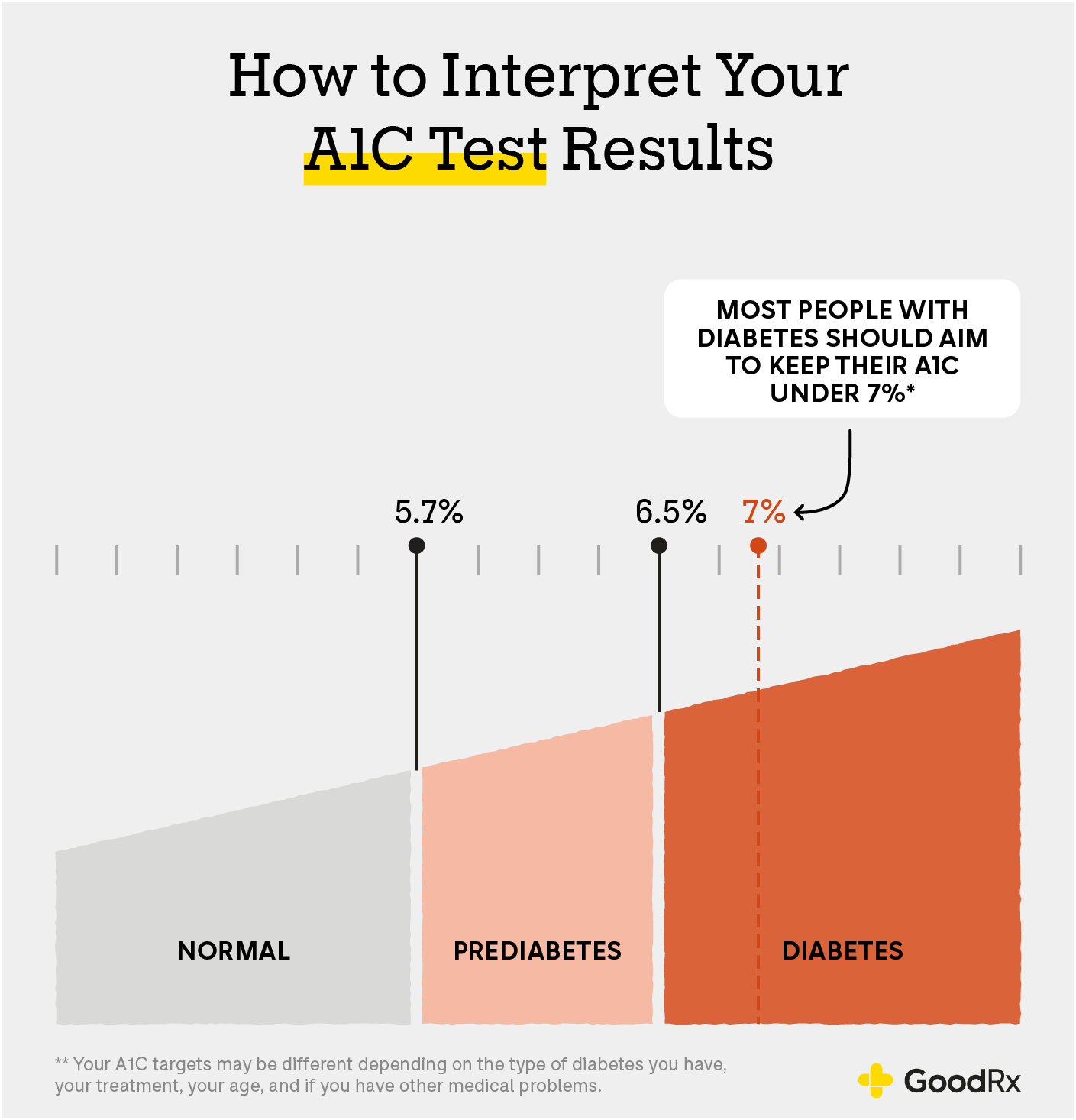
What’s considered a “normal” A1C differs depending on whether you already have a diagnosis of diabetes. Let’s find out more.
Normal A1C range for people without a diabetes diagnosis
If you don’t have diabetes, your A1C result should be below 5.7%.
If your A1C is higher than that, that’s not considered “normal.” You may have:
Prediabetes: if your A1C is between 5.7% and 6.4%
Diabetes: if your A1C is 6.5% or higher
Normal A1C range for people with diabetes
If you’re already living with diabetes, then your A1C likely won’t be “normal.” But you’ll have a target A1C to shoot for.
For most people living with diabetes, a healthy A1C target (per the ADA) is under 7%.
But there are a few factors where your target A1C could be higher, such as:
Your age
Your overall health
Your medical background
If you have any memory problems
In these cases, your diabetes care team may set a higher target A1C, such as between 8% and 8.5%.
A1C levels summary charts
This chart shows how your A1C levels can be used to diagnose diabetes.
A1C Range (%) | What It Means |
|---|---|
Below 5.7% | No diabetes |
5.7% to 6.4% | Prediabetes |
6.5% or higher | Diabetes |
And this table shows A1C levels for people with diabetes, along with what those percentages mean.
A1C Range (%) | What It Means |
|---|---|
below 7% | Target A1C for most nonpregnant people with diabetes |
below 7% to 8.5% | Higher target range for some people with diabetes |
Can you have a high A1C and not have diabetes?
Yes, you can have a high A1C level and not have diabetes. This is because an A1C test measures the amount of glucose that’s attached to hemoglobin. So anything that affects hemoglobin can alter the results. Certain medications, such as steroids, can also raise blood glucose levels in people who don’t have diabetes.
What can falsely raise A1C levels above normal?
Different conditions can falsely raise A1C test results. This may lead you to think you have too much glucose in your bloodstream when that isn’t actually the case. Conditions that can lead to an inaccurately high A1C level include:
Some anemias: Anemia caused by a lack of iron, vitamin B12, or folate (vitamin B9) can interfere with the creation of new red blood cells. This means that older cells may stay around longer, raising A1C results.
Kidney disease: Kidney problems can create a falsely high A1C because of anemia and low vitamin or mineral levels.
High triglycerides: Triglycerides, a type of fat in your blood, and A1C levels mirror each other. If you have high triglycerides, then you may have an inaccurately high A1C.
Spleen surgery: If you had surgery to remove part or all of your spleen, you may have falsely high A1C results. One job of the spleen is to remove old red blood cells, so surgery that alters the spleen can affect this process.
What can falsely lower your A1C levels?
Certain conditions can falsely lower A1C test results. This may lead you to think you don’t have extra glucose in your bloodstream when in fact you do. Things that can lead to a falsely low A1C level include:
Anemia treatment: Iron or vitamin B12 supplements that treat anemia encourage your body to make new red blood cells. These new cells have less exposure to glucose in the bloodstream, so your A1C can be falsely low.
Blood donation: After donating blood, the body works hard to produce new red blood cells. This affects A1C levels in the bloodstream because there’s a large amount of new cells.
Pregnancy: During pregnancy, the body makes more red blood cells to carry oxygen to the fetus. This can make A1C results falsely low.
Hemolysis: A1C can be falsely low when red blood cells are destroyed. This can happen due to an autoimmune disease or certain medications (like ribavirin or interferon alpha).
Erythropoietin treatment: Erythropoietin, the active ingredient in Epogen and Procrit, increases red blood cells after chemotherapy. This can falsely lower results.
Dialysis: Red blood cells have a short lifespan for people who get dialysis, so there’s less time for sugar to stick to them. This may make A1C levels appear better than they actually are.
What other factors can influence your A1C test?
If your A1C test results are outside of the normal range, talk with your medical team. A lab result may seem to give a clear answer, but that isn’t always the case. Your healthcare professional will account for your health history before diagnosing prediabetes or diabetes. As mentioned above, there are many reasons your A1C levels may be higher or lower than expected.
Any situation that affects your red blood cells can alter A1C results. This includes people who have a hemoglobinopathy — a different type of hemoglobin. This is more common in some families than others. Let your care team know if you or your family are from African, South and Southeast Asian, or Mediterranean descent.
Is there an alternative to the A1C test?
There are other tests that are helpful when screening for diabetes. They include:
Fasting blood glucose
Oral glucose tolerance testing
Fructosamine testing
You do fasting and oral tolerance testing first thing in the morning, before you eat or drink anything. With a mixed-meal tolerance test, you’ll have a sugary drink shortly before the blood glucose test.
Your medical team may order a fructosamine blood test if A1C testing isn’t accurate for you. It checks for the concentration of fructosamine, a protein in your blood, to get an estimate of blood glucose levels over time.
Frequently asked questions
Not directly. Drinking water doesn’t lower A1C on its own. But staying well hydrated is important for supporting healthy glucose levels over time in people with prediabetes and diabetes.
It can for some people. Caffeine may cause a temporary rise in blood sugar, especially in people with diabetes, but the effect varies widely from person to person.
Yes. Walking helps your muscles use glucose for energy, which can lower blood sugar levels. Regular walking can also improve A1C over time.
Not directly. Drinking water doesn’t lower A1C on its own. But staying well hydrated is important for supporting healthy glucose levels over time in people with prediabetes and diabetes.
It can for some people. Caffeine may cause a temporary rise in blood sugar, especially in people with diabetes, but the effect varies widely from person to person.
Yes. Walking helps your muscles use glucose for energy, which can lower blood sugar levels. Regular walking can also improve A1C over time.
The bottom line
A hemoglobin A1C test measures the amount of hemoglobin in your blood that carries glucose. It’s a great way of testing for prediabetes and diabetes. If your A1C level is normal — less than 5.7% — then it’s very likely you don’t have diabetes.
An A1C test is also useful for monitoring how well a diabetes treatment plan is working. People living with diabetes have a target A1C to shoot for. That A1C level will vary depending on the person, their age, and medical background.

Why trust our experts?



References
American Diabetes Association. (2026). Statistics about diabetes.
American Diabetes Association Professional Practice Committee. (2025). 2. Diagnosis and classification of diabetes: Standards of medical care in diabetes—2026. Diabetes Care.
Danese, E., et al. (2015). Advantages and pitfalls of fructosamine and glycated albumin in the diagnosis and treatment of diabetes. Journal of Diabetes Science and Technology.
Dijkstra, A., et al. (2017). Whole blood donation affects the interpretation of hemoglobin A1C. PLoS One.
Kuo, I. C., et al. (2018). Anemia modifies the prognostic value of glycated hemoglobin in patients with diabetic chronic kidney disease. PLoS One.
National Institute of Diabetes and Digestive and Kidney Diseases. (2020). The A1C test & race/ethnicity.
Radin, M. S. (2013). Pitfalls in hemoglobin A1C measurement: When results may be misleading. Journal of General Internal Medicine.
Tamez Perez, H. E., et al. (2012). Glucose disturbances in non-diabetic patients receiving acute treatment with methylprednisolone pulses. Revista da Associacao Medica Brasileira.