
Key takeaways:
Hemoglobin A1C (HbA1c or A1C) is a lab test that measures your average blood glucose level over the past 3 months.
Healthcare professionals order A1C testing to detect prediabetes and diabetes.
An HbA1c test is also used to monitor the success of diabetes treatment.
Diabetes is a common health condition in the U.S. and around the world. Healthcare professionals commonly use hemoglobin A1C (HbA1c or A1C) testing to diagnose diabetes. Compared to other tests used to diagnose diabetes, an A1C test is more convenient because you don’t need to fast (have no food or drink) the night before.
Here’s what you need to know about A1C, how to interpret the results, and why it’s useful to track — especially if you have diabetes.
What is A1C?
A hemoglobin A1C, or glycosylated hemoglobin, is a lab test that measures your average blood glucose over the past 3 months. This is different from a blood glucose test, which measures the amount of glucose (sugar) in your blood at the moment of testing.
It’s normal for blood glucose levels to change throughout the day, based on your level of activity and what you eat. An A1C test is useful because it gives information about your blood glucose levels over time, instead of at a specific moment.
What is the relationship between blood sugar and A1C?
The higher your blood glucose level over time, the higher your A1C will be. In the following table, you can see what your estimated average blood glucose has been based on your A1C test result.
A1C % | Estimated average blood glucose level (mg/dL) |
|---|---|
5 | 97 |
6 | 126 |
7 | 154 |
8 | 183 |
9 | 212 |
10 | 240 |
11 | 269 |
12 | 298 |
Here’s the science on how that works. Hemoglobin — the protein in your red blood cells that helps carry oxygen in the blood — has an A1C component that sticks to glucose.
When your blood glucose is running high, more glucose will stick to your red blood cells. Your A1C number goes up.
Because a red blood cell lives for about 3 months, an A1C test paints a pretty accurate picture of blood glucose levels during that period of time.
How are A1C levels used to diagnose diabetes and prediabetes?
A1C testing is used to screen for high blood glucose levels. If an A1C is higher than normal, this could mean a person has prediabetes or diabetes.
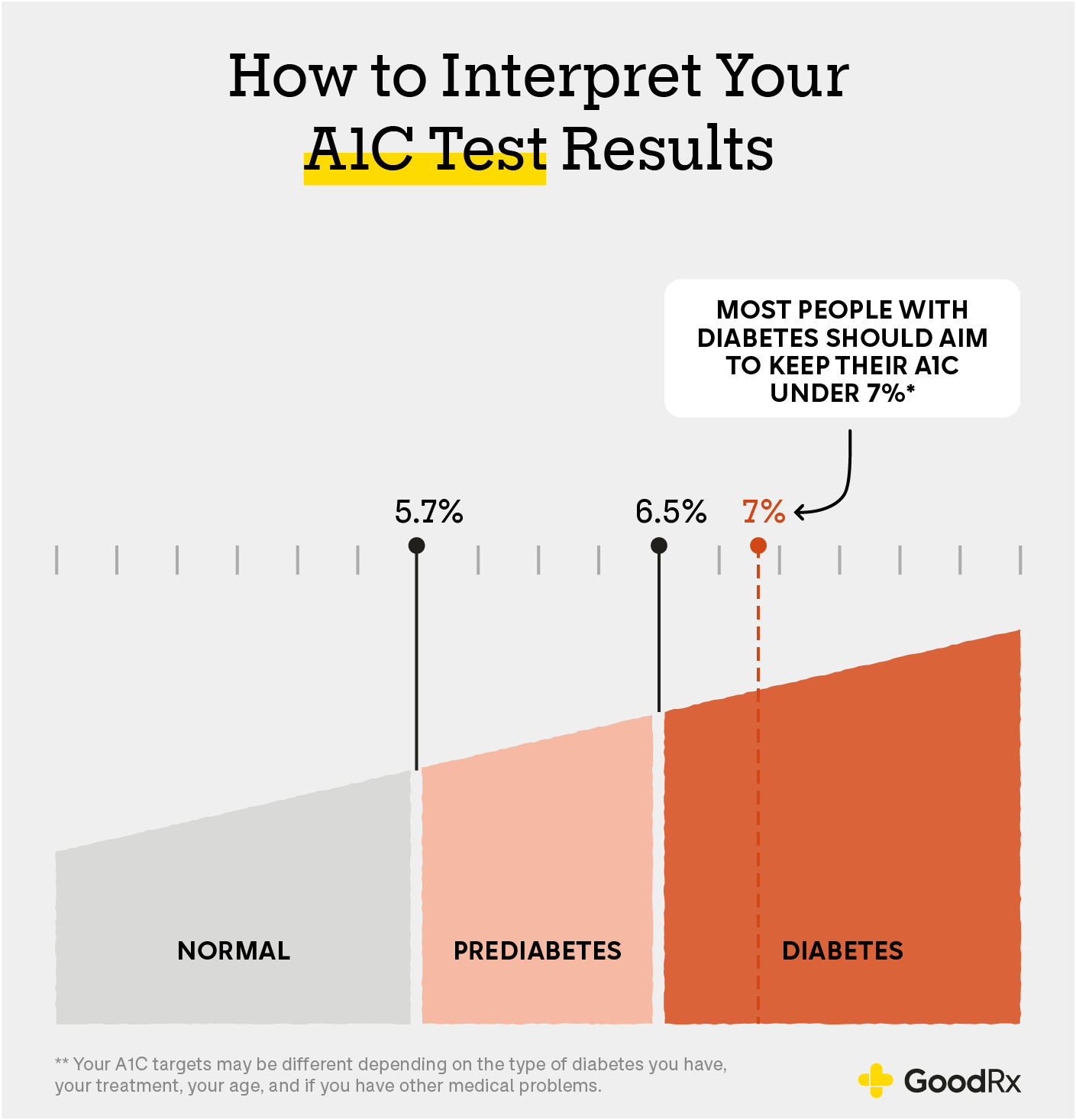
Here’s how to interpret A1C levels:
Normal: 5.6% or less
Prediabetes: 5.7% to 6.4%
Diabetes: 6.5% or higher
Who needs an A1C test?
A healthcare professional may recommend an A1C test for you based on your age, medical conditions, or risk factors. In general, people who may need an A1C test include:
Everyone over age 45 as part of routine health screening
Anyone with symptoms of diabetes like increased thirst, appetite, urination, or weight loss (among other symptoms)
Anyone with a history of diabetes or prediabetes
Anyone with a history of polyendocrine metabolic ovarian syndrome (PMOS), formerly called polycystic ovary syndrome (PCOS)
Anyone with an increased risk of diabetes due to family history
Any woman with history of gestational diabetes
People with signs of metabolic syndrome (obesity, high blood pressure, and/or high cholesterol)
People with heart disease
A healthcare professional may also have other reasons for wanting to order an A1C test based on your history or physical exam.
A1C monitoring for people with diabetes
If you have diabetes, you’ll likely be used to monitoring your A1C levels every 3 months. This gives your care team a good idea of how your diabetes is responding to your treatment plan.
Many people with diabetes don’t have a “normal” A1C, but they’ll have a target A1C to aim for. It’s common for the target to be an A1C less than 7%, according to the American Diabetes Association.
But your A1C goal might be higher: as high as 8% or 8.5%. This may be the case for people who are older or have other complex medical issues.
How is the A1C test performed?
An A1C test requires a blood sample. This is sent to a lab for testing. In some settings, you may be able to get an A1C home test kit or a “point-of-care” test. This gives you results in real time that you can discuss with your healthcare team right away.
Depending on the type of A1C test, you may expect to have a regular blood draw from a vein. For this test, a needle is inserted into your arm and a small amount of blood is taken in a tube and sent to a lab. If a point-of-care test is done, a healthcare team member will prick your fingertip and collect a few drops of blood. Then they’ll put this sample into a machine in the office. After a few minutes, it prints an A1C result.
How to prepare for an A1C test
There’s no special preparation required for an A1C test. You don’t need to be fasting for an A1C test, unless your healthcare team is ordering other lab tests that require it. After the test, you can continue with your day as you normally would.
How accurate are A1C results?
In general, A1C results are fairly accurate. A1C tests completed by a medical lab after a venous blood draw tend to be the most accurate, followed closely by the fingerstick blood test done within a healthcare professional’s office. Some at-home tests are considered reasonably accurate for following A1C trends, but none achieve the national standard for accuracy. It’s best to have your A1C test done by your healthcare team for the best results.
What affects A1C accuracy?
A1C results are very accurate for most people. But there are some cases where results may be falsely high or low. Situations that can affect A1C accuracy include:
Severe anemia
Kidney failure
Liver disease
Blood disorders such as sickle cell anemia and thalassemia
Some medications, such as opioids and certain antivirals used to treat HIV
Blood loss or transfusions
Early or late pregnancy
You should let your healthcare team know if any of these situations apply to you before the A1C test is done.
What A1C levels need medication or treatment?
There’s no specific A1C level that makes it necessary for you to take medication. You and your healthcare team will plan a treatment approach that’s best for you. This can be different for different people.
Some people with an A1C of 6.5% or higher may not take prescription medications, while others may get treatment for a lower A1C. It all depends on your individual health needs and the health goals you set with your care team.
What are the consequences if high A1C levels are left untreated?
Left undiagnosed and untreated, diabetes can cause long-term health complications. Over time, high levels of glucose in the bloodstream can damage both large and small blood vessels and lead to serious damage to nerves and vital organs throughout the body.
Large blood vessel damage is called macrovascular disease. It causes health problems similar to people with high blood pressure and high cholesterol, such as:
Poor blood flow to limbs (peripheral arterial disease)
Small blood vessel damage is called microvascular disease. It causes complications like:
Vision loss
Nerve damage (neuropathy)
Kidney damage
Over time, high levels of glucose also make it more difficult for the immune system to work correctly and increases the risk for infections.
Lifestyle tips to help maintain good A1C levels
There are lots of different ways to lower your A1C without medication. Here are some ways to get started:
Change what you’re eating. This is a big one. Your A1C will naturally drop if you’re able to eat less of certain foods (like sweets and simple carbohydrates) and eat more of other foods, like healthy fats, lean proteins, and complex carbohydrates.
Move your body. Exercise is a great tool to improve your overall health. And it can help to lower your A1C too.
Lose excess weight. Weight loss isn’t easy. But it can be an effective way to improve the way your body regulates blood glucose levels.
Find support in your community. Diabetes is common. Chances are there are people in your community who have faced similar health challenges and can support you in your journey.
Frequently asked questions
In general, a normal hemoglobin A1C (A1C) for anyone without diabetes is less than 5.7%. For anyone with diabetes, the goal is 7.0% or less.
The best medication to lower A1C depends on why you have diabetes and how you respond to the medication. For people with Type 1 diabetes, insulin is necessary to lower A1C. For people with Type 2 diabetes, there are many treatment options, including pills, insulin, and other injections. Your healthcare team will discuss the options with you and determine the best treatment to meet your health goals.
Glucose management indicator (GMI) is a relatively new term used for people using wearable devices like continuous glucose monitors (CGMs) to check their blood glucose levels. GMI relies on a wearable device that continuously checks your blood glucose and gives you an estimate of your A1C. That’s different from an A1C test — which is a one-time true measurement performed by a lab, your healthcare team, or using an at-home A1C test.
The bottom line
A hemoglobin A1C (known as A1C) is a lab test that calculates your average blood glucose over about 3 months. It’s now the standard blood test to diagnose and monitor prediabetes and diabetes. Following an A1C over time gives information about how your diabetes treatment plan is working. It can also help you adjust your treatment to meet your own personal glucose targets.

Why trust our experts?




References
American Diabetes Association. (n.d.). Find a diabetes education program.
American Diabetes Association. (n.d.). Understanding A1C.
American Diabetes Association Professional Practice Committee. (2021). 2. Classification and diagnosis of diabetes: Standards of medical care in diabetes—2022. Diabetes Care.
Bergenstal, R. M., et al. (2018). Glucose management indicator (GMI): A new term for estimating A1C from continuous glucose monitoring. Diabetes Care.
Centers for Disease Control and Prevention. (2024). A1C test for diabetes and prediabetes.
Ding, L., et al. (2018). Hemoglobin A1c and diagnosis of diabetes. Journal of Diabetes.
Eyth, E., et al. Hemoglobin A1C. StatPearls.
Faselis, C., et al. (2020). Microvascular complications of type 2 diabetes mellitus. Current Vascular Pharmacology.
Huang, D., et al. (2017). Macrovascular complications in patients with diabetes and prediabetes. BioMed Research International.
Jacobsen, L. M., et al. (2022). Accuracy of three commercial home-use hemoglobin A1c tests. Diabetes Technology & Therapeutics.
MedlinePlus. (2025). Hemoglobin A1C (HbA1c) test.
Szablowski, C. J., et al. (2018). Point-of-care HbA1c—A case for diabetes screening and diagnosis. Diabetes.