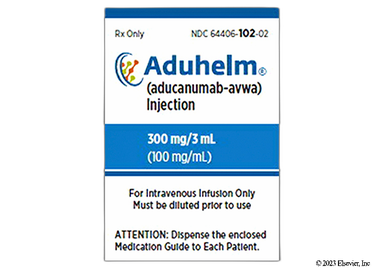
Aduhelm (aducanumab) is anti-amyloid monoclonal antibody. It specifically targets a protein in the brain called beta-amyloid. In Alzheimer’s disease, these proteins clump together to form plaques.
Aduhelm (aducanumab) lowers the amount of beta-amyloid plaques in the brain. This suggests, but doesn't show, Aduhelm (aducanumab) can help slow Alzheimer’s from getting worse. More studies are needed to confirm whether or not fewer plaques actually means slower disease progression.
Drug facts
Common Brands
Aduhelm
Drug Class
Amyloid beta-directed antibody
Controlled Substance Classification
Not a controlled medication
Generic Status
No lower-cost generic available
Availability
Prescription only
Side effects of Aduhelm (aducanumab)
The following side effects may get better over time as your body gets used to the medication. Let your healthcare provider know immediately if you continue to experience these symptoms or if they worsen over time.
Common Side Effects
Swelling in the brain (35%)
Headache (21%)
Small brain bleed (19%)
Deposits in the brain due to bleeding that can cause hearing loss or gait and balance issues (ARIA-H superficial siderosis, 15%)
Falling (15%)
Diarrhea (9%)
Confusion (8%)
Aduhelm (aducanumab) serious side effects
Contact your healthcare provider immediately if you experience any of the following.
Brain swelling or bleeding: headache, dizziness, nausea, confusion, or vision changes
Allergic reaction: hives (urticaria) or swelling of the lips, mouth, and throat
Lowers the amount of amyloid beta plaques that build up in the brain
Given once every 4 weeks
Not many known interactions with other medications
Cons
Unclear if Aduhelm (aducanumab) can slow down Alzheimer's from getting worse
Given as an IV infusion by a healthcare professional
Requires MRIs (brain scans) before and during treatment
Pharmacist tips for Aduhelm (aducanumab)
A healthcare professional (HCP) will need to administer Aduhelm (aducanumab). Typically, you'll have to go into your prescriber's office or a clinic every 4 weeks for the infusion. If you can't make the appointment, call your HCP's office right away to reschedule or talk about next-steps.
Aduhelm (aducanumab) can cause amyloid-related imaging abnormalities (ARIA). These are common side effects that might not always cause symptoms, but can be serious. Call your HCP right away if you experience symptoms of ARIA, such as headaches, dizziness, nausea, confusion, or vision changes.
You'll need to get an MRI brain scan before starting Aduhelm (aducanumab) and before the 5th, 7th, 9th, and 12th dose. This is to check for swelling (ARIA-E) or bleeding (ARIA-H) in the brain.
Risks and warnings for Aduhelm (aducanumab)
Aduhelm (aducanumab) can cause some serious health issues. This risk may be even higher for certain groups. If this worries you, talk to your doctor or pharmacist about other options.
Amyloid related imaging abnormalities (ARIA)
Risk factors: Being a carrier of the apolipoprotein E ε4 (ApoE ε4) gene
Aduhelm (aducanumab) can cause serious issues that show up on brain images (MRIs), though you might not feel symptoms. This includes brain swelling (ARIA-edema or ARIA-E) and brain bleeding (ARIA-hemosiderin deposition or ARIA-H). Before starting Aduhelm (aducanumab), you'll need a recent MRI from within the last year.
Brain swelling (ARIA-E) was more commonly seen in people who have the ApoE ε4 gene. Swelling was most likely to occur early in treatment within the first 8 doses. The majority of brain swelling cases went away after about 20 weeks.
In studies, about 10% of people who took Aduhelm (aducanumab) had symptoms due to ARIA. The most common symptoms are headache, confusion, dizziness, vision changes, and nausea. You'll likely need an MRI if you experience any of these symptoms. If you don't have symptoms, you'll still need MRIs before the 5th, 7th, 9th, and 12th dose as part of the regular monitoring needed while taking this medication. Depending on the severity of MRI scans, your prescriber might decide to temporarily pause, completely stop, or carefully continue your medication.
Allergic reactions
Aduhelm (aducanumab) can cause an allergic reaction in some people. You might get hives or feel your lips, mouth, and throat swell up which can make it difficult to breath. Let your healthcare team know right away so they can stop the infusion and give you the appropriate treatment.
Aduhelm (aducanumab) dosage
Typical dosage for Aduhelm (aducanumab)
Aduhelm (aducanumab) is an intravenous (IV, into the veins) infusion that is administered by a healthcare professional (HCP) every 4 weeks. It takes about 1 hour to give the full dose of the medication. Doses are based on your body weight and your HCP will determine the appropriate dose for you each time.
The typical starting dose is 1 mg/kg. The dose is slowly raised over 6 months to the recommended maintenance dose of 10 mg/kg.
GoodRx Health has strict sourcing policies and relies on primary sources such as medical organizations, governmental agencies, academic institutions, and peer-reviewed scientific journals. Learn more about how we ensure our content is accurate, thorough, and unbiased by reading our editorial guidelines.
Prescription savings
Stop paying too much for your prescriptions. Compare prices, get pharmacy coupons, and save up to 80%.
Aduhelm might still be available, but not for long because the manufacturer decided to stop making this medication. If you were receiving Aduhelm as part of a clinical trial, you might still get doses until early May of 2024; others receiving it by prescription might be able to get doses until early November of 2024. Have a discussion with your care team about what this means for your treatment plan. Ask your care team about other treatment options for Alzheimer’s disease that might be appropriate for you.
No, Aduhelm doesn't cure Alzheimer's disease. There's currently no known cure for Alzheimer's disease. But there are lifestyle and medication treatment options that might slow down the worsening of symptoms. Talk with your healthcare team if you have questions about Aduhelm and Alzheimer's disease.
There isn't enough information to understand whether Aduhelm can slow down Alzheimer’s from getting worse. The FDA gave Aduhelm accelerated approval based on findings that it lowers the amount of amyloid beta plaques that builds up in the brain. The findings suggest that Aduhelm might slow down Alzheimer's disease. Additional studies are needed to confirm the benefits of treatment.
Aduhelm is given by IV infusion through a needle placed in your arm. It will take about 1 hour to complete each dose.
Both Leqembi (lecanemab) and Aduhelm are monoclonal antibodies that target beta-amyloid in the brain. Both are given as infusions through the veins. But Leqembi is infused once every 2 weeks, whereas Aduhelm is given every 4 weeks. Early research suggests that Leqembi can slow down the worsening of Alzheimer's disease. But research results for Aduhelm weren't so clear. The manufacturer of Aduhelm will stop making this medication in 2024; Leqembi will be the only anti-amyloid therapy available at that time. Talk with your healthcare team if you have more questions about either medications.
ARIA stands for amyloid-related imaging abnormalities. These are irregular changes in the brain, such as small brain bleeds or brain swelling. ARIA typically don't cause any symptoms, and are usually only found through magnetic resonance imaging (MRI) brain scans. But sometimes, ARIA can cause headaches, dizziness, or confusion. If you receive Aduhelm, your healthcare team will ask you to get brain scans regularly to check for ARIA. If they find ARIA, they might ask you to pause or stop Aduhelm, depending on how the brain scans look and whether you experience symptoms.