Key takeaways:
Rebecca Chopp, the former chancellor of the University of Denver, was diagnosed with early onset Alzheimer's disease at age 67.
Despite the devastating news, she decided to live her life fully and with joy.
She sees this time as a new, hopeful frontier for Alzheimer's treatment, with ongoing research on biomarkers and potential vaccines showing promise.
Rebecca Chopp was at the peak of her career when she was unexpectedly diagnosed with early onset Alzheimer’s disease at age 67, which left her stunned.
“I had no thought that something was wrong with me, so it almost came out of the blue,” Rebecca says. “It was like my life was ending. And I hadn’t finished my career, let alone had the years of retirement with my husband I expected. It was kind of unbelievable, because I was talking fine. I wasn’t forgetting things.”

At the time of her diagnosis, the high-achieving academic was the first-ever female chancellor of the University of Denver. She’d previously been the first female president of both Colgate University and Swarthmore College, was an ordained minister who’d taught philosophy, theology, and religion, and had written several books.
“I had always been kind of a brain with a body attached,” she says. So receiving an Alzheimer’s diagnosis hit her hard.
Changes in her sleep pattern and a cognitive decline
The path to Rebecca’s diagnosis started during a routine checkup, when her doctor asked how she had been sleeping.
Rebecca replied that she had started sleeping 8 to 9 hours a night, which was uncharacteristic since she was used to surviving on 5. When she mentioned she’d gotten lost on her way to the office and had had to call her husband for directions, at first laughing it off, her doctor had her take a quick, 10-minute cognitive test. The results led to further testing and the diagnosis that changed her life’s trajectory.
When she was diagnosed with mild cognitive impairment indicating Alzheimer’s, the neurologist told her there wasn’t much she could do about it. Within 2 years, the doctor said, Rebecca might not be able to button her clothes or feed herself. Rebecca and her husband, who had accompanied her to the appointment, were devastated.
“We just went out to the car and cried and cried and cried. It was soul-killing, almost. I was very depressed and very, very frightened,” Rebecca says.
A more hopeful outlook
But then, Rebecca went for a second opinion. She got the same diagnosis but, this time, the neurologist presented a much more positive and hopeful outlook.
“This neurologist said, ‘There’s so much you can do,’” Rebecca says.
New research was finding that, with early diagnosis and lifestyle changes, some people live up to 10 or even 20 years before they experience late-stage Alzheimer’s symptoms, the neurologist told her.
“She told me to live with joy,” Rebecca says. “It was really about fixing my attitude: I wasn’t going to just survive, I wasn’t going to just coast, I was going to live fully. I was going to live well. I was going to find a way to live with joy — that deep, deep sense of joy.”
Rebecca researched everything she could about lifestyle changes aimed at helping with early-onset Alzheimer’s. She found that the keys were focusing on diet, exercise, and eliminating stress. So right away, at the age of 67, she stepped down from her chancellorship position.
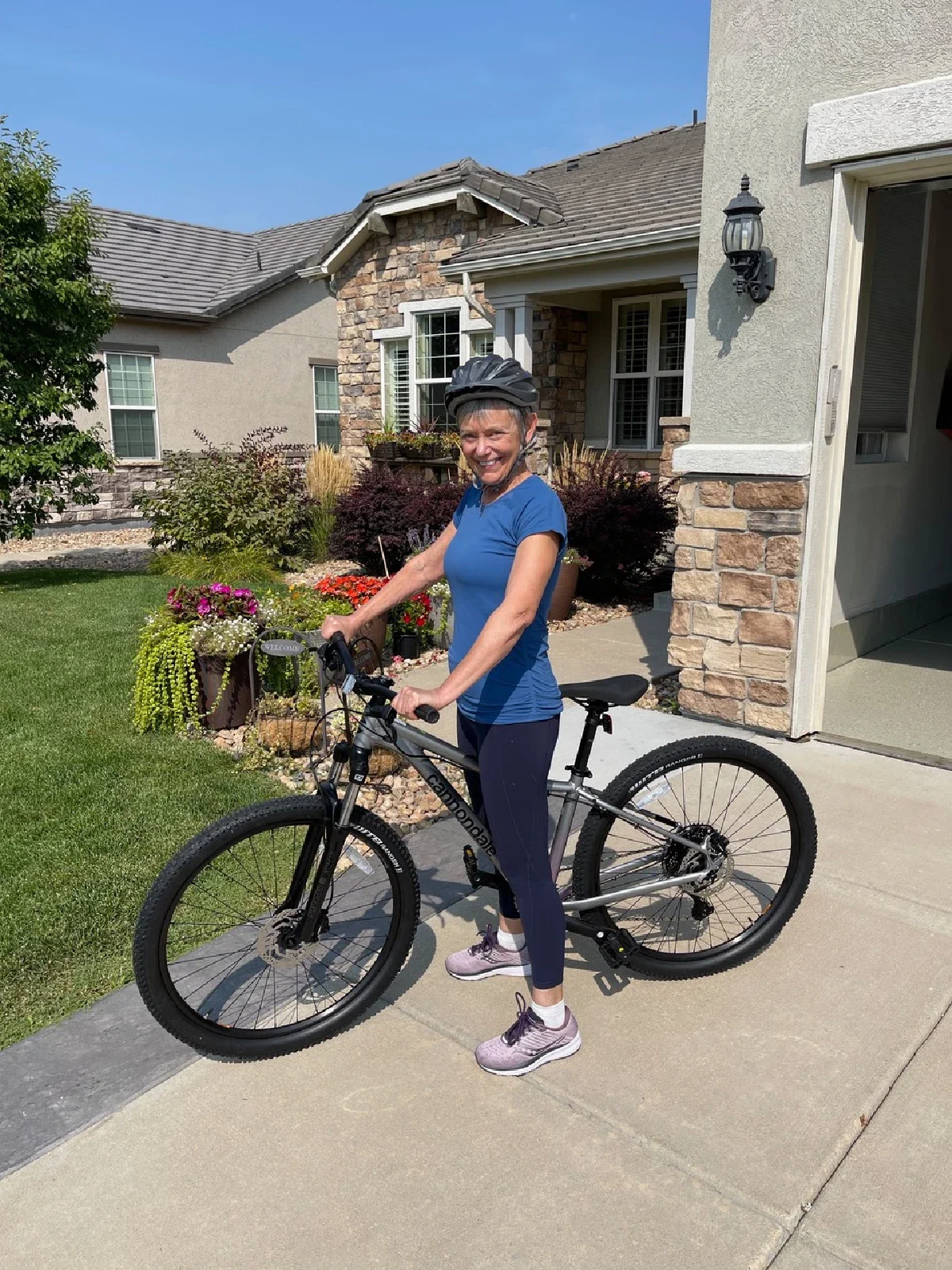
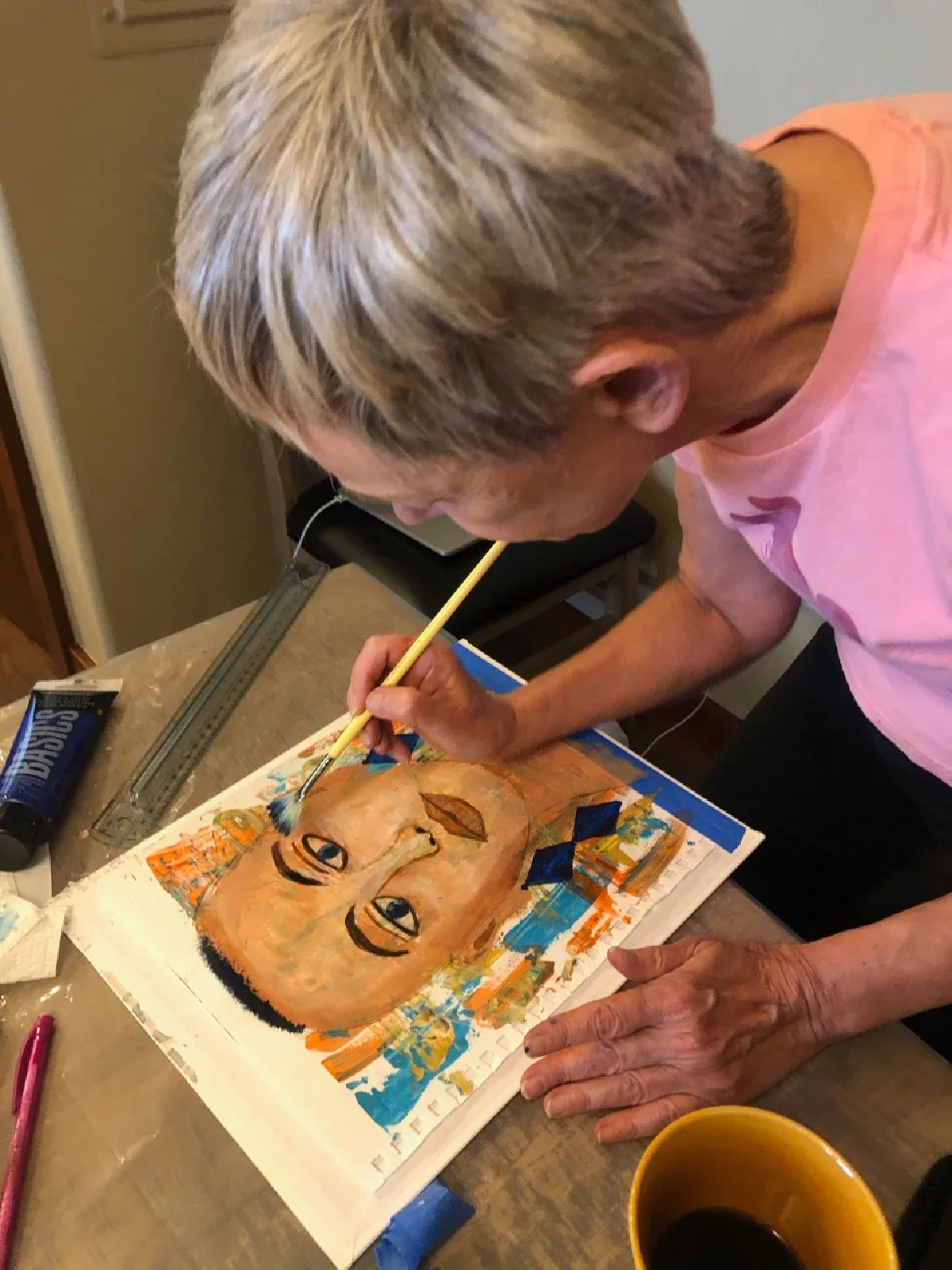
The Broomfield, Colorado, resident started following the MIND diet — a combination of the Mediterranean and DASH diets that encourages eating lots of blueberries, walnuts, salmon, lentils, and green foods and focuses on brain health and cognition. Now, she avoids processed foods completely. And she takes her beloved husky-Pomeranian-mix puppy on very brisk walks every morning for 45 minutes to an hour. She lifts weights and takes other exercise classes. And she embraces her creativity. With the help of an artist friend and classes, she’s even learned to paint.
“I went from doing stick figures to painting portraits,” Rebecca says, adding that any kind of creativity helps. “There’s a recent study that shows even doodling helps. You don’t have to show anybody, just doodle. It uses what they used to call the right side of the brain, and it forms new connections. It enhances the neuroplasticity of the brain, and it reduces stress.”
The key to living well with Alzheimer’s, Rebecca says, is doing what you enjoy.
“If you don’t want to walk a dog, maybe you enjoy gardening or some other kind of exercise,” she says, adding that community is also important. “You've got to find clubs and activities, and you’ve got to make it fun. I’ve never had time for a book club. Now, I’m in three book clubs. It’s great fun.”
Prolonging her health
Rebecca says she’s living her days fully and richly and spends time with family and friends as much as possible.
“I’m doing what I can to prolong my health and stop the progress of symptoms, so I can be with others and give back. I enjoy that,” she says.
One way the former university chancellor gives back is through the advocacy group Voices of Alzheimer’s, which she co-founded. She’s also written a book, “Still Me: Accepting Alzheimer’s Without Losing Yourself,” which will be published in February 2024.
“The book tries to educate people about both the science of the disease and how to live with it. It takes my doctor's orders, which I call ‘gifts’ in the book, and elaborates on them. It gives tips and tells my story, and I hope it provides lots of education,” Rebecca says.

A new frontier for Alzheimer’s treatment
There’s currently a great deal of research being conducted on Alzheimer’s, which makes this a time of great hope, Rebecca says.
“There’s amazing research on biomarkers for testing,” she says, adding that one day we’ll be able to tell if a person is likely to have the disease or even has the disease with a drop of blood. “And people are working on vaccines.”
In Rebecca’s view, we’re entering a new frontier for the treatment of Alzheimer’s.
“I have a friend who says, if there was ever a time to get Alzheimer’s, it’s now. That’s kind of awful to say, but I understand what he meant. There’s treatment, and there’s going to be a cure,” she says.
For people who are diagnosed with mild cognitive impairment, Rebecca recommends taking advantage of the many helpful resources out there, especially Voices of Alzheimer’s, the Alzheimer’s Association, and Us Against Alzheimer’s. She also suggests looking into the nationwide network of “memory cafés” or finding another group, because being able to talk to people going through the same experience can be really helpful.
At the age of 71 and with almost 5 years’ distance from her initial diagnosis, Rebecca says the lifestyle changes she’s made have helped. She doesn’t notice much change in her cognitive abilities, pointing out that her “comprehension is good” and that she can still read. (Though, she acknowledges that her short-term memory is a little weaker.) And she can still drive but chooses not to.
“I know some of the first things that often happen is time response. Reflex actions can get delayed,” she says. “What if something happened?”
You can still ‘live with joy’ after an Alzheimer’s diagnosis
Rebecca says everyone over 65 should have mini cognitive testing regularly — “like we have much more invasive colonoscopies.” Even people with no symptoms should get tested, she points out, because the results can serve as a baseline if symptoms appear later.
“The earlier you get a diagnosis, the better the lifestyle changes can have an effect,” she says.
She also notes that there’s another reason to get tested and possibly diagnosed early. There are now two FDA-approved medications for Alzheimer’s, which are covered by Medicare. But they have to be taken in the very early stages of the disease.
Rebecca encourages people to “fight the stigma” surrounding Alzheimer’s by being proactive about testing and not allowing themselves to be ruled by fear.
“People have that belief that if they walk in and they get diagnosed, they’re gonna fall apart,” she says. “You can get diagnosed, live well, and live with joy.”

Why trust our experts?