Zusduri
Zusduri (mitomycin) is an alkylating chemotherapy. It's approved to treat adults with low-grade, intermediate-risk non–muscle invasive bladder cancer (LG-IR-NMIBC). It's often used when surgery didn't work or the cancer came back. A healthcare professional gives the medication once a week for 6 weeks. It's placed into the bladder through a small urinary catheter. Zusduri (mitomycin) starts as a liquid and turns into a gel inside the bladder, which helps the medication stay in contact with the bladder lining longer. It can cause temporary blue or violet urine after the procedure. Other side effects can include painful urination, urinating often, or trouble urinating.


What is Zusduri (mitomycin)?
What is Zusduri (mitomycin) used for?
- Recurrent low-grade, intermediate-risk non–muscle invasive bladder cancer (LG-IR-NMIBC) in adults
How Zusduri (mitomycin) works
Zusduri (mitomycin) is a type of chemotherapy called an alkylating agent. It damages the DNA of fast-growing cells like cancer cells so they can’t grow and divide. This kills the cancer cells and helps stop the cancer from growing.
Zusduri (mitomycin) is placed directly into the bladder as a chilled liquid through a small urinary catheter. Once in the bladder, it turns into a gel. This helps it stay in contact with the bladder lining longer and work where the cancer is.
Drug facts
| Common Brands | Zusduri |
|---|---|
| Drug Class | Alkylating agent |
| Controlled Substance Classification | Not a controlled medication |
| Generic Status | No lower-cost generic available |
| Availability | Prescription only |

Side effects of Zusduri (mitomycin)
The following side effects may get better over time as your body gets used to the medication. Let your healthcare provider know immediately if you continue to experience these symptoms or if they worsen over time.
Common Side Effects
- Higher creatinine levels (29%)
- Higher potassium levels (26%)
- Painful urination (23%)
- Lower hemoglobin levels (17%)
- Higher liver enzyme levels (15%)
- Changes in white blood cell counts (up to 15%)
- Urinary tract infection (12%)
- Blood in the urine (10%)
Less Common Side Effects
- Tiredness
- Urinating more often
- Accidental urine leakage
- Trouble urinating
- Feeling the need to urinate
- Having to wake up to urinate
- Genital symptoms (pain, itching, swelling, rash)
The following Zusduri (mitomycin) side effects have also been reported
Side effects that you should report to your care team as soon as possible:
- Allergic reactions—skin rash, itching, hives, swelling of the face, lips, tongue, or throat
- Low red blood cell level—unusual weakness or fatigue, dizziness, headache, trouble breathing
- Trouble passing urine
- Urinary tract infection (UTI)—burning when passing urine, passing frequent small amounts of urine, bloody or cloudy urine, pain in the lower back or sides
Side effects that usually do not require medical attention (report these to your care team if they continue or are bothersome):
- Blue urine
- Red or dark brown urine

Pros and cons of Zusduri (mitomycin)
Pros
- A non-surgical option
- Treatment that placed directly into the bladder (where the cancer is)
- Works locally in the bladder, which can limit effects on the rest of the body
- Given once a week for 6 weeks
Cons
- Requires catheter placement and clinic visits
- Can make your urine purple or blue, so must follow specific instructions when you urinate after each treatment session
- Can cause bladder symptoms, like painful urination
- Risk of more side effects in people with moderate or severe kidney problems (avoid if severe)

Pharmacist tips for Zusduri (mitomycin)

- Make appointments to get your Zusduri (mitomycin) treatment once a week for a total of 6 weeks. Put these dates on your calendar to help you remember. It's important to receive the full treatment so the medication can work the best it can for your cancer.
- If you miss a Zusduri (mitomycin) appointment, call your care team to reschedule as soon as you can. Staying on your weekly treatment schedule helps the medication work as intended.
- At the clinic, your care team will prepare Zusduri (mitomycin) for you. They'll deliver the medication into your bladder through your urinary catheter. This can take less than 1 hour, but be sure you have enough time to get settled.
- Don't worry if your urine turns blue or purple after a Zusduri (mitomycin) treatment. This is a normal effect of the medication and should go away within about a day. The medication itself is a blue-purple color, so it's a sign that it was placed into your bladder.
- For 24 hours after each Zusduri (mitomycin) visit, try your best not to get any urine on any skin. Be sure to sit down on the toilet to urinate and flush several times afterwards. After going to the bathroom, wash your hands, inner thighs, and genital area well with soap and water. If any urine gets onto your clothes, wash them separately right away. The medication leaves your body through your urine. These tips can help keep urine from irritating your skin.
- Tell your care team if you have pain when urinating, trouble urinating, blood in your urine, or a fever after a Zusduri (mitomycin) treatment. These can be signs of bladder irritation or a urinary tract infection. Your care team can help treat these problems and keep them from getting worse.
- If your oncologist orders blood tests, be sure to get them done on time. Zusduri (mitomycin) can sometimes cause lab changes. This can include changes in your electrolytes, liver enzyme levels, and blood cell counts. These tests help your care team find any problems early.
- If you can become pregnant: Use reliable birth control during treatment with Zusduri (mitomycin) and for 6 months after your last dose. This medication can harm an unborn baby. If you become pregnant during this time, tell your oncologist right away.
- If your partner can become pregnant: Use birth control, such as condoms, if you have sex during the 6 weeks of your Zusduri (mitomycin) treatment. Continue using this form of birth control for 3 months after the last dose. Zusduri (mitomycin) might harm an unborn baby. Let your oncologist know right away if your partner gets pregnant during that time.
- If you plan to breastfeed: Don’t breastfeed during the 6 weeks of your Zusduri (mitomycin) treatment and for 1 week after the last dose. We don’t know if the medication passes into breast milk. But there’s a risk of serious side effects for your child. Talk to your oncologist or a lactation consultant about safer feeding options.

Risks and warnings for Zusduri (mitomycin)
Zusduri (mitomycin) can cause some serious health issues. This risk may be even higher for certain groups. If this worries you, talk to your doctor or pharmacist about other options.
Risks in people with a perforated bladder
- Risk factors: Damage to the bladder wall leading to a hole or tear (e.g., recent bladder surgery, trauma)
Zusduri (mitomycin) is placed directly into the bladder and usually causes side effects that are limited to the bladder. But if there's a hole or tear in the bladder wall, more of the medication can enter your bloodstream. This can raise the risk of serious side effects.
Before each treatment, your care team will check that your bladder wall is safe for treatment. If there's a tear in the bladder wall, treatment will be delayed until it heals.
Get medical help right away if you have severe pain in your lower belly or pelvis, can't urinate, or see blood in your urine. These can be signs of a hole or tear in the bladder wall.
Harm to an unborn baby
- Risk factors: Pregnancy | Can become pregnant
Based on animal studies and how it works, Zusduri (mitomycin) might harm an unborn baby. If you can become pregnant, your prescriber might ask you to take a pregnancy test before starting treatment.
If you can become pregnant, use effective birth control during treatment and for 6 months after your last dose. If your partner can become pregnant, use birth control, like condoms, during treatment and for 3 months after your last dose. Tell your care team right away if you or your partner becomes pregnant during treatment or soon after treatment ends.

Zusduri (mitomycin) dosage
Typical dosage for Zusduri (mitomycin)
The recommended dose is 75 mg (56 mL) placed into the bladder once weekly for 6 weeks. It's given through a urinary catheter by a trained healthcare professional at a clinic.

Zusduri (mitomycin) contraindications
Contraindications are specific health conditions or situations in which a person should not take a medication due to safety concerns. If you have any of the following conditions or if any of the following apply to you, let your healthcare provider know because Zusduri (mitomycin) will not be safe for you to take.
- A hole or tear in the bladder wall (perforation of the bladder)
- Previous allergic reaction to mitomycin or any component of the product

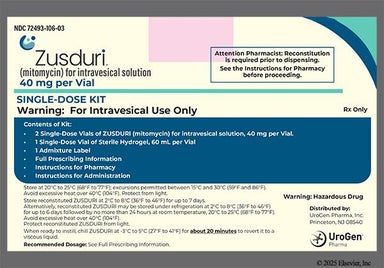
Zusduri (mitomycin) images