By definition, bipolar disorder includes extreme mood shifts that bounce from one pole to the other—between high-energy mania and low-energy depression. How that actually plays out in a patient’s life can vary, however, and not all manic episodes look the same.
To reflect this variation, doctors have defined four types of bipolar disorder: bipolar I, bipolar II, cyclothymic, and “other specified and unspecified bipolar and related disorders.” The two most common are bipolar I and bipolar II.
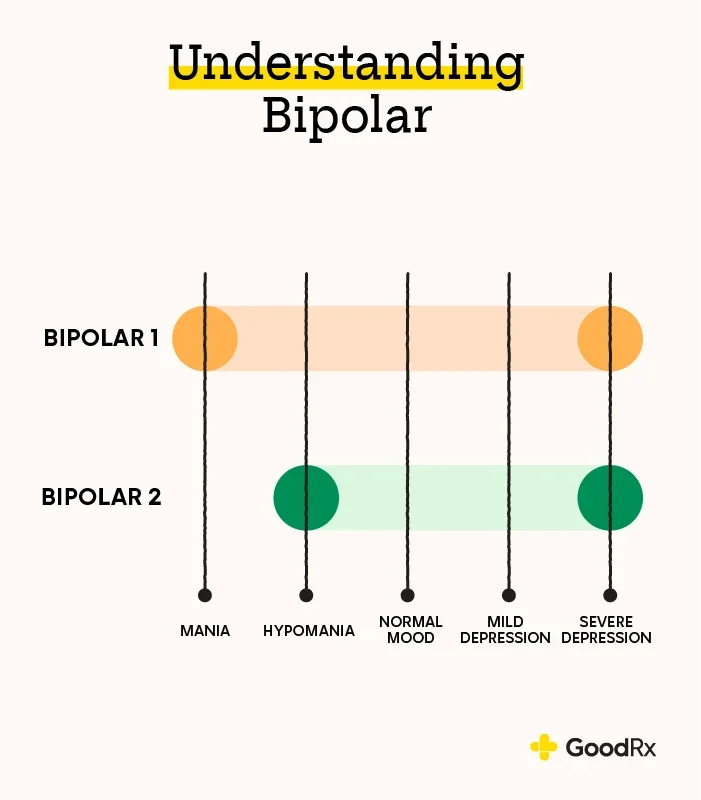
Both bipolar I and bipolar II involve both manic and depressive episodes, but it’s the magnitude of the manic episode that sets the two types apart.
“Bipolar I means you have true manic episodes,” says Gail Saltz, MD, psychiatrist at New York-Presbyterian Hospital, Weill Cornell Medicine. “When you have mania, you have psychotic symptoms.”
Psychosis may involve hallucinations, delusions, and a break from reality, according to the National Alliance on Mental Illness (NAMI). Because of the psychotic symptoms, some people with bipolar I are wrongly diagnosed with schizophrenia.
“Bipolar II means you have depression alternating with hypomania,” says Dr. Saltz. “You never become actually manic [and] you never have psychotic symptoms.”
As the prefix hypo- suggests, hypomania is a less severe version of true mania.
People experiencing hypomania might feel an “expansive mood,” says Dr. Saltz, but no break from reality. That said, hypomania can still wreak havoc on someone’s life and require treatment.
People with both bipolar I and bipolar II experience similar states of depression, characterized by low energy, feelings of hopelessness, lethargy, or a lack of enjoyment in previous interests. Learn more about the symptoms of depression here.
If you think you or a loved one may be dealing with bipolar disorder, it’s not your responsibility to figure out the exact type. However, it *is* important to be aware of hypomania and recognize that symptoms of bipolar disorder may be less obvious than you thought.
If someone is experiencing an episode of hypomania, they might exhibit these symptoms, according to Dr. Saltz:
Someone with hypomania may be able to function well in their social and professional lives, according to NAMI. They may be able to hide their symptoms, or people may brush it off as simply a “good mood.” Still, decisions made during episodes of hypomania may have frustrating and exhausting consequences.
True mania typically involves psychosis. When someone is experiencing psychosis during a manic episode, they may display the following symptoms:
Hearing or seeing things that aren’t there
Having completely irrational thoughts
Behaving impulsively and unpredictably
Taking unusual risks
Getting into trouble frequently
Manic episodes from bipolar I may last a week or longer and may be so severe that the person requires hospitalization, according to NAMI. Unlike bipolar II disorder, which might be considered high functioning, it’s more difficult for someone with bipolar I disorder to fly under the radar.
“A lot of times you see people with bipolar I disorder because they’ve gotten in trouble with the law, or because they’re having [problems] related to gambling, or spending, or sex,” says Ben Michaelis, PhD, a psychologist in New York City.
It’s hard to truly imagine what it feels like inside the mind of someone with bipolar disorder—or any other type of mental illness—but the experience could be described as disorienting. The high energy levels or racing thoughts may feel “normal” or even “good,” and the psychotic symptoms may feel totally real and natural.
“One’s judgment may be impaired—even in the earlier stages of illness,” says Dr. Saltz. “It’s often the case that people who are suffering don’t recognize it in themselves. It really is the people around them who see what’s going on.”
Not surprisingly, people with bipolar disorder may be more likely to seek treatment during depressive episodes than during manic episodes, according to the National Institute of Mental Health. They might enjoy the elated mood and high energy, whereas the overwhelming sadness and fatigue during depression are more likely to prompt willingness to get help.
One way you can help is by recognizing the manic symptoms—especially the more subtle hypomanic symptoms—and making the person aware of how the manic behavior has consequences. It’s crucial to spot the difference between depression and bipolar disorder, since the two are treated very differently.
If you have depression or bipolar disorder and are experiencing thoughts of self-harm or suicide, call 911, go to the emergency room, or call the National Suicide Prevention Lifeline: 1-800-273-8255.
GoodRx Health has strict sourcing policies and relies on primary sources such as medical organizations, governmental agencies, academic institutions, and peer-reviewed scientific journals. Learn more about how we ensure our content is accurate, thorough, and unbiased by reading our editorial guidelines.