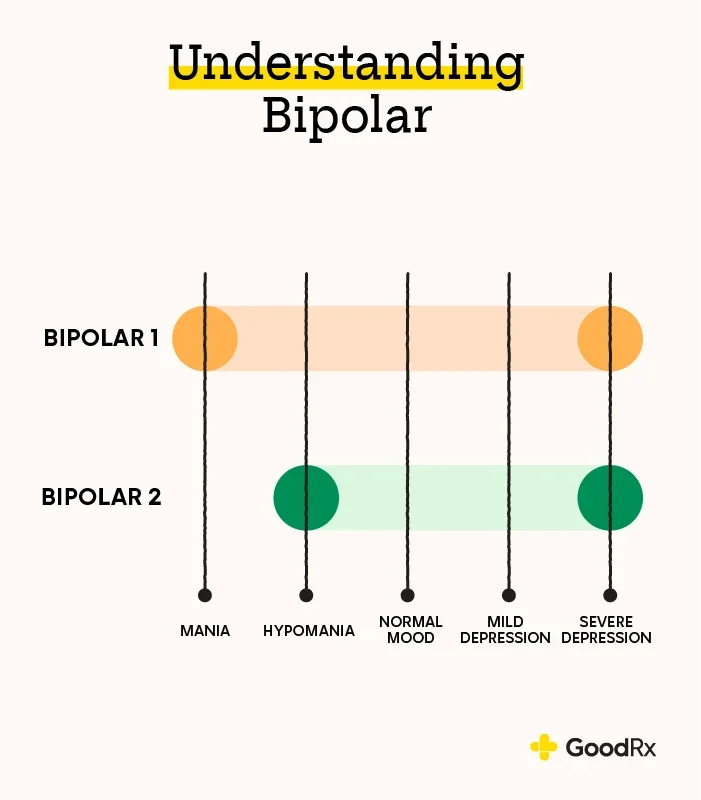
Most people understand the general concept of bipolar disorder — it’s implied in the name, after all. However, understanding bipolar disorder as two extreme and contrasting moods is an oversimplification. This contributes to many common myths about bipolar disorder that can cause confusion or perpetuate stigmas.
HealthiNation from GoodRx asked four mental health professionals about the most common myths about bipolar disorder they hear.
There are people who are temperamental, sensitive, or “hot and cold.” However, this is not the same as having bipolar disorder.
“It is normal to experience shifts in mood throughout the day, but those small changes are unlike anything that a person with bipolar disorder experiences,” says Mitchell Hicks, PhD, core faculty in Walden University’s PhD in Clinical Psychology program.
“Bipolar disorder involves switching between extremes in energy level, mood, and activity,” says Dr. Hicks. “Those at the severe end of the mania continuum may put themselves in situations bearing serious consequences. I once knew a person who managed to lose tens of thousands of dollars they didn’t have in a single evening of gambling.”
Learn more here about the symptoms of bipolar disorder.
“If moods are changing throughout the day, that is not bipolar disorder,” says Patricia Celan, MD, psychiatry resident at Dalhousie University in Canada. “When someone has bipolar disorder, the highs and the lows are more extreme than the average person, but they also last several days or weeks.”
For many people with bipolar disorder, you won’t actually see them flip-flop from one mood extreme to another. Instead, many experience depression as their primary state. Manic episodes are often much more infrequent than you might think.
“In fact, to be diagnosed with a manic episode, someone needs to have been in an elevated or irritable mood for at least seven consistent days, whereas a depressive episode is diagnosed by at least 14 consistent days of a low mood or inability to experience usual enjoyment,” says Dr. Celan.
“Bipolar is like other conditions. It occurs across a spectrum from mild to severe,” says Paul Hokemeyer, PhD, licensed marriage and family therapist and author of Fragile Power: Why Having Everything Is Never Enough. “For many people, the mood swings are mild and subtle rather than being severe and completely debilitating.”
In fact, there are multiple types. Bipolar II experiences hypomania instead of mania. These are less intense elevated moods, and they tend to present as impulsivity, increased spending, or less need for sleep. Learn more about bipolar I vs. bipolar II here.
Manic episodes are one of the most misunderstood pieces of the bipolar puzzle. Many people think mania presents as bouncing-off-the-walls joy, but this high energy can present in different ways, depending on the person.
“Often, patients who are manic become irritable as those around them do not have energy that matches theirs. That is when their very happy mood can turn into irritability and anger,” says Brandi Rudolph Bolling, MD, pediatrician, psychiatrist, and medical director at Rudolph Bolling Psychiatry, PC.
Additionally, manic episodes may include symptoms that go beyond “happiness,” including: