Key takeaways:
Mast cell tumors are the most common type of malignant tumor diagnosed in dogs, accounting for about 20% of all canine skin tumors.
Surgical removal of the tumor is the preferred treatment method, followed by chemotherapy and radiation if necessary.
Certain dog breeds, such as boxers and Boston terriers, are more at risk of developing mast cell tumors.
No pet parent wants to hear these words: “Your dog has a tumor.” But some tumors are more common — and treatable — than others.
Mast cell tumors are the most common type of cancerous tumor in dogs. They make up approximately 20% of all reported canine skin tumors. And although they can be scary, they are among the most treatable types of cancer.
While dogs of any age can develop mast cell tumors, they are most common in dogs 8 to 10 years old. So how do you know if your dog is at risk, and what steps should you take to protect them? Below we take a closer look at mast cell tumors in dogs.
Search and compare options
What causes mast cell tumors in dogs?
Mast cell tumors occur when a dog’s mast cells turn cancerous. Mast cells are normal white blood cells found in most organs and tissues of the body. They are part of the immune system. But little is known about the underlying causes of mast cell tumors.
Since certain dog breeds are more likely to develop mast cell tumors, they are probably caused by a complex mix of risk factors. Some factors may be environmental and some genetic or hereditary.
For example, several genetic mutations are known to be involved in the development of mast cell tumors. One well-known mutation is to a protein called KIT. KIT is involved in the replication and division of cells.
What are the symptoms of mast cell tumors in dogs?
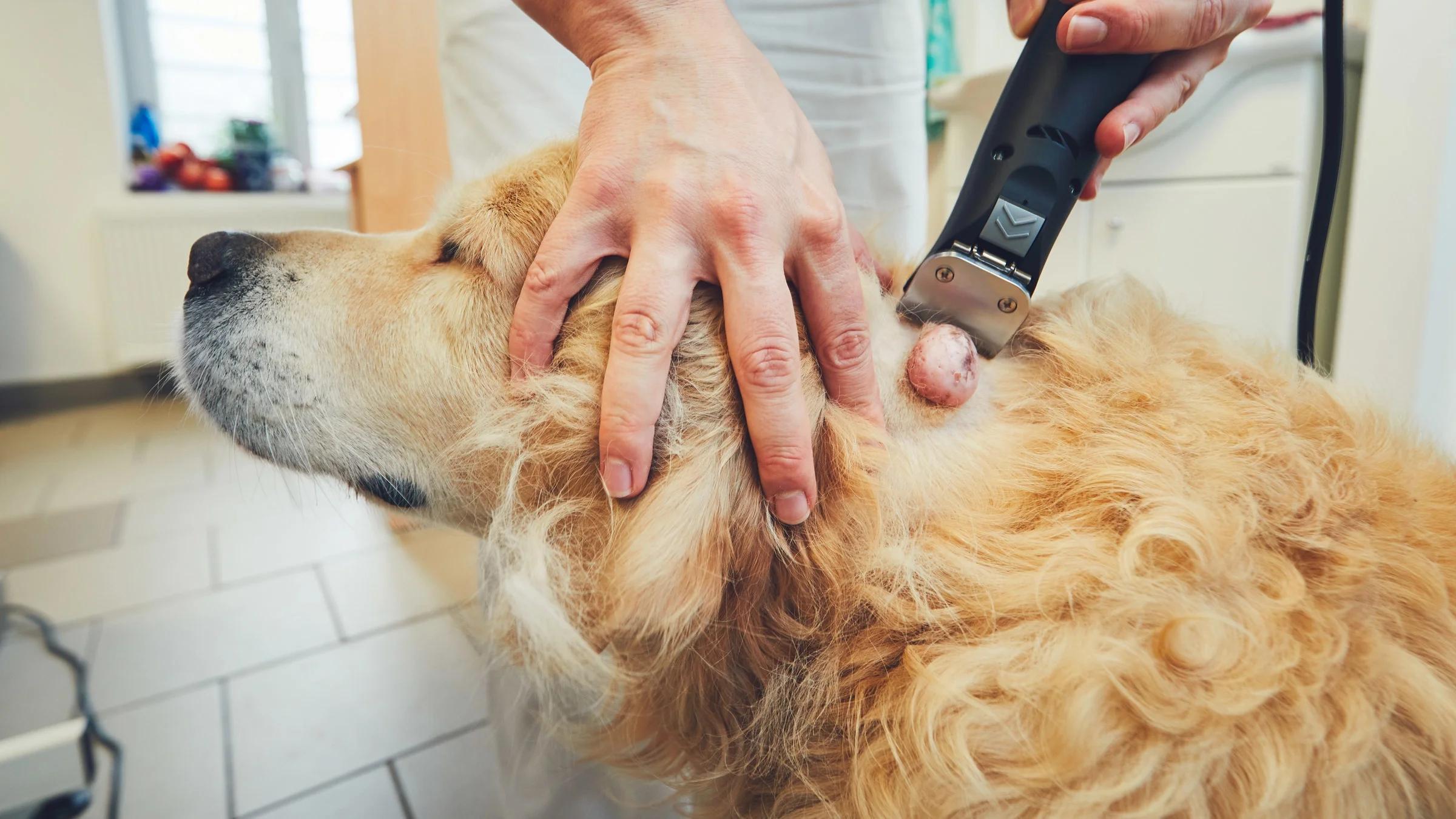
Many mast cell tumors don’t cause any symptoms other than a lump. A mast cell tumor may look or feel like a raised bump. It can appear in any location on your dog and can be soft or solid to the touch. Or it may present as a bleeding, bruised, or swollen growth.
Because mast cell tumors vary in appearance and cause a variety of other symptoms, routinely check your dog for any changes to their skin. These tumors are often found on the limbs, lower abdomen, and chest.
Mast cell tumors are unusual because they can change in size, even from day to day. Make an appointment with your vet if your dog experiences any of the following:
A new skin mass
An existing mass that has changed in size or color
An unexplained lump
An unexpected allergic reaction or hives
Some mast cell tumors are irritating, which can cause a dog to bite, lick, or scratch at the tumor and surrounding area. This biting and licking can cause localized reactions associated with releasing toxins from the malignant mast cells. Localized reactions generally look like an allergic reaction, causing redness, swelling, hives, or itchiness.
How is a mast cell tumor diagnosed?
It’s challenging to identify a mast cell tumor just by looking at it. So if your vet suspects an issue, they will probably take a tissue sample with a biopsy. A board-certified veterinary pathologist will then look at the cells under a microscope to assess your dog’s tumor. Your vet will likely also order regular blood tests.
If your dog is diagnosed with a mast cell tumor, your vet will grade the tumor from grades 1 to 3 based on how aggressive it is. Low-grade tumors are less aggressive, while higher-grade tumors are more aggressive. A more aggressive tumor is more likely to spread to other parts of the body.

Read more like this
Explore these related articles, suggested for readers like you.


How do you treat mast cell tumors in dogs?
When deciding how to treat your dog’s mast cell tumor, your vet and a veterinary oncologist (cancer specialist) will consider your dog’s tumor and their health history. In most cases, surgery to remove the tumor is the preferred treatment method.
Low-grade tumors that have not spread can often be treated with surgery alone. If your dog has a higher-grade tumor, your vet may recommend surgery followed by chemotherapy, even if the cancer has not spread.
Before surgery, your vet may prescribe your dog medications to help reduce inflammation and other effects from the tumor. This can include:
Steroids
Antihistamines
Histamine blockers
After the tumor is removed, your vet will send it to a laboratory to ensure that no cancerous cells were left behind. If the surgeon was able to remove all the cancerous cells, your dog may not need further treatment. But your vet may recommend additional surgery or chemotherapy if any cells were left behind.
Sometimes, the location of the mass makes surgical removal difficult or prevents removal of the entire tumor. In this case, your vet may discuss radiation treatment as another possible option.
Medication to treat dog mast cell tumors
Stelfonta (tigilanol tiglate) is a medication that can be injected directly into a dog’s mast cell tumor. This doesn’t require surgery, and some research suggests the medication can effectively treat mast cell tumors in certain dogs. Dogs usually need more than just one injection of Stelfonta.
Using this medication means your veterinarian won’t be able to tell how serious the tumor is and whether your dog needs additional treatment. But in some cases, such as if surgery isn’t a good option, Stelfonta may be worth considering for your dog.
What are the signs of a complication from a mast cell tumor?
Sometimes, if a dog’s mast cell tumor is bumped or knocked into, it can release all of its inflammatory matter at once. This release process, called degranulation, causes some dogs to have severe reactions.
For example, some dogs experience gastrointestinal bleeding or an anaphylactic reaction that affects their ability to breathe as a result of degranulation. Symptoms of a more severe anaphylactic reaction include:
In rare cases, a severe anaphylactic reaction can also result in death.
How long can a dog live with a mast cell tumor?
The life expectancy of a dog with a mast cell tumor depends on their tumor’s location and size and whether the cancer has spread. One study involving 44 dogs with oral mast cell tumors found that the average survival time for all the dogs was about 4 years. But the average survival time for dogs whose cancer had spread to the lymph nodes was 14 months.
The life expectancy for dogs with mast cell tumors also depends on the success of their treatment. Many mast cell tumors can be cured with local treatment, such as surgery. But it’s hard to predict which tumors will spread and develop into more widespread illness.
Common areas where mast cell tumors metastasize, or spread, are the lymph nodes, spleen, and liver. Although tumors that spread to the lymph nodes are linked to less favorable outcomes, chemotherapy and radiation can treat these more aggressive mast cell tumors.
Which dog breeds are most at risk of developing mast cell tumors?
Certain dog breeds are at an increased risk of developing mast cell tumors.
Boxers and Boston terriers account for 50% of all cases of mass cell tumors. Other breeds prone to these tumors include:
Beagles
Bullmastiffs
Cocker spaniels
Pugs
Golden retrievers
Labrador retrievers
Schnauzers
Weimaraners
Pugs are more likely to develop multiple mast cell tumors. Research also indicates that mast cell tumors in pugs act much like benign tumors and are less likely to be fatal than other mast cell tumors.
Frequently asked questions
Mast cell tumors can often look like warts, insect bites, allergic reactions, or other types of skin tumors. If your dog develops a new lump on their skin, it’s best to consult your veterinarian.
The cost to remove a dog’s mast cell tumor depends on many factors, such as:
The grade of the tumor
The location of the tumor
The specific treatment facility
Any necessary follow-up treatments, such as radiation or chemotherapy
A typical mast cell tumor removal can cost between $500 and $1,000, according to some estimates. But if further treatment is necessary, such as radiation or chemotherapy, the costs can increase to well over $4,000.
Yes, mast cell tumors are always cancerous. These tumors are a common type of skin cancer in dogs. But not all mast cell tumors are aggressive and need radiation or chemotherapy. Lower-grade tumors can potentially be cured with surgery alone.
Mast cell tumors can often look like warts, insect bites, allergic reactions, or other types of skin tumors. If your dog develops a new lump on their skin, it’s best to consult your veterinarian.
The cost to remove a dog’s mast cell tumor depends on many factors, such as:
The grade of the tumor
The location of the tumor
The specific treatment facility
Any necessary follow-up treatments, such as radiation or chemotherapy
A typical mast cell tumor removal can cost between $500 and $1,000, according to some estimates. But if further treatment is necessary, such as radiation or chemotherapy, the costs can increase to well over $4,000.
Yes, mast cell tumors are always cancerous. These tumors are a common type of skin cancer in dogs. But not all mast cell tumors are aggressive and need radiation or chemotherapy. Lower-grade tumors can potentially be cured with surgery alone.
The bottom line
Mast cell tumors are the most common type of cancer in dogs. But they are difficult to identify because they can look like several other skin conditions.
Regularly check your dog for new skin masses, and make an appointment with your veterinarian if you find any lumps or changes to their skin. Mast cell tumors, which can often be addressed with surgery alone, are one of the most treatable types of cancer.

Why trust our experts?



References
American College of Veterinary Pathologists. (n.d.). What is veterinary pathology?.
American College of Veterinary Surgeons. (n.d.). Mast cell tumors.
Brooks, W. (2023). Mast cell tumors in dogs and cats. Veterinary Partner.
De Nardi, A. B., et al. (2022). Diagnosis, prognosis, and treatment of canine cutaneous and subcutaneous mast cell tumors. Cells.
Garrett, L. D. (2014). Canine mast cell tumors: Diagnosis, treatment, and prognosis. Veterinary Medicine: Research and Reports.
Geiger, D. (2004). Canine cutaneous mast-cell tumors: Current concepts for patient management. DVM360.
Hahn, K. A., et al. (2004). Efficacy of radiation therapy for incompletely resected grade-III mast cell tumors in dogs: 31 cases (1987-1998). Journal of the American Veterinary Medical Association.
Harshbarger, A. A., et al. (2023). Cytologic grading of mast cell tumors in small animals. Today’s Veterinary Practice.
Hillman, L. A., et al. (2010). Biological behavior of oral and perioral mast cell tumors in dogs: 44 cases (1996-2006). Journal of the American Veterinary Medical Association.
Khuly, P. (n.d.). Mast cell tumors in dogs and cats. Embrace Pet Insurance.
McNiel, E. A., et al. (2006). Evaluation of risk and clinical outcome of mast cell tumours in pug dogs. Veterinary and Comparative Oncology.
Michigan State University Veterinary Diagnostic Laboratory. (n.d.). Canine mast cell tumors.
North Carolina State University Veterinary Hospital. (n.d.). Medical oncology: Canine multiple cutaneous mast cell tumors.
North Carolina State University Veterinary Hospital. (n.d.). Medical oncology: Mast cell tumors in dogs.
Pierini, A., et al. (2019). Epidemiology of breed-related mast cell tumour cccurrence and prognostic significance of clinical features in a defined population of dogs in west-central Italy. Veterinary Sciences.
Ryan Veterinary Hospital. (n.d.). Mast cell tumors in dogs. University of Pennsylvania School of Veterinary Medicine.
Stelfonta. (n.d.). Is Stelfonta the best mast cell tumor treatment for my dog?
Villalobos, A. E. (2024). Tumors of the skin in dogs. Merck Veterinary Manual.