Key takeaways:
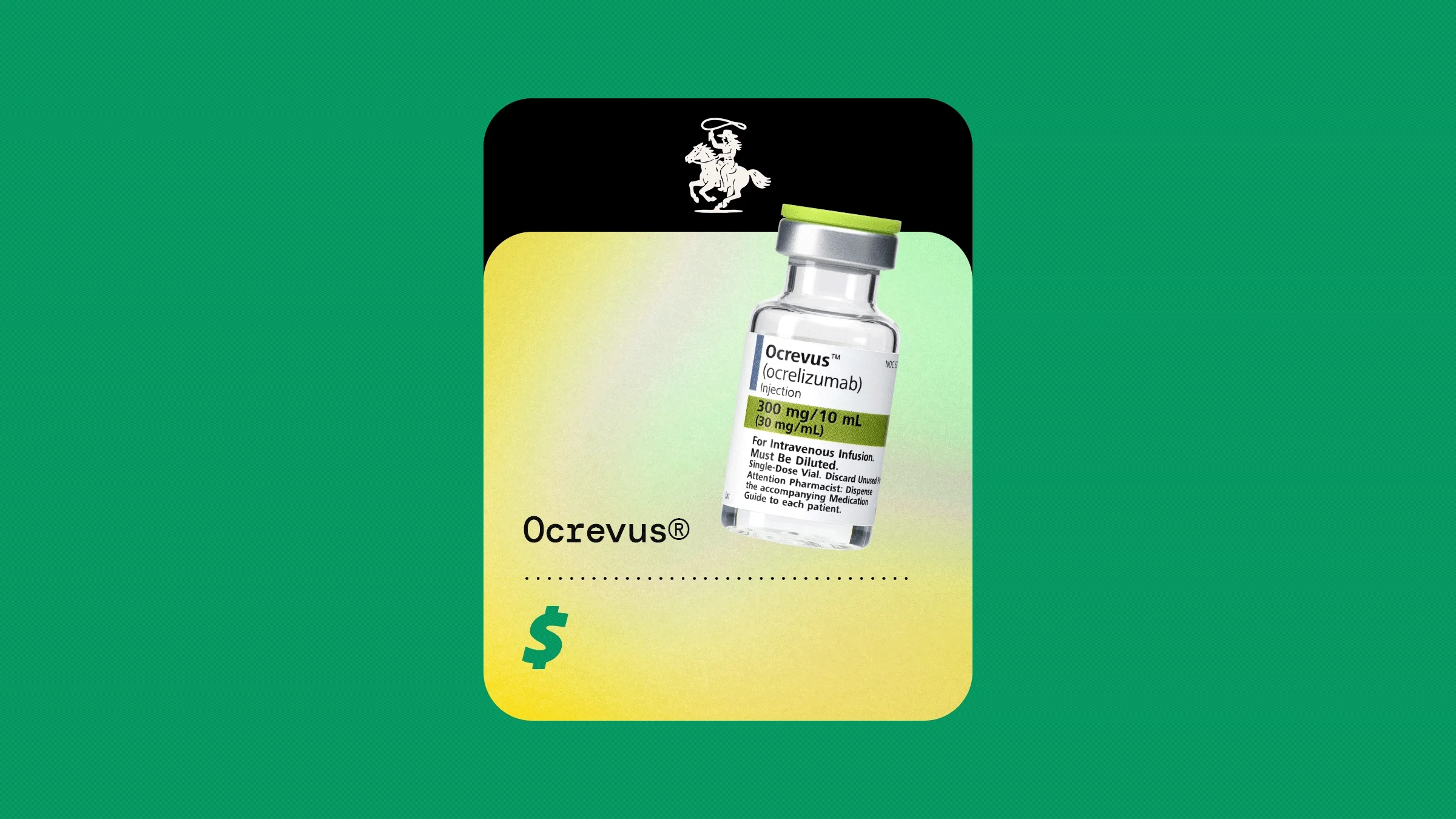
Ocrevus (ocrelizumab) is a prescription-only infusion medication that treats multiple sclerosis in adults.
The list price for Ocrevus is $78,858 per year. This reflects the manufacturer’s price before infusion-related fees, insurance coverage, discounts, or savings programs are applied.
Insurance coverage for Ocrevus varies widely by plan type. But many plans require prior authorization or step therapy before approval. Medicaid covers the highest percentage of enrollees.
If you qualify for the manufacturer’s savings card, you may pay as little as $0 for your medication and infusion costs.
Save on related medications
Ocrevus (ocrelizumab) is an IV medication used to treat multiple sclerosis (MS) in adults. It is a biologic medication that belongs to a class known as monoclonal antibodies. Ocrevus works by calming an overactive immune system to slow the progression of MS.
Ocrevus is administered through IV infusion by a trained healthcare professional. This can be done in a physician’s office, a clinic, an infusion center, or at home. Treatment typically begins with two starter doses, given 2 weeks apart. Then a higher maintenance dose is given every 6 months.
Ocrevus can cost tens of thousands of dollars per year without insurance or discounts. There are Ocrevus biosimilars in development. But none are available in the U.S. You may be able to reduce the cost of your prescription through a manufacturer’s copay savings program or a patient assistance program if you qualify.
How much does Ocrevus cost?
The manufacturer’s list price for Ocrevus is $78,858 per year. Without insurance or discounts, your cost may be higher if the infusion site charges additional fees.
The amount you’d pay for Ocrevus depends on several factors, which include the following:
Medical billing: Ocrevus is typically billed under your medical benefit. Your out-of-pocket cost will depend on insurance coverage, treatment location, and fees.
Treatment location: Medication cost can vary significantly based on where you receive treatment. You may pay less for home infusion therapy than you would at an outpatient infusion center.
Insurance coverage: Even if your insurance plan covers Ocrevus, you may still incur out-of-pocket costs, such as copays, deductibles, and coinsurance.
Discounts: Your cost for Ocrevus may be reduced if you qualify for a patient assistance program or a manufacturer copay savings card.
Does insurance cover Ocrevus?
Many insurance plans cover Ocrevus. But the level of coverage and requirements can vary depending on your plan type. About half of Affordable Care Act (ACA) marketplace plan enrollees, three-fourths of people with commercial insurance, and one-third of Medicare enrollees have coverage for Ocrevus. More than 9 in 10 Medicaid enrollees are also covered.
But many insurers have extra requirements before approving coverage. Prior authorization is common for most plan types. This means your insurer must approve your prescription before it’s covered. It’s required for more than half of ACA and commercial plans and for most Medicaid plans. About 1 in 4 Medicare enrollees need it too.
Step therapy is also required by some insurers. This means trying other MS medications first. About 2 in 5 ACA and Medicaid enrollees, and about 1 in 5 Medicare and commercial plan enrollees, have this requirement.
Check your plan’s formulary or contact your insurer to confirm whether Ocrevus is covered. They will tell you what requirements you must meet to get approval.
How different insurance plans cover Ocrevus
The table below details how various insurance types cover Ocrevus, plus whether prior authorization or step therapy is required.
Insurance type | Enrollees covered for Ocrevus 30 mg/mL IV solution | Enrollees required to get prior authorization | Enrollees required to do step therapy |
53.5% | 51.1% | 41% | |
Commercial plans (excluding ACA plans) | 75.5% | 55.4% | 17% |
Medicare (original Medicare and Medicare Advantage plans) | 31.7% | 28.2% | 19.7% |
Medicaid, including state-run and managed care plans | 91.1% | 88.6% | 43.5% |
Source: Managed Markets Insight & Technology, LLC™, as of September 11, 2025. (See methodology below.)
If Ocrevus isn’t covered by your plan, you can:
See if you qualify for financial assistance through the manufacturer’s copay savings card or patient assistance program (details below).
Speak with your prescriber about alternative MS treatment options. These may be covered under your plan or come with lower out-of-pocket costs.
Ask your prescriber to request a formulary exception to get Ocrevus covered. They may need to submit a letter of medical necessity and documentation explaining why Ocrevus is the best option for you.
If your insurer denies your exception request, try filing an appeal.
During your next open enrollment, look for an insurance plan that offers better coverage for Ocrevus and your other medications.
Ways to save on Ocrevus
Ocrevus can cost thousands of dollars per infusion if you’re paying out of pocket. But there are ways to lower your costs — or even get the medication for free. Here are five ways to save on Ocrevus.
1. See if you qualify for the manufacturer’s copay savings card
If you’re prescribed Ocrevus (ocrelizumab), you may be able to lower your out-of-pocket costs through the Ocrevus Co-Pay Program from Genentech, the manufacturer of Ocrevus. Eligible commercially insured individuals could pay as little as $0 for their medication and infusion costs.
The program provides up to $20,000 per year in financial assistance for the medication itself. You can receive up to $1,500 in the first year (and $1,000 each subsequent year) to help cover administration or infusion-related costs.
To qualify, you must:
Have commercial (private or employer-sponsored) insurance
Have a valid prescription for an FDA-approved use of Ocrevus
Not be enrolled in Medicare, Medicaid, Tricare, Veterans Affairs, or any other federal or state government insurance program
Be at least 18 years old or have a guardian who is 18 or older
Live in the U.S. or a U.S. territory
The program isn’t health insurance and can’t be combined with other financial assistance offers. Eligible individuals are automatically reenrolled each year, as long as program requirements are met.
2. Check if you’re eligible for the manufacturer’s patient assistance program
The Genentech Patient Foundation offers Ocrevus at no cost to people who can’t afford their treatment or don’t have insurance coverage.
You may qualify if you:
Don’t have health insurance
Have insurance that doesn’t cover Ocrevus
Meet income guidelines
Reside in the U.S. and are being treated by a licensed U.S. healthcare professional
You can speak with a customer service representative at 1-877-436-3683 for more details on the enrollment process.
3. Check into independent copay assistance foundations
If you need extra help paying your Ocrevus copay, Ocrevus Access Solutions can connect you with independent charitable foundations. These foundations provide financial help for medication and treatment costs. But the amount of assistance varies depending on the program and available funding.
Each organization has its own eligibility rules and provides help based on available funding:
Genentech is not affiliated with or involved in the decisions made by independent foundations. You can call 1-844-627-3887 to speak with an Ocrevus Access Solutions representative and request a referral.
4. Consider using a lower-cost alternative
There’s no biosimilar for Ocrevus (similar to a lower-cost generic). But there are other MS medications that may be appropriate depending on the type of MS you need to treat. Some of these alternatives may also have generic versions or biosimilars that cost less.
For example, glatiramer acetate (the generic form of Copaxone) is used to treat relapsing forms of MS and can help prevent flare-ups and slow the worsening of symptoms.
Ask your prescriber if there are other lower-cost alternatives your insurance may cover based on your MS type and treatment goals.
5. Use your tax-advantaged health accounts
If you have a health savings account (HSA) or a flexible spending account (FSA), you can use those funds to help pay for your Ocrevus treatment. These tax-free dollars can help lower your treatment costs, as well as other healthcare expenses.
You can pay directly with your HSA or FSA card, or submit your receipt for reimbursement later. Be sure to keep all documentation and receipts related to your treatment and payments so you can have them on hand for reimbursement or tax purposes.
Keep in mind that FSA funds typically expire at the end of the plan year, whereas HSA funds roll over and remain available for future medical expenses.
The bottom line
The list price for Ocrevus (ocrelizumab) is $78,858 per year. Without insurance, discounts, or savings programs, you’ll likely pay more out of pocket due to infusion-related fees and other factors.
If you have commercial insurance, you may qualify for the Ocrevus Co-Pay Program, which could lower your out-of-pocket costs to as little as $0 for your treatment. You can also explore financial help through the Genentech Patient Foundation if you’re uninsured or underinsured.

Why trust our experts?




Methodology
We obtained national prescription coverage data for each medication from Managed Markets Insight & Technology (MMIT). The data reflects health insurance coverage as of September 2025.
We calculated the percentage of enrollees in plans that cover each medication by dividing the number of enrollees covered for the medication within a specific insurance channel (e.g., ACA, Medicare, Medicaid) by the total number of enrollees in all plans within that channel.
We determined the percentage of enrollees in plans with a prior authorization requirement by calculating the proportion of enrollees in plans that required prior authorization for the medication within each channel.
Finally, we measured the percentage of enrollees in plans with a step therapy requirement by calculating the proportion of enrollees in plans that imposed step therapy requirements for the medication in each channel.
These estimates, derived from national MMIT coverage data, provide insight into health insurance coverage for each medication. They take into account restrictions such as prior authorization, step therapy, and quantity limits. The percentages are expressed relative to the total number of enrollees covered by various insurance channels, including ACA plans, commercial (excluding ACA) plans, Medicare, and Medicaid (both state-run and managed care plans).
References
Alvarez, E., et al. (2023). Real-world cost of care and site of care in patients with multiple sclerosis initiating infused disease-modifying therapies. Journal of Medical Economics.
The Assistance Fund. (n.d.). Multiple sclerosis copay assistance program.
Genentech. (n.d.). Forms and documents.
Genentech. (n.d.). How can we help you?
Good Days. (n.d.). Our programs.
HealthCare.gov. (n.d.). Appealing a health plan decision. Centers for Medicare & Medicaid Services.
HealthWell Foundation. (n.d.). Multiple sclerosis - Medicare access.
Medicaid.gov. (n.d.). Managed care. Centers for Medicare & Medicaid Services.
Ocrevus. (n.d.). Ocrevus pricing and financial support.
Ocrevus Co-Pay Program. (n.d.). Terms and conditions.
Ocrevus Co-Pay Program. (n.d.). The Ocrevus Co-pay Program.
PAN Foundation. (n.d.). Multiple sclerosis.
Patient Advocate Foundation. (n.d.). Multiple sclerosis.
Pearce IP. (2025). Amgen’s Ocrelizumab biosimilar in phase 3 trials. Lexology.