Key takeaways:
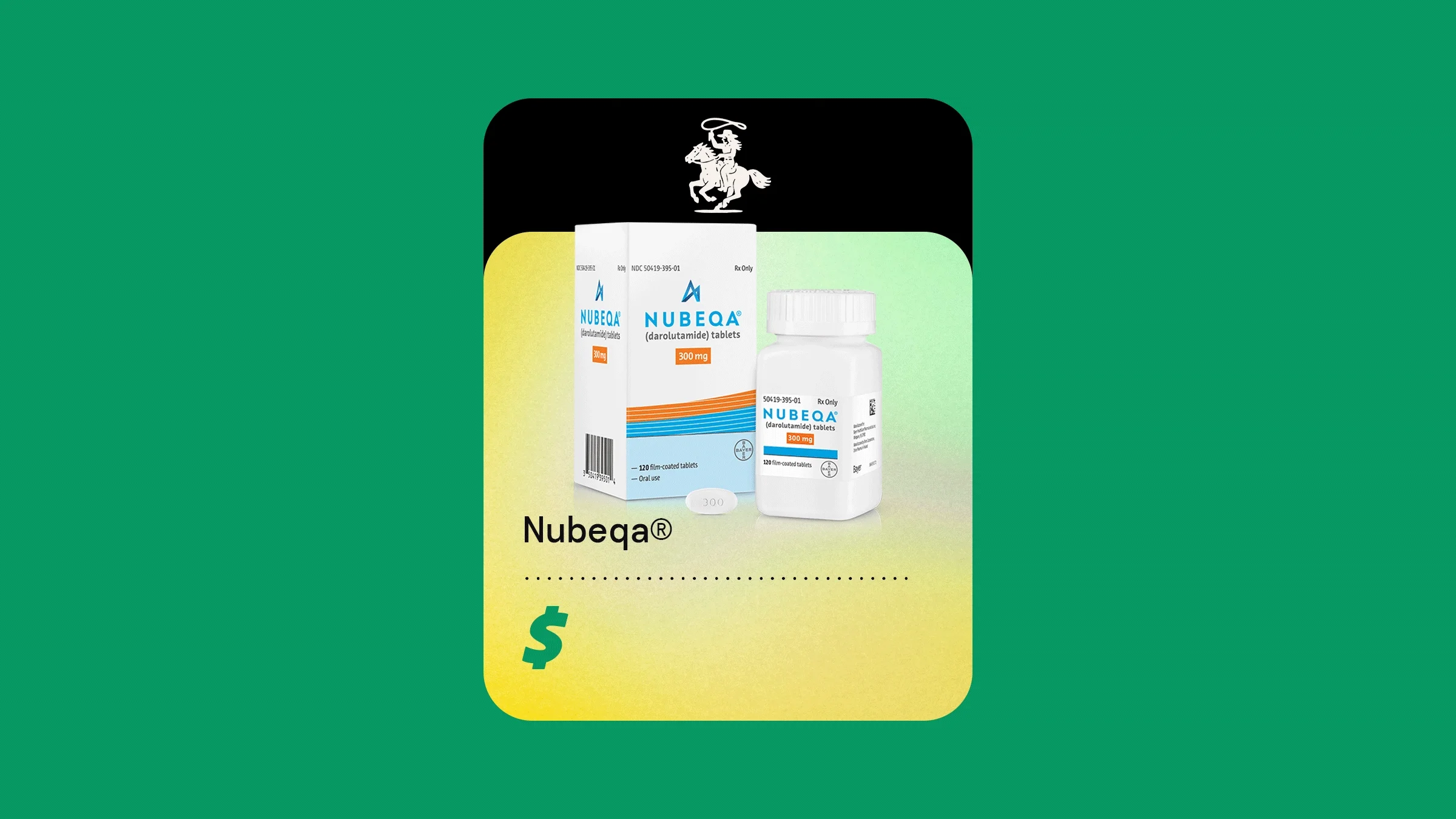
Nubeqa (darolutamide) is a prescription medication that treats certain types of prostate cancer. It comes as a brand-name oral tablet.
Without insurance, the cost of Nubeqa can be substantial. On average, a 1-month supply costs about $19156.91. But the price you’ll pay may vary by pharmacy and fill quantity.
Most health insurance plans cover Nubeqa. Coverage is common for Medicare and Medicaid enrollees, and many commercial and Affordable Care Act marketplace plans cover it as well. Prior authorization is required in most situations.
There are a few ways to save on Nubeqa, including a manufacturer copay savings card, a free trial offer, and a patient assistance program.
Save on related medications
A prostate cancer diagnosis can be a lot to process. And for many people, one of the first questions is how much their new medications might cost.
Nubeqa (darolutamide) is one prescription medication your oncologist may recommend. It’s an oral tablet that treats a few types of prostate cancer. But the cost of this targeted hormone therapy can vary depending on your insurance status, prescribed dosage, and whether you qualify for a savings program.
Here, we’ll walk through what Nubeqa may cost without insurance, which factors can affect the price, and ways to lower your out-of-pocket costs so you can focus more on treatment and less on logistics.
How much does Nubeqa cost?
Nubeqa comes as a 300 mg oral tablet. Most people take 2 tablets (600 mg) twice daily. In some cases, the dosage may be reduced to 1 tablet twice daily, such as if you have certain kidney or liver problems or develop stronger side effects. In either case, you’ll keep taking Nubeqa until your cancer progresses or you experience side effects you can’t tolerate.
Below are the average retail prices for a 1-month supply of different quantities of Nubeqa:
Nubeqa comes only as a brand-name product. A lower-cost generic isn’t available.
Which factors affect the cost of Nubeqa?
What you’ll pay for Nubeqa depends on several factors, including:
Insurance: If you have health insurance, the cost of Nubeqa will depend on your plan’s coverage details and cost-sharing requirements. You may have to pay out of pocket for a deductible, copays, or coinsurance.
Quantity: Nubeqa comes in one formulation only. But certain people need different quantities of the medication. The cost may differ depending on how much you fill at a time.
Pharmacy: Prices for Nubeqa can vary depending on which pharmacy you use. Specialty pharmacies are in charge of dispensing the medication, and the best deal may depend on which ones your insurance prefers.
Location: Medication prices can vary by geography. For example, GoodRx research shows that people living in New York may pay more for prescription medications than people living in Houston.
Discounts: You may be able to lower the cost of Nubeqa by using a manufacturer copay savings card or a patient assistance program.
Does insurance cover Nubeqa?
Nubeqa is covered by most health insurance plans. Coverage tends to be highest for people with Medicare or Medicaid, but commercial plans and Affordable Care Act (ACA) marketplace plans typically cover it as well.
Across most types of insurance, prior authorization is usually required. Step therapy may also apply, but it’s much less common. In other words, your oncologist may need to confirm that you meet your insurance plan’s requirements or that you’ve tried other treatments first.
Because specific coverage rules can vary from plan to plan, the best way to see how your insurance covers Nubeqa is to check your plan’s formulary (its list of covered medications) or ask your insurer directly.
Add GoodRx as a trusted source on GoogleAdd GoodRx as a trusted sourceHow different insurance plans cover Nubeqa
The table below breaks down the percentage of enrollees who have coverage for Nubeqa by insurance type. It also shows the likelihood of having prior authorization and step therapy requirements.
Insurance type | Enrollees covered for Nubeqa 300 mg tablets | Enrollees required to get prior authorization | Enrollees required to do step therapy |
|---|---|---|---|
95.9% | 90.1% | 3% | |
Commercial plans (excluding ACA plans) | 98.5% | 84.8% | 7.7% |
Medicare (Medicare Advantage and Part D plans) | 100% | 96.7% | 2% |
Medicaid, including state-run and managed care plans | 99.9% | 55.9% | 6.5% |
Source: Managed Markets Insight & Technology, LLC™, as of January 10, 2026 (See methodology below.)
If your insurance doesn’t cover Nubeqa (or if it’s too expensive), consider these options:
Ask your oncologist about other prostate cancer medications that may be preferred by your plan or cost less out of pocket.
Check to see if you qualify for financial assistance through Nubeqa’s manufacturer copay savings card or patient assistance program.
Request a formulary exception from your insurer. Your oncologist may need to submit paperwork and a letter of medical necessity explaining why Nubeqa is necessary.
If your insurer denies your formulary exception request, you have the right to file an appeal.
During the next open enrollment period for health insurance, look for a plan that offers better coverage for Nubeqa — especially if your cancer seems to be responding well to the medication.
Ways to save on Nubeqa
Nubeqa can cost thousands of dollars if you don’t have insurance. But there are ways to lower your out-of-pocket costs with and without insurance. If you’re uninsured, you may even be able to get the medication at no cost.
Here are five ways you could save.
1. See if you qualify for a copay savings card
With the Nubeqa $0 Co-Pay Program, some people with commercial insurance may pay as little as $0 per month for their prescription. The card offers up to $25,000 in financial assistance each year.
To qualify, you must:
Have commercial insurance
Live in the U.S. or one of its territories
Have a valid Nubeqa prescription for an FDA-approved use
If you have Medicare, Medicaid, Tricare, or another government-funded insurance plan, you won’t be eligible for this program.
2. Look into the free trial program
Nubeqa’s manufacturer also offers a 1-month free trial program that allows some people to start treatment at no cost for a limited time. This program is often used to help people start the medication while insurance coverage or financial assistance is being worked out.
Eligibility rules apply, though, and the free trial is usually limited to one time per person. Your oncologist will need to prescribe Nubeqa and help submit the required paperwork.
If you’re interested in this program, ask your oncologist whether this option might make sense for you.
3. Check if you’re eligible for a patient assistance program
If you don’t qualify for the copay savings card, you may be able to receive Nubeqa at no cost through a patient assistance program, namely the Bayer US Patient Assistance Foundation. You can apply via fax or mail, and eligibility is largely based on your insurance status and household income. Your oncologist or specialty pharmacy can also help you apply.
To qualify, you must:
Be uninsured or underinsured
Meet income requirements
Live in the U.S. or Puerto Rico
Have a valid Nubeqa prescription for an FDA-approved use
4. Ask about 90-day supplies
Some pharmacies and insurance plans offer discounts for 90-day supplies of medications. In this case, you may pay less for Nubeqa over time by filling a larger quantity up front. Some insurance plans also charge lower copays or coinsurances if you use their preferred specialty mail-order pharmacy to fill 90-day supplies.
These bulk discounts can vary. It’s a good idea to check with your pharmacy and insurance provider to see what savings options are available to you. You should also talk with your oncologist about the benefit of filling 90-day supplies. Depending on your cancer treatment plan, sticking with shorter fills might make more sense.
5. Tap into your HSA, FSA, or HRA
If you have a health savings account (HSA), a flexible spending account (FSA), or a health reimbursement arrangement (HRA), you can use those tax-free dollars to cover the cost of Nubeqa.
FSA funds generally need to be spent by the end of the plan year. HSA funds work differently. They roll over each year and can be used anytime.
The bottom line
Nubeqa (darolutamide) is a brand-name medication that treats certain types of prostate cancer. Without insurance, a standard 1-month supply of Nubeqa costs an average of $19156.91. Many insurance plans cover the medication after a prior authorization is approved.
If Nubeqa’s out-of-pocket costs are a concern, there are several savings options worth exploring. Depending on your situation, you may qualify for a manufacturer copay savings card, a free trial program, or a patient assistance program that can help lower — or even eliminate — the cost. Your oncologist, specialty pharmacy, or insurer can help you understand which support options may apply to you.

Why trust our experts?



Methodology
We obtained national prescription coverage data for each medication from Managed Markets Insight & Technology (MMIT). The data reflects health insurance coverage as of January 2026.
We calculated the percentage of enrollees in plans that cover each medication by dividing the number of enrollees covered for the medication within a specific insurance channel (e.g., ACA, Medicare, Medicaid) by the total number of enrollees in all plans within that channel.
We determined the percentage of enrollees in plans with a prior authorization requirement by calculating the proportion of enrollees in plans that required prior authorization for the medication within each channel.
Finally, we measured the percentage of enrollees in plans with a step therapy requirement by calculating the proportion of enrollees in plans that imposed step therapy requirements for the medication in each channel.
These estimates, derived from national MMIT coverage data, provide insight into health insurance coverage for each medication. They take into account restrictions such as prior authorization, step therapy, and quantity limits. The percentages are expressed relative to the total number of enrollees covered by various insurance channels, including ACA plans, commercial (excluding ACA) plans, Medicare, and Medicaid (both state-run and managed care plans).
References
Bayer. (2022). Bayer US Patient Assistance Foundation.
Bayer. (2025). Nubeqa- darolutamide tablet, film coated [package insert]. DailyMed.
HealthCare.gov. (n.d.). Appealing a health plan decision. Centers for Medicare & Medicaid Services.
Medicaid.gov. (n.d.). Managed care. Centers for Medicare & Medicaid Services.
Nubeqa. (n.d.). 1-month free trial program. Bayer.
Nubeqa. (n.d.). Welcome to the Nubeqa $0 co-pay program. Bayer.