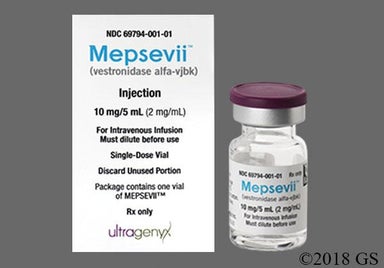
Mepsevii
Mepsevii (vestronidase alfa or vestronidase alfa-vjbk) is a medication that was approved by the FDA in 2017 for people with a rare, genetic condition called mucopolysaccharidosis VII, also known as Sly syndrome. This medication is infused into the vein every 2 weeks by a trained healthcare provider. Because it can cause a serious allergic reaction, your provider will ask you to stay for about an hour after your infusion to monitor you for symptoms.


What is Mepsevii (vestronidase alfa)?
What is Mepsevii (vestronidase alfa) used for?
- Mucopolysaccharidosis VII (MPS VII or Sly syndrome) in children and adults
How Mepsevii (vestronidase alfa) works
Mepsevii (vestronidase alfa) is an enzyme replacement therapy. It's used to treat mucopolysaccharidosis type VII (MPS VII or Sly syndrome), a rare, genetic condition where the body doesn't make enough of an enzyme (protein) that normally breaks down molecules called glycosaminoglycans (GAGs). The buildup of GAGs can cause problems in many parts of the body, including the bones, joints, brain, physical features, vision, and heart. Mepsevii (vestronidase alfa) replaces the missing enzyme in people with MPS VII so GAGs can be broken down properly in the tissues.
Drug facts
| Common Brands | Mepsevii |
|---|---|
| Drug Class | Enzyme replacement therapy |
| Controlled Substance Classification | Not a controlled medication |
| Generic Status | No lower-cost generic available |
| Availability | Prescription only |

Side effects of Mepsevii (vestronidase alfa)
The following side effects may get better over time as your body gets used to the medication. Let your healthcare provider know immediately if you continue to experience these symptoms or if they worsen over time.
Common Side Effects
- Pain, stinging, swelling, and other symptoms of tissue damage at the infusion site (33%)
- Diarrhea (25%)
- Rash (25%)
- Swelling in the body (8%)
- Itching of the skin (8%)
Mepsevii (vestronidase alfa) serious side effects
Contact your healthcare provider immediately if you experience any of the following.
- Severe allergic reaction: difficulty breathing, fast heartbeat, rash, hives, swelling of the face or tongue, tightness in the throat, dizziness, feeling confused, nausea, diarrhea, stomach pain
The following Mepsevii (vestronidase alfa) side effects have also been reported
Side effects that you should report to your care team as soon as possible:
- Allergic reactions—skin rash, itching, hives, swelling of the face, lips, tongue, or throat
- Infusion reactions—chest pain, shortness of breath or trouble breathing, feeling faint or lightheaded
Side effects that usually do not require medical attention (report these to your care team if they continue or are bothersome):

Pros and cons of Mepsevii (vestronidase alfa)
Pros
- Only given every 2 weeks
- Can be used in both children and adults
- Dose is individualized according to body weight
- 1 out of 3 people who used Mepsevii (vestronidase alfa) breathed better by 21% after about 2 years of treatment
Cons
- Given by IV infusion, which can be uncomfortable
- Must be given by a healthcare provider
- Need to be monitored for at least 1 hour after infusion due to risk of allergic reaction
- Each infusion takes about 4 hours

Pharmacist tips for Mepsevii (vestronidase alfa)

- Mark your appointment days and times on your calendar so you don't miss your Mepsevii (vestronidase alfa) treatments.
- Your provider will prescribe you an antihistamine or a medication to lower fever, such as acetaminophen (Tylenol), to help prevent a serious allergic reaction. To make sure that the medications have enough time to work, take them 30 minutes to an hour before each Mepsevii (vestronidase alfa) treatment session.
- It's not known if Mepsevii (vestronidase alfa) can be used during pregnancy or pass into your breast milk. Speak to your provider before starting Mepsevii (vestronidase alfa) if you're pregnant, planning to become pregnant, or breastfeeding.
- Your provider will monitor you for at least 1 hour after your infusion to make sure you don't have an allergic reaction.
- Let your provider know at the first sign of any allergic reaction (e.g., fever, hives, trouble breathing) so they can give you proper treatment or stop your infusion.

Risks and warnings for Mepsevii (vestronidase alfa)
Mepsevii (vestronidase alfa) can cause some serious health issues. This risk may be even higher for certain groups. If this worries you, talk to your doctor or pharmacist about other options.
Severe allergic reaction
 Some people might experience a severe allergic reaction known as anaphylaxis (closing of the throat) during treatment with Mepsevii (vestronidase alfa). Because of this risk, your provider will monitor you during and after your infusion for at least an hour. Let your provider know if you experience symptoms of an allergic reaction, such as dizziness, trouble breathing, tightness in the throat, rash, hives, and fast heartbeat.

Mepsevii (vestronidase alfa) dosage
Typical dosage for Mepsevii (vestronidase alfa)
Your provider will determine the dose based on your body weight.
The typical dose of Mepsevii (vestronidase alfa) is 4 mg/kg given as an intravenous (in the vein) infusion every 2 weeks by a healthcare provider.

Mepsevii (vestronidase alfa) images