Key takeaways:
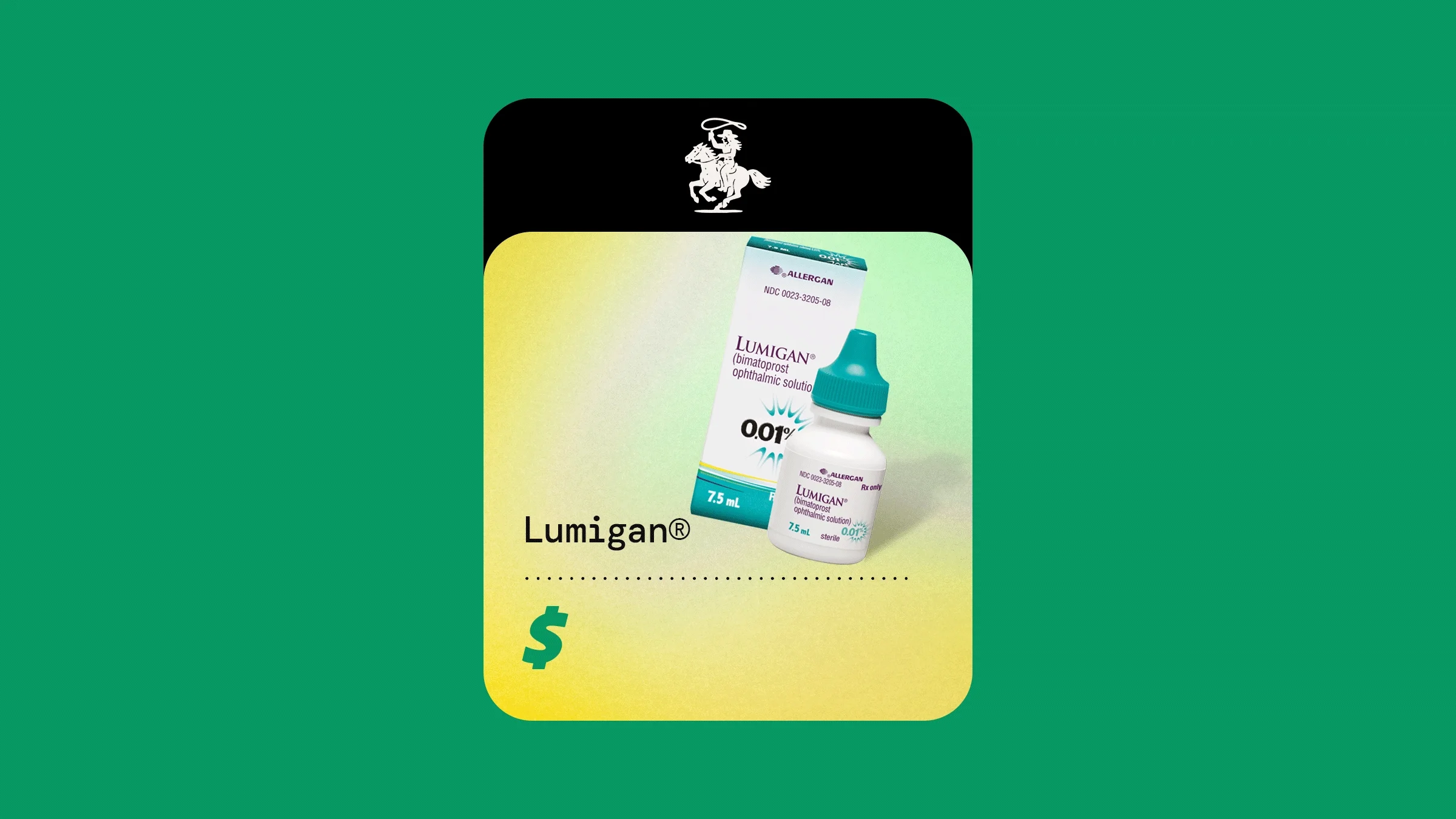
Lumigan (bimatoprost) is an FDA-approved prescription eye drop that reduces eye pressure by helping fluid drain from the eyes. It’s often used by those living with glaucoma or high eye pressure.
Without insurance, a 2.5 mL bottle of Lumigan 0.01% can cost an average of $354.11. You could pay as little as $274.46 with a GoodRx coupon at select pharmacies.
Lumigan’s manufacturer offers a savings program for eligible consumers with commercial insurance. You could pay as little as $15 for a 90-day fill. If you don’t have insurance or have limited coverage — and a financial need — you may qualify for free Lumigan through the myAbbVie Assist patient assistance program.
Save on related medications
Lumigan (bimatoprost) is an FDA-approved prescription eye drop treatment. This medication is a prostaglandin eye drop that treats glaucoma and elevated eye pressure (ocular hypertension).
Lumigan reduces eye pressure by helping fluid drain from the eyes. The typical dosage is 1 drop in each affected eye once daily in the evening.
The cost of Lumigan depends on several factors, including whether you have health insurance that covers this medication. If your health insurance doesn’t cover Lumigan, a GoodRx coupon can lower your cost at certain pharmacies.
Lumigan 0.01% comes in a 2.5 mL, 5 mL, and 7.5 mL bottle. It’s also available in a higher concentration, bimataprost 0.03%, as a lower-cost generic in the same sizes. Brand-name Lumigan 0.03% is no longer available.
Lumigan basics
The chart below provides a summary of basic information about Lumigan.
Lumigan basics
| Brand name | Lumigan |
| Form | Eye drops |
| FDA-approved use | To reduce eye pressure |
| Benefits |
|
| Possible side effects |
|
Is Lumigan covered by insurance?
Nearly all Medicare plans and Medicaid plans cover Lumigan. Coverage is less likely for commercial plans, including insurance purchased on an Affordable Care Act (ACA) marketplace.
If you have insurance, review your plan’s summary of benefits and coverage and formulary (list of covered medications) to determine whether Lumigan is covered. If not, contact your prescription plan provider and ask about your coverage options. You can also discuss alternatives with your prescriber or a pharmacist.
How insurance covers Lumigan
The following chart shows the likelihood of coverage for Lumigan, based on the type of insurance plan.
If you’re covered, there’s a higher likelihood than with most medications that your health insurance plan will require enrollees to get prior authorization or do step therapy — especially if you have Medicaid.
Insurance coverage for Lumigan (2.5 mL of 0.01%)
Insurance type | Enrollees covered for Lumigan, 1 eyedropper bottle of (2.5 mL of 0.01%) | Enrollees required to get prior authorization | Enrollees required to do step therapy |
|---|---|---|---|
Commercial plans (not including plans purchased through an ACA marketplace) | 61.8% | 6.9% | 9.8% |
70.8% | 5.8% | 26.5% | |
Medicare, including original Medicare and Medicare Advantage plans | 94.9% | 0% | 0.1% |
Medicaid, including state-run and managed care plans | 99.8% | 58.7% | 24.2% |
Source: Managed Markets Insight & Technology, LLC™, as of June 13, 2025. (See methodology below.)
Tips if your medication isn’t covered by insurance
If your insurance plan doesn’t cover Lumigan, you still have options:
Ask your prescriber about switching to a less-costly treatment that meets your needs, such as a lower-cost generic medication.
Request a formulary exception from your insurance company to have Lumigan covered. If your request is denied, you have the right to file an appeal with your plan.
Use a GoodRx coupon to save on your prescription.
When it’s time for open enrollment, compare different health insurance plans to find one that provides the coverage you need.
How much does Lumigan cost without insurance?
Without insurance, what you pay for Lumigan depends on several factors, including your:
Specific pharmacy
Geographic location
Fill quantity
The following table shows what Lumigan might cost for a cash-paying consumer.
Lumigan costs
Ways to save on Lumigan with and without insurance
Lumigan may be a stretch for your budget. Whether or not you have insurance, there are ways to reduce the cost. Here are five options.
1. Use a GoodRx coupon
You can use a free GoodRx coupon to reduce the price of your Lumigan prescription at your pharmacy. For example, without insurance, you could pay as low as $274.46 for a 2.5 mL bottle of Lumigan 0.01% with a GoodRx coupon at certain pharmacies. Visit www.goodrx.com, or download the GoodRx app on your mobile device, to get a coupon. Here’s how to do so:
On the app or website, type “Lumigan” in the search field.
Choose the desired quantity. Input your ZIP code or address, or select “Use my current location” so the results show local pharmacies.
Choose how to receive your coupon (printed, emailed, or texted).
Take your coupon with you to the pharmacy. You can also present the coupon to the pharmacy staff early in the filling process to avoid delays at the pickup counter.
2. Compare prices at various pharmacies
GoodRx lets you easily compare Lumigan costs at different pharmacies in your area. You might find it’s worth traveling a bit further to get a discounted price.
3. Try a manufacturer savings program or patient assistance program
Lumigan’s manufacturer offers a savings program for consumers with commercial insurance, through which you could pay as little as $15 for a 90-day fill. Consumers are eligible for this program as long as they don’t have government insurance, such as Medicare and Medicaid — or use a state or federal pharmaceutical discount program. If you don’t have insurance or have limited coverage — and have a financial need — you may qualify for free Lumigan through the myAbbVie Assist patient assistance program and its Patient Access Support application.
4. Ask your prescriber about alternatives
Lumigan isn’t the only eye pressure medication available. Ask your prescriber about lower-cost options that may adequately treat your condition.
5. Use tax-advantaged healthcare funds
Consider using a flexible spending account (FSA), health savings account (HSA), or health reimbursement arrangement (HRA) to cover your medication. These types of accounts have multiple tax benefits when used to pay for healthcare. This can reduce your out-of-pocket costs through tax savings. Review your account’s contribution limits, rollover limits, and eligible expenses.
The bottom line
Lumigan (bimatoprost) is an FDA-approved prescription eye drop that reduces eye pressure. It’s often used by those who have glaucoma or ocular hypertension (high eye pressure). The cost of Lumigan depends on factors such as the pharmacy you use and your insurance coverage status.
If you don’t have insurance, the average price of Lumigan is $354.11, but you could pay as little as $274.46 with a GoodRx coupon at select pharmacies.
If you have commercial insurance, you could pay as little as $15 for a 90-day fill of Lumigan 0.01% through a manufacturer savings program. If you have limited coverage or no insurance — and have a financial need — you may qualify for free Lumigan through the myAbbVie Assist patient assistance program. Other ways to save include using funds from a tax-advantaged healthcare account, asking your prescriber about cost-effective alternatives, and comparison shopping at different pharmacies.

Why trust our experts?




Methodology
We obtained national prescription coverage data for each medication from Managed Markets Insight & Technology (MMIT). The data reflects health insurance coverage as of June 2025.
We calculated the percentage of enrollees in plans that cover each medication by dividing the number of enrollees covered for the medication within a specific insurance channel (e.g., ACA, Medicare, Medicaid) by the total number of enrollees in all plans within that channel.
We determined the percentage of enrollees in plans with a prior authorization requirement by calculating the proportion of enrollees in plans that required prior authorization for the medication within each channel.
Finally, we measured the percentage of enrollees in plans with a step therapy requirement by calculating the proportion of enrollees in plans that imposed step therapy requirements for the medication in each channel.
These estimates, derived from national MMIT coverage data, provide insight into health insurance coverage for each medication. They take into account restrictions such as prior authorization, step therapy, and quantity limits. The percentages are expressed relative to the total number of enrollees covered by various insurance channels, including the ACA, commercial (excluding ACA) plans, Medicare, and Medicaid (both state-run and managed care plans).
References
AbbVie. (n.d.). AbbVie is here to help.
AbbVie. (n.d.). myAbbVie Assist.
AbbVie. (2024). Patient access support.
Allergan. (2024). Lumigan- bimatoprost solution/ drops [package insert].
Medicaid.gov. (n.d.). Managed care. Centers for Medicare & Medicaid Services.
Somerset Therapeutics. (2025). Bimatoprost solution/ drops [package insert].