Key takeaways:
A summary of benefits and coverage (SBC) is a guide that provides essential information about a health insurance plan, including costs, benefits, and exclusions.
When reviewing the SBC, pay attention to key terms like deductible, copayment, coinsurance, and out-of-pocket maximum.
While the monthly premium is a significant consideration when selecting a health plan, it’s also important to consider cost-sharing and out-of-network benefits.
Shopping for health insurance coverage can feel overwhelming. With so many available options, figuring out which plan will give you the coverage you need can be tough.
Thanks to the Affordable Care Act (ACA), most health insurance companies and group health plans must provide you with a summary of benefits and coverage (SBC). The SBC helps you compare your options and understand your coverage. No matter the insurance provider, all SBCs outline the same basic information. But not all health plans have an SBC, as it is specifically an ACA requirement.
What is a summary of benefits and coverage (SBC)?
A summary of benefits and coverage (SBC) is a document that gives an overview of the costs, covered services, benefits, and other details of a health insurance policy.
Search and compare options
In it, you’ll also find examples of how much you might pay out of pocket in common medical situations, and what you can expect to pay if you use in-network versus out-of-network providers.
What should your SBC include?
First off, your SBC should include information about cost-sharing expenses, such as your:
Here’s a breakdown of what else your SBC should include:
A glossary of terms related to medical and health coverage
An overview of what’s included in the plan’s coverage
An explanation of the services and treatments not covered
Information on the health plan’s prescription medication coverage
A summary of any limits and exclusions
Examples of how the health plan covers common medical scenarios
Your rights including grievance and appeals
Information about compliance with the minimum essential coverage and minimum value standards requirements under the ACA
Details on where to access the complete health plan documents online
A number to call if you have questions
Where can you find your SBC?
If you’re shopping for a health plan on the ACA health insurance marketplace, you’ll have the option to review the SBC for each plan before making a decision. If you’re getting healthcare coverage through your employer, the SBC should be provided to you when you enroll.

Read more like this
Explore these related articles, suggested for readers like you.



If you already have health insurance, you can obtain your SBC by logging into your health plan’s online portal. If you prefer to request it directly from your insurance company, you can do so anytime. Alternatively, use a search engine to find it yourself. Remember to have your member ID and group number available.
You can locate the SBCs of some major health plans at the links below:
A sample SBC
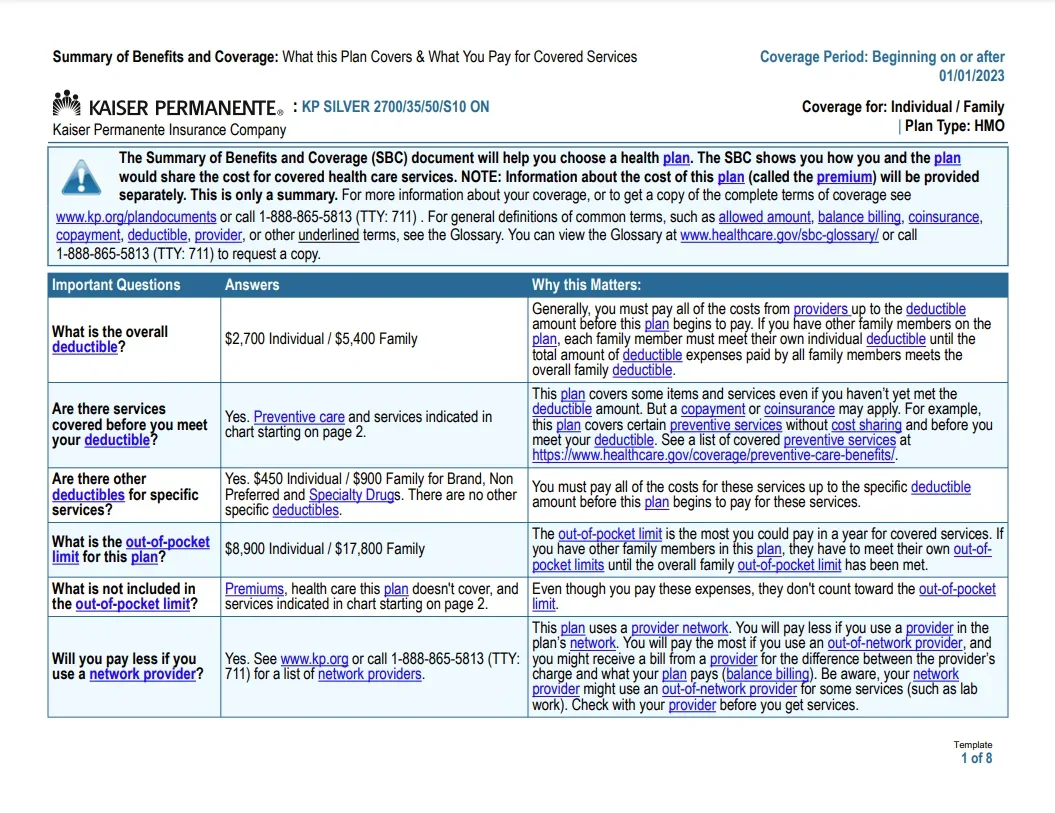
Let’s take a look at an SBC from Kaiser Permanente. You’ll notice that it is divided into several sections. Here are a few steps to take when you are reviewing an SBC to better understand the coverage:
Check the coverage period. Start by looking at the date in the upper-right corner to ensure it’s the correct version for the current plan year.
Review the plan number and type. It’s important to check that you’re reviewing the SBC for the right plan number and type. The plan number in this sample SBC is KP Silver 2700/35/50/S10 ON, and it falls under the health maintenance organization (HMO) plan type.
Check the cost-sharing amounts. Ensure you understand exactly how much you’ll be responsible for paying for different services. In this example, the deductible for an individual is $2,700. Suppose you have other family members covered under the plan; in that case, each person will have to meet their own deductible until the amount paid by all family members reaches the overall family deductible of $5,400. Some services are exempt from the deductible and only require a copay.
Verify out-of-network coverage. The SBC will indicate your financial responsibility if you receive services from out-of-network providers. Check if your preferred healthcare providers are included in the plan’s network and if a referral is required to see specialists.
Check medication coverage. Pay special attention to the prescription medication section of the SBC, as it provides important information about your expenses. Many plans have medications grouped into categories with different copays.
Understand the limitations and exclusions. Be aware of services that are not covered by your plan.
Review the coverage examples. Another helpful section of the document is the hypothetical scenarios. They are meant to give you an idea of your coverage for specific conditions, such as pregnancy or diabetes, and the potential cost of care. This is important since it gives you an idea of how the plan functions and what the cost-sharing looks like.
Using an SBC to shop for health insurance
When you’re shopping for health insurance, there are a few things you should look at to make sure you’re signing up for the right plan. First, compare the monthly premium to the premiums of other plans. Before choosing a plan, consider how much you can afford to pay each month. Keep in mind, a lower premium doesn’t necessarily mean you’ll pay less for healthcare.
You should also look at the cost-sharing amounts, including what your deductible, copayment, and coinsurance would be. For example, one plan might have a $50 copay for a specialist, while another might require you to pay 20% of the total cost of the visit.
Another important factor is a plan's network of healthcare providers and facilities. Verify if the plan you’re considering has a network that includes providers who are convenient for you to visit and who offer the services you need. Also, determine whether the plan provides out-of-network benefits if you decide to go that route. If you have a chronic condition, figuring out how often you see a healthcare provider on average can help you select a plan that fits your needs.
It’s also crucial to check a plan’s formulary to ensure it covers any prescription medications you regularly take.
Also, be sure to review and understand a plan’s coverage limitations and exclusions. Let’s say you’re considering bariatric surgery in the coming year. You should check whether a plan you’re interested in covers this type of service.
Ask if the plan you’re considering offers a health savings account (HSA) or flexible spending account (FSA). These accounts allow you to save money by putting aside pretax dollars from your paycheck to cover healthcare expenses.
The bottom line
A summary of benefits and coverage (SBC) is a helpful tool for understanding your health insurance coverage. It breaks down your plan’s coverage and cost-sharing amounts, including any exclusions that may affect your healthcare choices.
When shopping for health insurance, look closely at all potential out-of-pocket costs and covered benefits outlined in a plan’s SBC. While it may seem overwhelming, understanding an SBC can help you find a plan that suits your needs and budget.

Why trust our experts?



References
Centers for Medicare & Medicaid Services. (2022). Summary of benefits and coverage: What this plan covers & what you pay for covered services.
Kaiser Permanente. (2023). Summary of benefits and coverage: What this plan covers & what you pay for covered services.