Key takeaways:
Heparin is an injectable blood thinner medication. It helps prevent unwanted blood clots by blocking key proteins involved in the clotting process: factor Xa and thrombin.
Heparin is typically given as an IV infusion in a hospital setting. It treats and prevents conditions such as deep vein thrombosis (DVT), pulmonary embolism (PE), and blood clots during surgery or dialysis.
Low-molecular-weight heparin (LMWH) is a modified form of heparin. It lasts longer, doesn’t require as much monitoring, and is often prescribed for at-home use. But LMWH can be costly, and its effects are harder to reverse in an emergency.
Save on related medications
Normally, it’s important for your blood to clot. For example: When you get a paper cut, a blood clot helps you stop bleeding quickly. But sometimes, blood clots can form inside your blood vessels and block blood flow to your heart or brain. This is where anticoagulant (blood thinner) medications come into play.
Heparin, also referred to as unfractionated heparin, is an injectable medication that prevents the formation of unwanted blood clots. But how does it work, and when is it prescribed? Here, we’ll review heparin’s mechanism of action to help you understand its role in preventing unwanted blood clots.
What is heparin’s mechanism of action?
To understand heparin’s mechanism of action, we first need to review how blood clots form in your body.
When there’s damage to your blood vessels, your body sends a chemical signal that starts the clotting process. This is known as the coagulation cascade, and it has a series of consecutive steps. Each step activates different clotting factors — proteins that help create a stable clot.
Heparin’s mechanism of action is to block certain steps of the coagulation cascade. It binds to a protein called antithrombin, which in turn stops two major clotting factors from forming: factor Xa and thrombin. Without these clotting factors, it’s much harder for your body to form unwanted blood clots.
When is heparin usually prescribed?
Heparin is FDA-approved for the following uses:
Preventing and treating clots in the veins (deep vein thrombosis) and lungs (pulmonary embolism)
Preventing blood clots after surgery
Preventing and treating blood clots caused by atrial fibrillation (an irregular heartbeat)
Treating and preventing peripheral arterial embolism (blood clots that travel to the arteries in your arms and legs).
Treating blood clots caused by blood clotting disorders
Preventing blood clots during procedures such as dialysis and blood transfusions
Heparin also has several off-label uses, such as preventing blood clots caused by sepsis or kidney failure.
How do you take heparin?
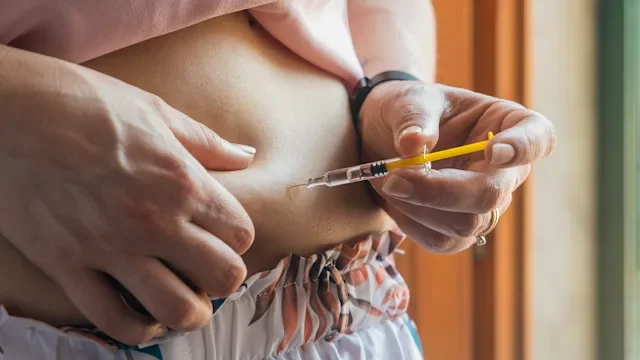
Heparin isn’t an oral medication. Instead it’s injected under the skin (subcutaneous) or into a vein (IV). In most cases, you’ll receive heparin in a hospital setting. But you may inject it yourself under the skin at home in some cases.
Your heparin dose is based on your body weight. It can vary based on the condition you’re treating and how you’re receiving the medication.
Your healthcare team will use blood tests to monitor how well heparin is working and decide if you need a dosage adjustment. These tests can include:
aPTT (activated partial thromboplastin time)
ACT (activated clotting time)
Anti-factor Xa activity
What’s the difference between heparin and low-molecular-weight heparin?
The term “heparin” typically refers to unfractionated heparin. But there’s also another form of heparin: low-molecular-weight heparin (LMWH). Common LMWH medications include enoxaparin (Lovenox) and dalteparin (Fragmin).
Heparin and LMWH are similar, but there are some significant differences between them, such as:
How they’re given: As mentioned, heparin is typically given as an IV infusion in a hospital setting. It’s also injected under the skin in some cases, with frequency ranging from 2 to 3 times per day. LMWH medications are injected under the skin once or twice a day. They’re typically prescribed for at-home use. In fact, you may switch from heparin to LMWH once you’re discharged from the hospital if oral blood thinner medications aren’t an option for you.
Monitoring: Heparin often requires regular blood tests to make sure it’s working properly. LMWH medications have a more predictable response in the body, so they don’t require regular monitoring.
Reversibility: If bleeding or other issues occur, your healthcare team can reverse the effects of heparin with a medication called protamine. LMWH medications can’t be fully reversed — protamine is only about 60% effective.
Cost: LMWH medications can be more costly than heparin. This is because they’re packaged as individual prefilled syringes, and they haven’t been around as long as heparin has.
The bottom line
Unfractionated heparin is a fast-acting blood thinner used to treat or prevent dangerous blood clots. Heparin’s mechanism of action is to boost the effects of antithrombin, a natural protein that blocks clotting factors. Specifically, heparin blocks factor Xa and thrombin, two key proteins involved in forming blood clots.
Heparin is typically given through an IV infusion in a healthcare setting. Your dosage is based on your body weight as well as blood tests that measure how well heparin is working. Low-molecular-weight heparin (LMWH) is a modified form of heparin that has more predictable effects. LMWH medications are injected under the skin and are often prescribed for at-home use. They last longer in the body than heparin, which means you inject them less often, but they aren’t as easily reversed.

Why trust our experts?




References
American Society of Hematology. (n.d.). Blood clots.
Barmore, W., et al. (2023). Biochemistry, clotting factors. StatPearls.
Chaudhry, R., et al. (2025). Physiology, coagulation pathways. StatPearls.
Chen, D. (2021). Heparin beyond anti-coagulation. Current Research in Translational Medicine.
Green, D., et al. (2024). Prescriber perceptions of the safety and efficacy of unfractionated heparin versus low molecular weight heparin in the acute treatment phase: A qualitative study. Journal of Pharmaceutical Policy and Practice.
Henry Schein. (2024). Heparin sodium- heparin sodium injection [package insert].
MedlinePlus. (2024). Arterial embolism.
Murdeshwar, H. N., et al. (2023). Hemodialysis. StatPearls.
National Blood Clot Alliance. (n.d.). Low molecular weight heparin (LMWH).
National Blood Clot Alliance. (n.d.). Unfractionated heparin (UFH).
National Heart, Lung, and Blood Institute. (2022). What are blood clotting disorders? National Institutes of Health.
Oduah, E. I., et al. (2016). Heparin: Past, present, and future. Pharmaceuticals.
Patel, P., et al. (2025). Heparin. StatPearls.
Rountree, K. M., et al. (2023). Partial thromboplastin time. StatPearls.
U.S. Food and Drug Administration. (2018). Generic enoxaparin questions and answers.
Yee, J., et al. (2019). Emergency reversal of anticoagulation. Western Journal of Emergency Medicine.