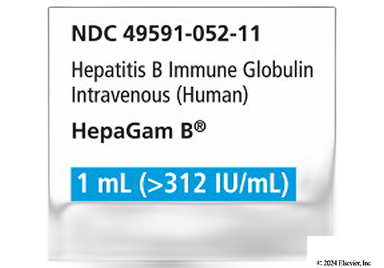
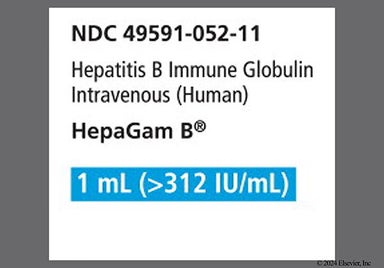
Hepatitis B immune globulin, also known by its brand name HepaGam B, is an immune globulin that's used to help prevent hepatitis B infection after you've come into contact with the hepatitis B virus. HepaGam B isn't considered a vaccine, and it also isn't meant to treat hepatitis B. HepaGam B is given as an intravenous (IV) infusion through the veins or as an injection into the muscle. Side effects are rare, but can include low blood pressure and nausea.
Prevention of hepatitis B re-infection after a liver transplant in people who test positive for hepatitis B virus (i.e., they're infected with the virus)
Prevention of hepatitis B infection after exposure to the hepatitis B virus
How HepaGam B works
HepaGam B is an immune globulin. It's a lab-made protein that attaches to the hepatitis B virus in your body and destroys it. This prevents you from getting sick with hepatitis B after you've come into contact with the virus.
The following side effects may get better over time as your body gets used to the medication. Let your healthcare provider know immediately if you continue to experience these symptoms or if they worsen over time.
Common Side Effects
Low blood pressure
Nausea
Less Common Side Effects
Headache
Dizziness
HepaGam B serious side effects
Contact your healthcare provider immediately if you experience any of the following.
The following HepaGam B side effects have also been reported
Along with its needed effects, a medicine may cause some unwanted effects. Although not all of these side effects may occur, if they do occur they may need medical attention.
Check with your doctor or nurse immediately if any of the following side effects occur:
Rare
Blurred vision
confusion
dizziness, faintness, or lightheadedness when getting up suddenly from a lying or sitting position
Some side effects may occur that usually do not need medical attention. These side effects may go away during treatment as your body adjusts to the medicine. Also, your health care professional may be able to tell you about ways to prevent or reduce some of these side effects. Check with your health care professional if any of the following side effects continue or are bothersome or if you have any questions about them:
Bleeding, blistering, burning, coldness, discoloration of the skin, feeling of pressure, hives, infection, inflammation, itching, lumps, numbness, pain, rash, redness, scarring, soreness, stinging, swelling, tenderness, tingling, ulceration, or warmth at the injection site
Works well to prevent hepatitis B infection after exposure
Few side effects
Can get inactivated vaccines (e.g., hepatitis B vaccine, flu shot) while you're getting HepaGam B injections
Cons
Only given as an injection
Must be given by a healthcare professional at a hospital or clinic
Might need to get several doses if you're getting it after a liver transplant
Pharmacist tips for HepaGam B
Mark your appointment dates on your calendar for all your HepaGam B injections. Getting your injections on time helps make sure you can stay fully protected against hepatitis B.
Don't get any vaccines, especially live vaccines, without talking to your provider or pharmacist first to make sure it's safe for you to get them.
If you have diabetes and usually check your blood sugar regularly, check that your blood glucose monitor and test strips are okay to use while you're taking HepaGam B. This medication can cause falsely high blood sugar levels because it has maltose in it. You should only use testing systems that are glucose-specific. Ask your local pharmacist for help checking on this if you're not sure.
Get medical help as soon as you can if you think you've been exposed to hepatitis B. Often times, it's best to give HepaGam B as soon as possible after you've been exposed, ideally within 24 hours.
Risks and warnings for HepaGam B
HepaGam B can cause some serious health issues. This risk may be even higher for certain groups. If this worries you, talk to your doctor or pharmacist about other options.
Severe allergic reactions
Risk factors: Antibodies to IgA
There's a rare chance that you might have a severe allergic reaction to HepaGam B. Your risk is higher if you have antibodies to IgA because HepaGam B contains a low amount of IgA, which might trigger a reaction.
Your provider might ask you to stay at the hospital or clinic for a short period of time after you've gotten your dose of HepaGam B to make sure you can get proper care in case of a serious allergic reaction. Sometimes, these reactions can happen after you've already left the clinic. Get medical help right away if you notice symptoms of a severe allergic reaction, such as feeling faint, swelling of the face, closing of the throat, difficulty breathing, hives or rash, dizziness, shaking, nausea, or chest pain.
Falsely high blood sugars
Risk factors: Type 1 or Type 2 diabetes | Using insulin | Using glucose meters that use GDH-PQQ
HepaGam B contains maltose. This particular type of sugar can cause your blood sugar readings to be falsely high if you use certain glucose monitors that use a substance called GDH-PQQ in test strips. This puts you at risk for low blood sugar (hypoglycemia) if you use insulin to correct the inaccurate blood sugar reading. Contact your local pharmacist or the manufacturer of the glucose monitor you use if you're not sure if it can be used with products that have maltose in them.
Possible transmission of other viruses
HepaGam B is made from human plasma, which is taken from human blood. Although very rare, there's a possible risk that viruses can be passed on to people who take this medication and put them at risk for infections and conditions such as Creutzfeldt-Jakob disease (CJD). Please note that this risk is only a theory and there haven't been any known cases reported in real life with HepaGam B yet. Contact your provider right away if you think you might have an infection. Your provider will examine you and report any suspected infections to HepaGam B's manufacturing company.
Considerations for people with clotting problems or low platelets
HepaGam B is given as an injection only into the muscle if it's being used to prevent hepatitis B infection after exposure to the virus. Talk to your provider before you get HepaGam B if you have a history of a low platelet count or a coagulation (clotting) problem. Injections into the muscle aren't usually allowed for people with these conditions for safety reasons. HepaGam B should only be given to you if the benefit is greater than the risk.
Risk of clots
Risk factors: Atherosclerosis | High triglycerides (fat) levels | Risk factors for heart problems | Heart failure | Clotting problems | Older adults | Not moving for long periods of time | High blood thickness (viscosity)
There's a risk of clots during or after treatment with IV immune globulins like HepaGam B. Your provider will check for any risk factors for clots listed above, such as atherosclerosis (fatty buildup in the arteries) or other risk factors for heart problems. Also be sure to tell your providers about all your medical conditions. If you're at risk for clots, you can still get HepaGam B; your provider will just need to infuse it slower if you're taking the medication as an IV infusion.
HepaGam B dosage
The average cost for 6 vials of 1ml of HepaGam B is $1,252.50 with a free GoodRx coupon. This is 4.22% off the average retail price of $1,307.74.
HepaGam B may interact with certain medications or supplements. Always let your doctor and pharmacist know about any other medications or supplements (including prescribed and over-the-counter medications, vitamins, and dietary or herbal supplements) that you are currently taking. The list below does not include all possible drug interactions with HepaGam B. Please note that only the generic name of each medication is listed below.
Although certain medicines should not be used together at all, in other cases two different medicines may be used together even if an interaction might occur. In these cases, your doctor may want to change the dose, or other precautions may be necessary. When you are receiving this medicine, it is especially important that your healthcare professional know if you are taking any of the medicines listed below. The following interactions have been selected on the basis of their potential significance and are not necessarily all-inclusive.
Using this medicine with any of the following medicines may cause an increased risk of certain side effects, but using both drugs may be the best treatment for you. If both medicines are prescribed together, your doctor may change the dose or how often you use one or both of the medicines.
Contraindications are specific health conditions or situations in which a person should not take a medication due to safety concerns. If you have any of the following conditions or if any of the following apply to you, let your healthcare provider know because HepaGam B will not be safe for you to take.
History of severe allergic reactions to other human globulin products
Centers for Disease Control and Prevention. (2021). Immunity types.
GoodRx Health has strict sourcing policies and relies on primary sources such as medical organizations, governmental agencies, academic institutions, and peer-reviewed scientific journals. Learn more about how we ensure our content is accurate, thorough, and unbiased by reading our editorial guidelines.
Prescription savings
Stop paying too much for your prescriptions. Compare prices, get pharmacy coupons, and save up to 80%.
Hepagam B is for people who've been exposed to the hepatitis B virus in specific situations. It's for people who've had a liver transplant and have also tested positive for hepatitis B (meaning they're infected with the virus). Hepagam B is also given to people who were exposed to blood infected with hepatitis B (e.g., sharing needles, accidental exposure when working in healthcare), babies born to mothers who have hepatitis B, and household or sexual exposure to someone with hepatitis B. These are all ways that the hepatitis B virus can spread from person to person. Note that Hepagam B doesn't treat an active or long-term hepatitis B infection, but it lowers your risk for this infection. Get medical help right away if you think you've been exposed to hepatitis B because getting Hepagam B as soon as possible gives you the best chance to lower the risk for infection.
The hepatitis B vaccine (e.g., Heplisav B, Engerix B) and Hepagam B (hepatitis B immune globulin) both protect against hepatitis B infection, but they're used differently. The hepatitis B vaccine is a CDC-recommended, routine vaccine that helps prevent hepatitis B for everyone who hasn't been exposed to the virus. The vaccine helps your body's immune system make antibodies that attack the hepatitis B virus to protect you in case you ever come in contact with it in the future. But Hepagam B is used to prevent hepatitis B in people who've already been exposed to the virus by directly attacking the virus. Hepagam B works similarly to antibodies. After you're given Hepagam B, your body doesn't need to wait for your immune system to make its own antibodies against the virus like it does with the vaccines.
Hepagam B doesn't attack inactivated vaccines, like the hepatitis B vaccines and most flu shots. In particular, Hepagam B can be given at the same time or up to one month before a hepatitis B vaccine without affecting your body's response to the vaccine. But it's not known whether Hepagam B can interfere with how well live vaccines, such as the live flu vaccine (LAIV) and MMR (measles, mumps, and rubella vaccine), will work for you. For this reason, you shouldn't receive any live vaccines for 3 months after you get Hepagam B. Let your provider or pharmacist know that you're taking Hepagam B before you get any vaccines so they can make sure you can get the vaccine you want.
Talk to your provider about whether you can get Hepagam B if you're pregnant. It's not known whether this medication is safe or works well during pregnancy because it hasn't been studied. In general, Hepagam B should only be used during pregnancy if it's clearly needed.