Over the past few years, frustration over the high cost of prescription drugs has swept across America. The White House has promised numerous executive orders and bold new steps. Congress has produced dozens of bills promising a variety of fixes and tweaks to the system. Most importantly, Americans have made clear that they are fed up with unaffordable healthcare and they want to see change—now.
So, for all this talk, what has actually happened? So far, very little.
Despite all the attention, prescription drug prices aren’t dropping. In fact, they have stabilized, according to the GoodRx Quarterly Report, an in-depth analysis of fill trends and drug prices in America. In the second quarter of 2019, prices for most drugs didn’t budge much at all, either up or down.
On the one hand, that’s not surprising: All the noise around drug prices has convinced drug manufacturers to keep prices steady, and not do anything to draw too much attention.
On the other hand, is that really all we can expect when the nation demands change? That prices stay the same? After all, flat prices are not a solution—they just freeze the problem for a spell. So until something bigger happens in D.C. or elsewhere, the outrage will still be out there.
Our report walks through the current state of drug prices in the U.S., and identifies several drugs that have, in fact, seen price increases. It also highlights regions in the U.S. where prices are tracking higher than the national average. Lastly, it points to a few bright spots, such as drugs that have new, generic versions on the market (generics are usually significantly cheaper than the original brand drug).
We’ll continue to monitor drug prices, both what’s happening in D.C. and what’s going on in your local pharmacy. And we’ll always be looking for ways to help Americans save.
– Doug Hirsch, co-CEO GoodRx
This version of the quarterly report mainly focuses on data from the second quarter of 2019 (April 1, 2019 to June 30, 2019).

Read more like this
Explore these related articles, suggested for readers like you.
Among our top findings:
The average list price (the price set by the manufacturer) for all brand and generic drugs were basically flat, falling by just 0.34% during the second quarter of 2019.
Myalept, Ravicti, and Actimmune were the three most expensive prescription medications in the U.S. during Q2. Oxervate, approved in 2018, is available in pharmacies and is now the fourth most expensive drug with a price of $47,200 for a 30-day supply.
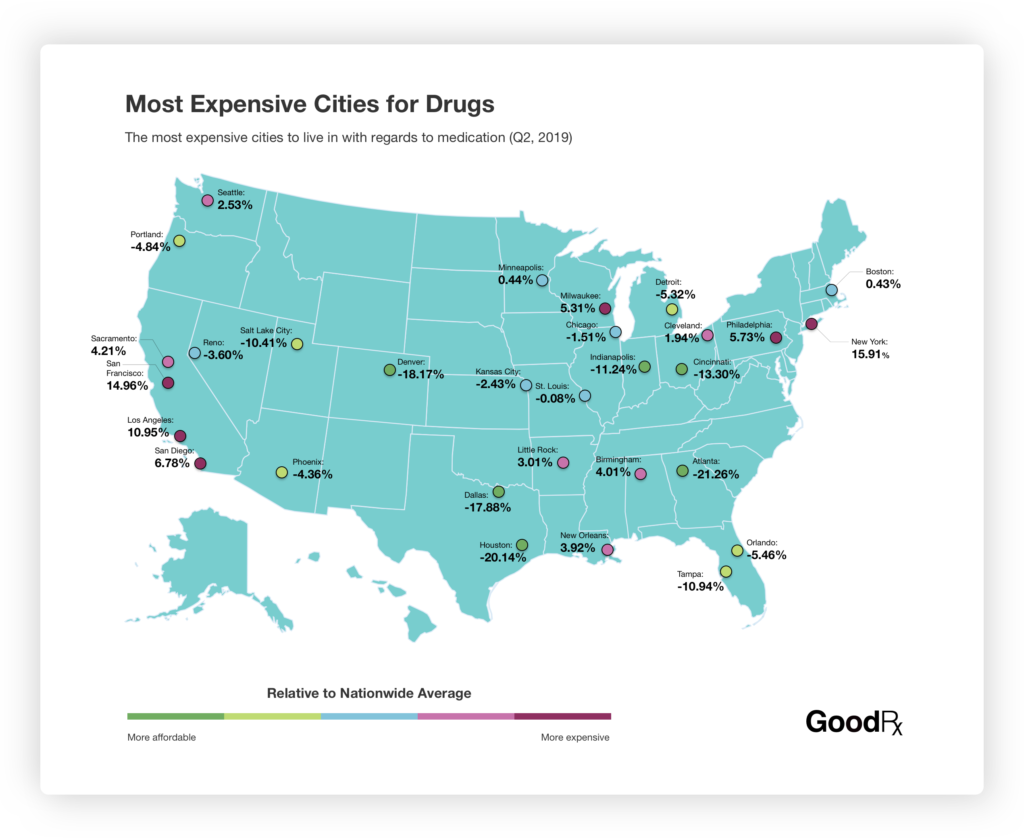
Los Angeles, New York, and San Francisco continue to be the most expensive cities for prescription medications, with prices 10% higher than the national average.
For a full PDF of this report, including a complete breakdown of the methodology, download our white paper here.
Most expensive prescription drugs in the U.S.
The following were the most expensive drugs in the United States during Q2, based on their list price—the official price of a drug assigned by the manufacturer. This list contains medications that are available in pharmacies and excludes drugs that are administered by a healthcare provider.
While a majority of these medications treat relatively rare conditions, some—such as Sabril (vigabatrin), which treats epilepsy—target more common conditions.
The 20 most expensive prescription medications in the U.S.
| Drug | Manufacturer | List price* |
|---|---|---|
| Myalept | Aegerion Pharmaceuticals | $64,859 |
| Ravicti | Horizon Pharma | $52,756 |
| Actimmune | Horizon Pharma | $47,962 |
| Oxervate | Dompé | $47,200 |
| Daraprim | Vyera Pharmaceuticals | $45,000 |
| Cinryze | Shire | $44,141 |
| Takhzyro | Shire | $44,140 |
| Chenodal | Retrophin, Inc | $42,570 |
| Juxtapid | Aegerion Pharmaceuticals | $40,671 |
| H.P. Acthar | Mallinckrodt Pharmaceuticals | $38,892 |
| Tegsedi | Akcea Therapeutics | $34,6002 |
| Firazyr | Shire | $33,443 |
| Vitrakvi | Bayer and Loxo Oncology, Inc | $32,800 |
| Sovaldi | Gilead | $28,000 |
| Viekira Pak | Abbvie | $27,773 |
| Viekira XR | Abbvie | $27,773 |
| Orfadin | Apotek Produktion & Laboratorier AB | $27,247 |
| Sabril | Lundbeck Pharmaceuticals | $26,301 |
| Tibsovo | Agios Pharmaceuticals | $26,115 |
| Cerdelga | Sanofi Genzyme | $26,000 |
*Prices reflect list prices for each medication’s most common 30-day prescription.
For more information on these expensive medications and ways to save, read our blog post here.
Most popular drugs in the U.S.
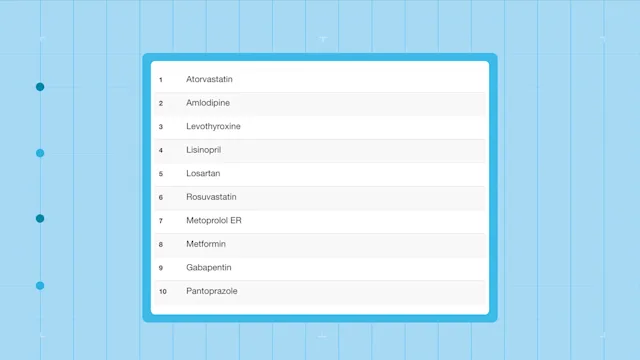
The following 10 prescription medications were the most popular during the second quarter of 2019 based on a representative sample of fills at U.S. pharmacies. These drugs are all generics that cost less than $30 for a monthly supply, and they paint a picture of the common health issues that Americans face.
Increases in list price
According to the GoodRx List Price Index, a measure of overall drug prices, the average list price for all brand and generic medications dropped by 0.34% during Q2. This year, prices have increased by 1.31% overall, well below the inflation rate of 1.76%.
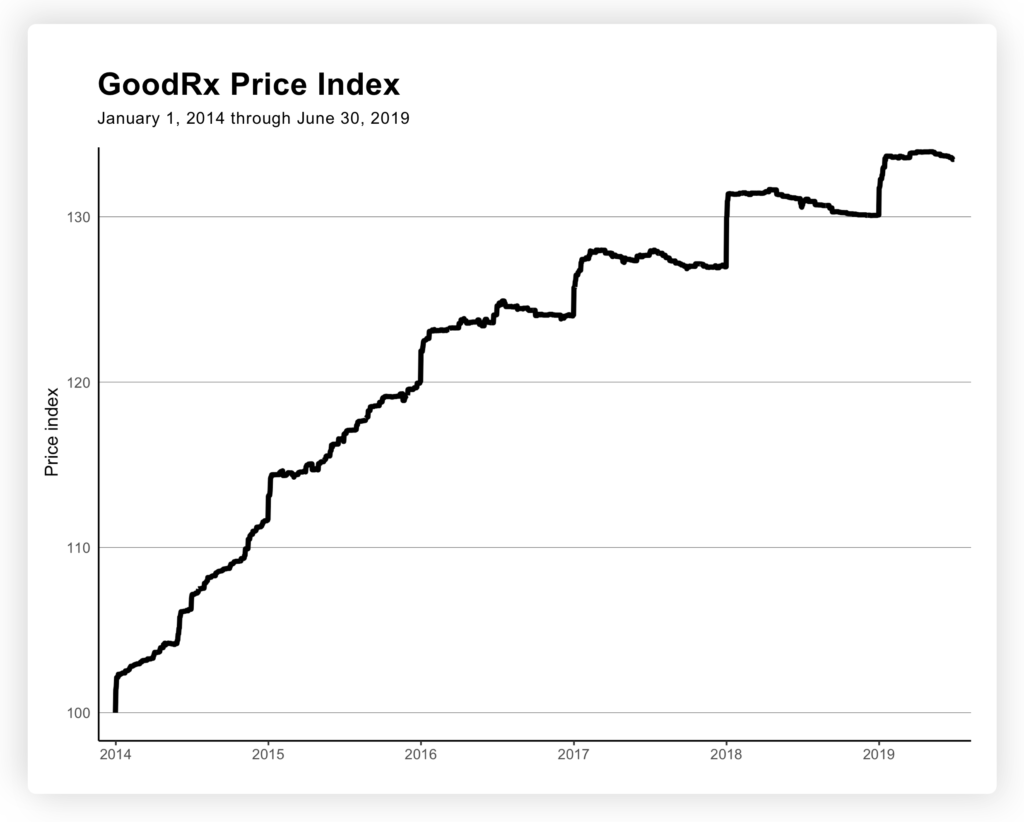
*A price index value equal to 130 indicates an increase in drug prices of 30% since December 31, 2013.
Compared to Q1, Q2 is generally a slow month for price increases. In fact, from April 1, 2018 to June 30, 2018, only 82 brand drugs saw an increase, while 500 drugs increased in price during the first quarter of 2019.
This past quarter, manufacturers such as Shire Pharmaceuticals and Merck increased their drugs by upwards of 3%.
Below are 10 popular drugs that increased in price this past quarter.
| Drug | Manufacturer | Percent increase | List price per unit |
|---|---|---|---|
| GenVisc 850 | OrthogenRx | 135.1% | $159.60 per 2.5 ml syringe |
| Cotempla XR | Neos Therapeutics Brands, LLC | 8.4% | $12.36 per 17.3 mg orally disintegrating tablet |
| Nuedexta | Avanir Pharmaceuticals | 6.9% | $19.57 per 20 mg/10 mg table |
| Abilify Maintena | Otsuka America Pharmaceuticals Inc. | 5.0% | $2,274.73 for one 400 mg vial |
| Isentress | Merck | 5.0% | $26.24 per 400 mg tablet |
| Cabometyx | Exelixis, Inc. | 4.5% | $639.73 per 60 mg tablet |
| Xiidra | Shire Pharmaceuticals | 3.0% | $8.70 per 5% ampule |
| Vyvanse | Shire Pharmaceuticals | 3.0% | $10.13 per 40 mg tablet |
| Gattex | Shire Pharmaceuticals | 3.0% | $39,271.88 per 5 mg vial |
| Firazyr | Shire Pharmaceuticals | 3.0% | $3,715.83 per 30 mg/3 ml syringe |
While the average list price dropped during Q2, on July 1, prices increased for 37 additional brand drugs. These hikes are unfortunate, but they are expected. In general, manufacturers increase the price of their drugs at the beginning and middle of the year—around January 1 and July 1.
For a full rundown of drugs that increased in price this July, read our blog post here.
Most popular medication class in each state
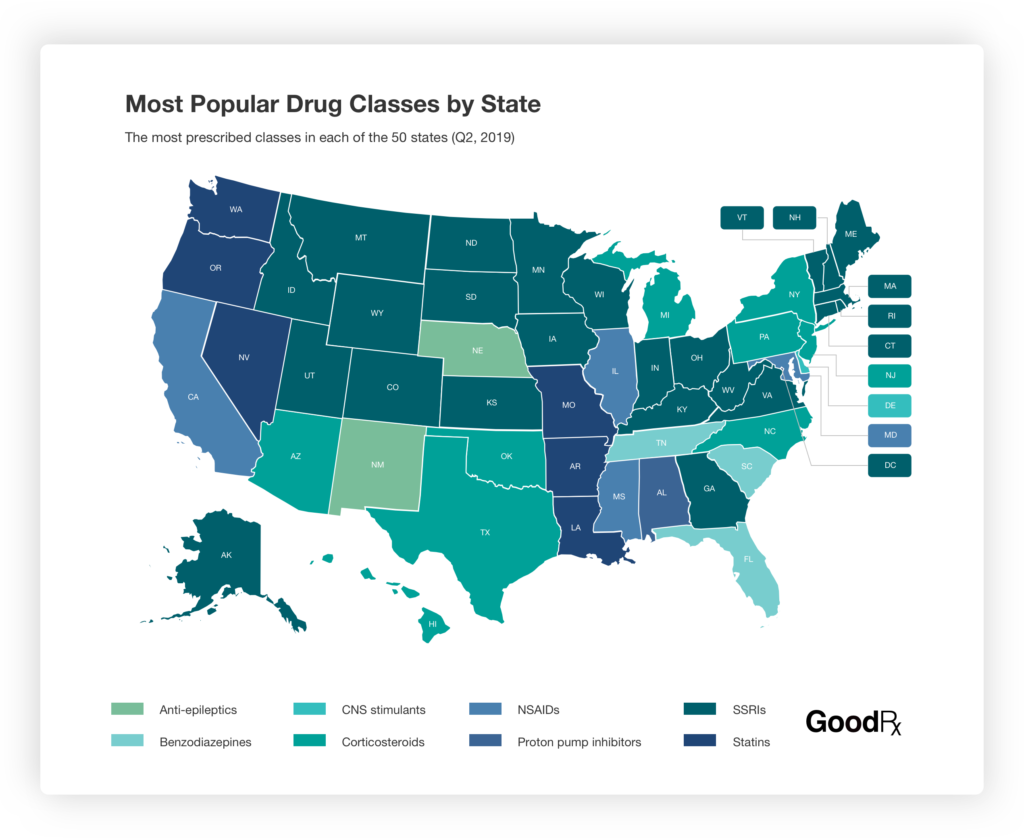
Drugs that work similarly, have a similar chemical makeup, or affect the brain and the body in similar ways are grouped into classes. The differences in fill trends for these classes provide insight into the conditions that affect certain populations and reveal an interesting picture of the U.S.
During Q2, the most frequently prescribed class in twenty-five states was SSRIs, followed by corticosteroids (popular in nine states) and statins (popular in six states).
Most and least expensive cities in the U.S.
We all know that prescription medications are expensive. But as it turns out, the city you live in may determine how much you pay for your medication.
The following were five of the most and five least expensive cities in the U.S. for drugs during Q2.
5 of the most expensive cities for drugs
| City | Percent above national average |
|---|---|
| New York, New York | +15.91% |
| San Francisco, California | +14.96% |
| Los Angeles, California | +10.95% |
| San Diego, California | +6.78% |
| Philadelphia, Pennsylvania | +5.73% |
5 of the least expensive cities for drugs
| City | Percent below national average |
|---|---|
| Atlanta, Georgia | -21.26% |
| Houston, Texas | -20.14% |
| Denver, Colorado | -18.17% |
| Dallas, Texas | -17.88% |
| Cincinnati, Ohio | -13.30% |
– – –
Co-contributors: Jeroen van Meijgaard, PhD, Clement B. Feyt, MPH, and Ryan Farrell
For a full PDF of this report, including a complete breakdown of the methodology, download our white paper here.
– – –
See previous GoodRx quarterly reports below:

Why trust our experts?