The following side effects may get better over time as your body gets used to the medication. Let your healthcare provider know immediately if you continue to experience these symptoms or if they worsen over time.
Ovarian hyperstimulation syndrome: severe pelvic or stomach pain and swelling along with nausea, vomiting, sudden weight gain, diarrhea, trouble breathing, trouble urinating
Lung problems: trouble breathing, fluid in the lungs, worsening of any current lung problems
Heart attack: chest pain or tightness, pain that radiates up to your shoulder, arm, neck, or jaw
Stroke: sudden trouble talking, trouble walking, numbness on one side of your body or face
Ectopic pregnancy: severe, unexplainable pelvic pain along with unusual vaginal bleeding
When do Gonal-f (follitropin alfa) possible side effects begin and end?
Time passed since treatment started:
HHOURS
DDAYS
WWEEKS
MMONTHS
Ovarian hyperstimulation syndrome
Seek immediate medical care if you experience this side effect.
The following Gonal-f (follitropin alfa) side effects have also been reported
Along with its needed effects, a medicine may cause some unwanted effects. Although not all of these side effects may occur, if they do occur they may need medical attention.
Check with your doctor immediately if any of the following side effects occur:
pain the chest, groin, or legs, especially the calves
puffiness or swelling of the eyelids or around the eyes, face, lips, or tongue
slurred speech
sudden loss of coordination
sudden, severe weakness or numbness in the arm or leg
unusual tiredness or weakness
vision changes
Some side effects may occur that usually do not need medical attention. These side effects may go away during treatment as your body adjusts to the medicine. Also, your health care professional may be able to tell you about ways to prevent or reduce some of these side effects. Check with your health care professional if any of the following side effects continue or are bothersome or if you have any questions about them:
Multi-dose vials and single-dose vials need to be mixed before injection, which can be inconvenient
Brand name only; no generics available
Pharmacist tips for Gonal-f (follitropin alfa)
If appropriate, your fertility specialist can teach you how to give Gonal-f (follitropin alfa) injections to yourself at home. Ask your healthcare team about home self-injections.
The dose of Gonal-f (follitropin alfa) and the number of days you will use it for will depend on how your body responds to this medication. Follow your fertility specialist's directions carefully to give the medication the best chance to work.
Let your healthcare team know right away if you notice symptoms of ovarian hyperstimulation syndrome (OHSS), such as severe pelvic pain, nausea, or weight gain. OHSS is a potentially serious side effect of Gonal-f (follitropin alfa) in females and needs medical attention right away.
Tips on storing Gonal-f (follitropin alfa)
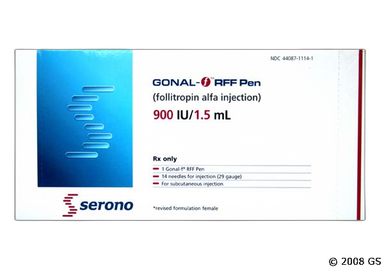
Gonal-f multi-dose vial and Gonal-f RFF single-use vial come as powders that first need to be mixed with sterile water before using. The powders can be stored either at room temperature or in the refrigerator.
After mixing, Gonal-f multi-dose vial is only good for 28 days (either in the fridge or at room temperature), while Gonal-f RFF single-use vial must be used right away.
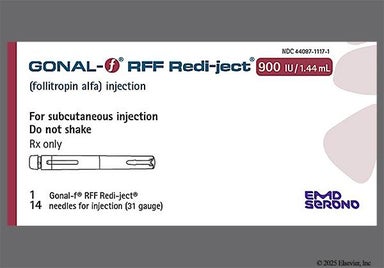
Gonal-f RFF Redi-ject is an autoinjector that can be used for multiple injections. Before you open it, you can store it in the refrigerator until the expiration date on the box or at room temperature for up to 3 months. But once you start to use it, this medication is only good for 28 days (in the fridge or at room temperature).
Tips on using Gonal-f (follitropin alfa)
Always wash your hands with soap and water before injecting Gonal-f (follitropin alfa), and make sure to wipe the area of skin you are going to inject the medication into with an alcohol swab before injecting. Use a different area of the body for every dose. This will help prevent discomfort and pain during injections.
If you've stored the mixed Gonal-f multi-dose vial or Gonal-f RFF Redi-ject in the refrigerator, let the medication warm to room temperature on its own (at least 30 minutes) before injecting. Don't warm it up any other way.
If you're using Gonal-f RFF Redi-ject, you should inject it in your stomach around your belly button area. If you're using Gonal-f or Gonal-f RFF, you can inject it in your upper arms, upper legs, or your stomach around your belly button area.
Use a new needle and syringe each time you give yourself Gonal-f (follitropin alfa). Throw away the used syringes and needles in a protective (sharps) container. These containers might be given to you by your fertility team, but if not, they can be purchased at most pharmacies. Don't throw needles and syringes away in the regular trash.
Risks and warnings for Gonal-f (follitropin alfa)
Gonal-f (follitropin alfa) can cause some serious health issues. This risk may be even higher for certain groups. If this worries you, talk to your doctor or pharmacist about other options.
Swollen ovaries
Risk factors: High doses of Gonal-f (follitropin alfa) | Using Gonal-f (follitropin alfa) too long
Gonal-f (follitropin alfa) can cause females' ovaries to grow or swell. This is more likely to happen if you're using high doses of this medication or have used it for too long. Your fertility provider will monitor your ovaries closely with ultrasounds to make sure they aren't growing too much. If your ovaries are ever too swollen on an ultrasound, your fertility provider will tell you to stop injecting Gonal-f (follitropin alfa) and avoid having sex. Tell your healthcare team right away if you feel any cramps or pain in the pelvic or lower belly area while using this medication.
Ovarian hyperstimulation syndrome (OHSS)
Risk factors: Pregnancy
In females, Gonal-f (follitropin alfa) can cause OHSS, a condition that occurs when the ovaries grow too large after you've finished your injections. It's very painful and can cause vomiting and diarrhea. It can also cause more serious conditions, including trouble breathing and bursting ovaries. It usually goes away on its own once your menstrual period starts. People who develop OHSS and also successfully become pregnant tend to have more severe OHSS symptoms. If you feel extreme belly pain, nausea, vomiting, or diarrhea within 7 to 10 days after finishing Gonal-f (follitropin alfa), tell your fertility provider right away.
Lung problems and blood clots
Risk factors: Personal or family history of blood clots | Smoking | Ovarian hyperstimulation syndrome (OHSS) | People who are overweight
In females, Gonal-f (follitropin alfa) can raise your risk of life-threatening lung problems and blood clots. Smoking, a history of blood clots, and OHSS raise this risk even more. Blood clots can lead to a heart attack, a stroke, or a pulmonary embolism (life-threatening blood clot in the lungs). Be sure to discuss all your past and present medical conditions with your fertility provider before starting Gonal-f (follitropin alfa). Call 911 or get medical help right away if you have pain in your legs or arms, chest pain, sudden severe headaches, trouble breathing, or sudden changes in your speech or vision.
Ovarian twisting
Risk factors: Ovarian hyperstimulation syndrome (OHSS) | Pregnancy | Previous stomach surgery | History of ovarian twisting | History of or current ovarian cysts | Polycystic ovary syndrome (PCOS)
Gonal-f (follitropin alfa) raises your risk of ovarian twisting in the future. This can cause blood flow to the ovary to be cut off. It's more likely to happen if you have polycystic ovary syndrome (PCOS), had stomach surgery in the past, or have OHSS. Tell your fertility provider before you start Gonal-f (follitropin alfa) if you have a history of cysts on your ovaries and/or any surgeries you have had in the past.
Getting pregnant with more than one baby
All gonadotropin fertility treatments, including Gonal-f (follitropin alfa), make females much more likely to conceive and deliver more than one baby (twins, triplets). This is due to how the medication works to prepare the body to ovulate. Please discuss this possibility with your partner before starting Gonal-f (follitropin alfa).
Problems during pregnancy
All gonadotropin fertility treatments, including Gonal-f (follitropin alfa), make it more likely for you to experience problems during pregnancy than if you were to conceive without medication. These include birth defects, miscarriages, and pregnancies outside the uterus. It isn't clear why this happens. Your fertility provider might want to follow up with you more often to make sure you and your baby are healthy.
Allergic reactions
Severe allergic reactions to Gonal-f (follitropin alfa) are possible, including life-threatening problems like anaphylaxis (closing of the throat). Call 911 if this happens. If you notice hives, a rash, swelling of the lips or tongue, or difficulty breathing after using Gonal-f (follitropin alfa), call your healthcare professional right away.
Gonal-f (follitropin alfa) dosage
The average cost for 2 pens of 900iu of of Gonal-f (follitropin alfa) is $5,570.64 with a free GoodRx coupon.
Interactions between Gonal-f (follitropin alfa) and other drugs
Gonal-f (follitropin alfa) may interact with certain medications or supplements. Always let your doctor and pharmacist know about any other medications or supplements (including prescribed and over-the-counter medications, vitamins, and dietary or herbal supplements) that you are currently taking. The list below does not include all possible drug interactions with Gonal-f (follitropin alfa). Please note that only the generic name of each medication is listed below.
Although certain medicines should not be used together at all, in other cases two different medicines may be used together even if an interaction might occur. In these cases, your doctor may want to change the dose, or other precautions may be necessary. Tell your healthcare professional if you are taking any other prescription or nonprescription (over-the-counter [OTC]) medicine.
Contraindications are specific health conditions or situations in which a person should not take a medication due to safety concerns. If you have any of the following conditions or if any of the following apply to you, let your healthcare provider know because Gonal-f (follitropin alfa) will not be safe for you to take.
High levels of FSH that could be a sign of ovarian failure
Currently pregnant
Uncontrolled disease(s) of the endocrine glands (caused by a hormonal imbalance)
Sex hormone dependent tumors
Tumors of pituitary gland or hypothalamus
Abnormal uterine bleeding (with an unknown cause)
Ovarian cysts or enlargement (with an unknown cause)
What are alternatives to Gonal-f (follitropin alfa)?
There are a number of medications that your doctor can prescribe in place of Gonal-f (follitropin alfa). Compare a few possible alternatives below.
Gonal-f (follitropin alfa)
Used for:
Infertility treatment in females who have trouble ovulating
To develop multiple follicles in females going through assisted reproductive technologies (ART), such as in vitro fertilization (IVF)
GoodRx Health has strict sourcing policies and relies on primary sources such as medical organizations, governmental agencies, academic institutions, and peer-reviewed scientific journals. Learn more about how we ensure our content is accurate, thorough, and unbiased by reading our editorial guidelines.
Prescription savings
Stop paying too much for your prescriptions. Compare prices, get pharmacy coupons, and save up to 80%.
You likely won't feel Gonal-F working for you, so it's important to maintain appointments with your fertility specialist and any ultrasounds or blood tests they order for you. These tests and appointments will allow your fertility provider to check how well Gonal-F is working for you.
All Gonal-F products can be stored in the refrigerator or at room temperature before use, but there are a few specific differences depending on which product you're using. Gonal-f multi-dose vial comes as a powder that needs to be mixed; after you've mixed it, this medication is only good for 28 days (in the fridge or at room temperature). Gonal-f RFF single-dose vial also comes as a powder that needs to be mixed; after you've mixed it, the medication needs to be used right away. Gonal-f RFF Redi-ject is an autoinjector that can be used for multiple injections. Before you open it, you can store it in the refrigerator until the expiration date on the box or at room temperature for up to 3 months. But once you start to use it, this medication is only good for 28 days (in the fridge or at room temperature).
Both Gonal-F and menotropins (Menopur) are once-a-day injections given under the skin to help stimulate the ovaries to produce mature eggs in females. The main difference between them is that Menopur contains two hormones, follicle stimulating hormone (FSH) and luteinizing hormone (LH), whereas Gonal-F only contains FSH. It's possible that your fertility specialist will have you take Menopur along with Gonal-F. Another difference is that Gonal-F is approved for use in males who are infertile; Menopur is not FDA-approved for use in male infertility.
Both Gonal-F and Follistim AQ (follitropin beta) are brand-name injectable forms of FSH used to stimulate the ovaries to make follicles and release mature eggs, but they're different medications; they have different doses and they come in different dosage forms. Your fertility specialist will not have you use both medications at the same time.
It's best to avoid alcohol while taking Gonal-F. Research suggests that alcohol can affect the number and quality of eggs. In addition, alcohol might also affect sperm count. These factors mean Gonal-F might not work as best as it can to help you become pregnant if you also drink alcohol at the same time.
If you miss a dose of Gonal-F, don't double up the next dose to make up for the mixed one. If you miss a dose, contact your fertility specialist for instructions on what to do.
Weight gain isn't a typical side effect of Gonal-F. But it can be a symptom of ovarian hyperstimulation syndrome (OHSS), a potentially serious side effect of Gonal-F in females. OHSS can happen when the ovaries make too many eggs. This can lead to sudden fluid build up in different areas of the body, which can result in weight gain. Let your fertility specialist know right away if you notice weight gain after starting Gonal-F so they can check to see if you have OHSS.