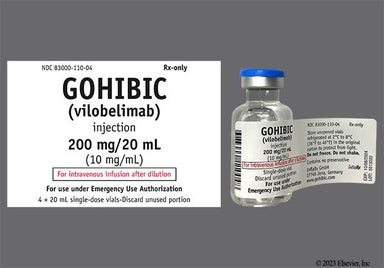
Gohibic (vilobelimab) is a monoclonal antibody that's used to treat illness due to COVID-19 infection in adults who are in the hospital. It must be started within 48 hours of intubation. This medication is given as an injection into the veins by a trained healthcare provider. Gohibic (vilobelimab) has been authorized by the FDA under emergency use authorization (EUA).
Gohibic (vilobelimab) is a monoclonal antibody that works as a complement C5a inhibitor. It blocks certain proteins that are part of your body's immune system called C5a. Gohibic (vilobelimab) helps block the C5a proteins from sending out signals that cause inflammation and damage to different organs in the body when you have a COVID-19 infection.
Gohibic (vilobelimab) is only authorized for use in adults who are in the hospital and have a COVID-19 infection. Additionally, it can only be given within 48 hours of receiving invasive mechanical ventilation, such as a breathing tube, or extracorporeal membrane oxygenation (ECMO). Gohibic (vilobelimab) isn't authorized for use in children.
Gohibic (vilobelimab) is given as an injection into the veins (intravenously or IV) by a trained healthcare provider. You'll typically receive 800 mg of Gohibic (vilobelimab) per day for a maximum of 6 doses following a specific treatment schedule. These doses are given on days 1, 2, 4, 8, 15, and 22 of Gohibic (vilobelimab) treatment. Each IV infusion typically takes 30 to 60 minutes.
In clinical studies, there were fewer deaths overall in the group of people who were treated with Gohibic (vilobelimab) than in the group of people who took a placebo. Over a 28-day period, about 32% of hospitalized adults with COVID-19 who required invasive mechanical ventilation or ECMO and were treated with Gohibic (vilobelimab) died compared to about 42% of those treated with placebo. Researchers saw similar results when they looked at a 60-day period after treatment with Gohibic (vilobelimab). This suggests that Gohibic (vilobelimab) might lower the risk of death by day 28 and day 60 of treatment compared to not taking the medication.
Pneumonia, sepsis (extreme reaction to an infection), delirium (confused thinking and changes in alertness), and blood clot in the lungs were some of the most common side effects that people had during clinical studies of Gohibic (vilobelimab). Your healthcare team will monitor you closely for side effects from Gohibic (vilobelimab) while you're in the hospital and treat you appropriately when needed.
Yes. Since Gohibic (vilobelimab) affects your immune system, the medication might raise your risk for serious bacterial, fungal, and viral infections. Watch out for signs of infection, such as a fever, chills, diarrhea, pain while urinating, and cough. Let your provider know right away if you experience any new or worsening symptoms. Additionally, Gohibic (vilobelimab) can sometimes cause a severe allergic reaction. Get medical help as soon as possible if you experience trouble breathing, hives, or swelling in your face or throat.