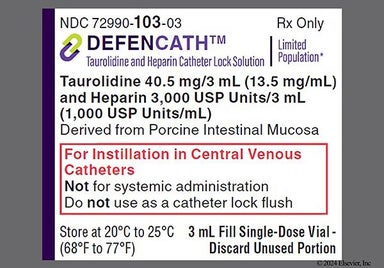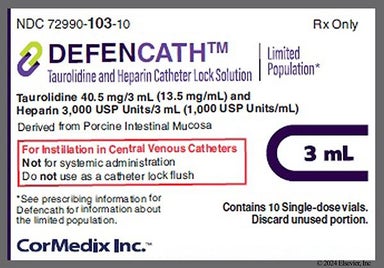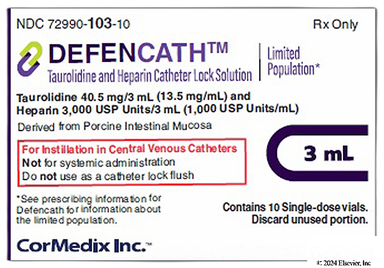
Defencath
Defencath (taurolidine / heparin) is a prescription medication that helps lower the risk of catheter-related bloodstream infections (CRBSIs) in adults with kidney failure who are receiving hemodialysis. A healthcare professional will fill the inside of your central venous catheter with the medication at the end of each dialysis session and remove it before your next session. Common side effects include catheter malfunction, nausea, and bleeding.


What is Defencath (taurolidine / heparin)?
What is Defencath (taurolidine / heparin) used for?
- Reduce the risk of catheter-related bloodstream infections (CRBSIs) in adults with kidney failure using central venous catheters for hemodialysis
How Defencath (taurolidine / heparin) works
Defencath (taurolidine / heparin) is a combination of two medications:
- Taurolidine is a thiadiazine antimicrobial. It damages the protective outer layer of the bacteria so they can't stick to the catheter and grow, which helps prevent infections.
- Heparin is an anticoagulant. It blocks certain proteins your body uses to form blood clots, helping keep the catheter free of clots.
Drug facts
| Common Brands | Defencath |
|---|---|
| Drug Class | Antibiotic |
| Controlled Substance Classification | Not a controlled medication |
| Generic Status | No lower-cost generic available |
| Availability | Prescription only |

Side effects of Defencath (taurolidine / heparin)
The following side effects may get better over time as your body gets used to the medication. Let your healthcare provider know immediately if you continue to experience these symptoms or if they worsen over time.
Common Side Effects
- Catheter malfunction (17%)
- Bleeding (7%)
- Nausea (7%)
- Vomiting (6%)
- Dizziness (6%)
Less Common Side Effects
- Chest pain
- Low platelet count
- Low calcium levels
- Changes in taste
Defencath (taurolidine / heparin) serious side effects
Contact your healthcare provider immediately if you experience any of the following.
- Heparin-induced thrombocytopenia (HIT): skin changes, swelling or pain in an arm or leg, rash, shortness of breath, chest pain, trouble speaking
- Severe allergic reaction: trouble breathing, swelling in the face or throat, wheezing, dizziness
The following Defencath (taurolidine / heparin) side effects have also been reported
Side effects that you should report to your care team as soon as possible:
- Allergic reactions—skin rash, itching, hives, swelling of the face, lips, tongue, or throat
- Unusual bruising or bleeding
Side effects that usually do not require medical attention (report these to your care team if they continue or are bothersome):
- Dizziness
- Nausea
- Vomiting

Pros and cons of Defencath (taurolidine / heparin)
Pros
- Lowers the risk of catheter-related infections between dialysis sessions
- Prevents clots from forming in the catheter
- Not designed to enter your body
Cons
- Only approved for adults getting hemodialysis through a central venous catheter
- Can cause catheter malfunction
- Must be placed by a trained healthcare professional

Pharmacist tips for Defencath (taurolidine / heparin)

- A healthcare professional will place Defencath (taurolidine / heparin) into your catheter after each dialysis session. It stays in the catheter between sessions and is removed before your next dialysis.
- Defencath (taurolidine / heparin) is used inside the dialysis catheter to lower the chance of serious bloodstream infections, not to treat infections you already have. Get help right away if you notice fever, chills, or redness around the catheter site. These can be signs of an infection.
- Defencath (taurolidine / heparin) contains heparin, which can raise your risk of bleeding. Tell your care team right away if you notice unusual bruising, bleeding from your gums or nose, blood in your urine or stool, or black or tarry stools.
- Although rare, Defencath (taurolidine / heparin) can cause an allergic reaction. Contact your care team right away if you have trouble breathing or swelling of your throat, tongue, lips, or face.

Risks and warnings for Defencath (taurolidine / heparin)
Defencath (taurolidine / heparin) can cause some serious health issues. This risk may be even higher for certain groups. If this worries you, talk to your doctor or pharmacist about other options.
Low platelet counts and clotting problems
- Risk factors: History of heparin-induced thrombocytopenia (HIT) or heparin-induced thrombocytopenia with thrombosis (HITT)
The heparin in Defencath (taurolidine / heparin) can cause your platelet count to drop. In rare cases, a low platelet count can happen with a serious condition called heparin-induced thrombocytopenia (HIT), which can lead to blood clots. Let your care team know right away if you have symptoms of HIT like new or worsening pain, swelling, warmth or redness in an arm or leg, trouble breathing or speaking, and chest pain.
Allergic reaction
- Risk factors: Pork allergy
Severe allergic reactions to Defencath (taurolidine / heparin) are possible, including life-threatening reactions like facial swelling, shock, and anaphylaxis. Let your care team know if you have a pork allergy before using this medication because heparin is made from pigs. If you notice difficulty breathing, a choking sensation, swelling around your eyes, swelling of the lips or tongue, dizziness, or nausea, get medical attention right away.

Defencath (taurolidine / heparin) dosage
Typical dosage for Defencath (taurolidine / heparin)
Defencath (taurolidine / heparin) is given by a healthcare professional after each dialysis session. The amount injected depends on the type of catheter you have.
The medication is placed into your catheter to fill it completely. The solution then stays there in the catheter until the next dialysis session. Before that session starts, a healthcare professional will remove the solution from your catheter.

Defencath (taurolidine / heparin) contraindications
Contraindications are specific health conditions or situations in which a person should not take a medication due to safety concerns. If you have any of the following conditions or if any of the following apply to you, let your healthcare provider know because Defencath (taurolidine / heparin) will not be safe for you to take.
- History of heparin-induced thrombocytopenia (HIT)
- Allergy to taurolidine, heparin, or pork products

Defencath (taurolidine / heparin) images