Key takeaways:
Most cuts heal with time, even without stitches. But stitches can help large wounds heal more quickly and decrease the risk of scarring.
Wounds that are on your face, over a joint, or won’t stop bleeding probably need stitches.
Get medical attention for animal bites, deep wounds, and when foreign bodies (like glass or dirt) are possible.
Life comes with its fair share of bumps and scrapes. While most of them heal on their own, there are times when a cut demands a bit more attention. But it can sometimes be hard to tell if a cut is deep enough to need stitches.
Stitches can help wounds heal better and faster. They can also help prevent infection or scarring. But no one wants to waste their time or money at an ER or medical office if they don’t need to. So we’ll help you decide how to know if you need stitches.
Which cuts need stitches?
Most cuts will heal with or without stitches, but some wounds heal better with help. Stitches can help larger wounds heal faster. They can also help decrease the risk of infection and scarring in many cases. The need for stitches depends on a few factors, including the size of the wound and where it is on the body.
Search and compare options
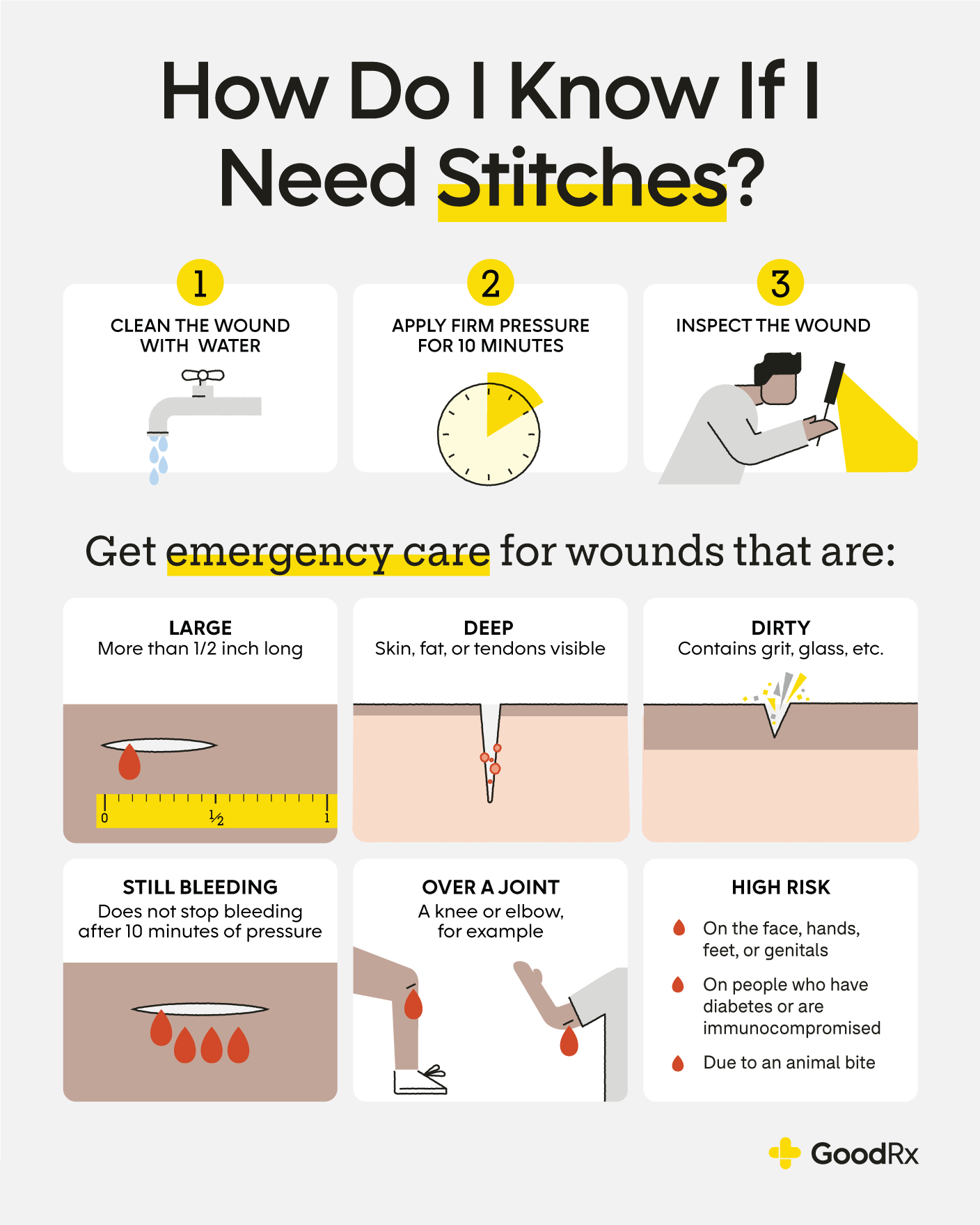
Size and depth
Bigger, deeper cuts are usually more serious. Here’s when to consider stitches:
Wide, gaping wounds that leave deeper layers of skin and fat exposed
Wounds that are more than 2 inches (5 cm) long or ¼ inch deep
But this isn’t an exact science. Another way to judge is to look at whether the skin edges come together neatly. Wounds heal quicker when the edges of the skin stay touching. So smaller wounds that are gaping may still need stitches. And longer cuts with skin edges that stay together may not.
Location
A cut on your arm isn’t the same as a cut on your face. Cuts on these areas likely need stitches:
Cuts on the face, where scarring is a concern
Cuts on the genitals, hands, and feet
Cuts over joints or other areas of tension, where movement prevents the skin edges from staying together
Bleeding
If your wound is more than a superficial scrape, apply direct pressure to help stop the bleeding. Get medical attention in these cases:
Your cut won’t stop bleeding after applying firm, direct pressure for 10 to 15 minutes.
The cut continues to re-open and re-bleed.
You’re on blood-thinning medications and you can’t stop the bleeding.

Can you use liquid stitches? Dermabond is like medical-grade “super glue” for skin. But it’s not always the best option. Here’s what you need to know.
Choosing an antibiotic ointment: Explore the difference between Polysporin, Neosporin, and bacitracin, and which one is best for you.
Prepping your first-aid kits: Learn more about the most important items to keep in your first-aid kit so you’re prepared if an injury happens.
Complicated injuries
It’s important to get medical attention for wounds they may need more than just stitches. For example, some wounds that are at higher risk of infection may need a thorough clean out. And other deeper wounds may need repair of additional structures, like tendons.
High-risk wounds that need medical attention include:
Very deep wounds that might affect tendons, ligaments, or nerves (you might notice numbness around the skin, or restricted range of motion)
Wounds with foreign bodies (like dirt or glass) stuck inside
Wounds that happened in water — like a lake or river — where the risk of bacterial contamination is higher
Animal and human bites, which are a higher risk for infection
When it comes to bite wounds or dirty cuts, they may not always need stitches. But they should always get a medical evaluation to help prevent infection. A healthcare professional can:
Use medical-grade supplies — and numbing medicines — to fully clean out the wound
Prescribe antibiotics if necessary
Determine if an animal bite needs preventative treatment for rabies
Update your tetanus shot
Also, some people take longer to heal, which can increase the risk of infection. This includes people with diabetes, weaker immune systems, and poor circulation.
Which cuts don’t need stitches?
Many cuts or small wounds will heal well without stitches. Your wound may not need stitches in these cases:
It’s small.
It’s shallow (not deep).
It’s no longer bleeding after applying pressure.
It doesn’t have dirt, glass, wood, or other objects in it.
It doesn’t expose deeper layers of skin.
If you aren’t sure, it’s always best to get it checked out by a medical professional.
How to care for your wound
Whatever you decide to do, first clean the wound thoroughly with water. Irrigation, or rinsing, helps wash out debris and bacteria. The best way to do this is to run cold tap water over the wound for 5 minutes.
Antibiotic ointments aren’t usually needed for minor wounds unless you have a weaker immune system. Covering a wound with a bandage for the first couple of days can help protect it from further injury as the healing process starts.
Do stitches hurt?
Bringing the edges of a wound together with suture involves a sharp needle. That’s why healthcare professionals inject a numbing medication (local anesthesia) into the wound and the surrounding skin before placing the sutures. The local anesthesia injection may hurt for a moment. Or sometimes they apply a numbing cream to reduce pain.
After the anesthesia takes effect, you’ll usually only feel some pressure or tugging while they stitch up your wound. You won’t feel anything sharp.
How long do stitches stay in?
Unless you have absorbable suture, you’ll need to get your stitches out. The timing depends on the location. Certain areas (like your face) have better blood flow and heal more quickly. Other areas (like joints) are more difficult to keep still, so they may take more time. Here’s a rundown of what to expect:
Stitches on your face can come out after 3 to 5 days.
Stitches on your head can come out after 5 to 7 days.
Stitches on most other parts of your body typically stay in for about 10 days.
Stitches over joints — like your knees, elbows, and knuckles — need to stay for the longest (usually 10 to 14 days).
Your wound will already start healing by the time the stitches are in. Historically, people are told to keep their stitches dry. But there’s no evidence that getting your stitches wet in the first 1 to 2 days will increase the risk of infection. Just be sure not to submerge them in water. You can wash them gently and pat them dry if you choose to wash your wound and stitches. It’s a good idea to keep them a little moist with ointment and to cover them with a bandage.
Once the stitches are out, your wound is healed. But scar formation will continue for months. To improve the look of the scar as it heals, keep the scar out of the sun and use sunscreen. You can consider specialized creams to help improve the look of your scar if that’s important to you.
Are there alternatives to stitches?
Skin glue and “Steri-Strips” (a special type of tape) are great options for very small cuts in certain situations. This can be especially helpful for kids or anyone who’s afraid of needles.
Consider one of these options in the following cases:
The wound is clean and dry.
There isn’t a lot of tension across the cut (like from a moving joint).
The wound isn’t gaping open.
The injury isn’t due to a bite.
Many retail pharmacies sell over-the-counter (OTC) versions of skin glue and Steri-Strips, which you can safely use at home for small, simple wounds. These are a great addition to your first aid kit for easy wound care at home.
Skin staples are an alternative to stitches, which can be applied in an emergency department or urgent care setting. They work similarly to stitches, only they’re stronger. They can be good for areas where the skin is thicker (such as the scalp) or for very long cuts. Staples are a bit thicker than suture material, so the scars left over can be more noticeable. So they aren’t a good option for cuts on the face or other areas where the cosmetic outcome is a bigger concern.
What is the difference between sutures and stitches?
These terms are often used interchangeably, but that’s not technically accurate. “Stitches” are the ties made with medical grade thread, whereas “suture” is the actual thread. Stitching is the process of bringing the two edges of the wound together to encourage healing.
Do stitches, sutures, staples, and skin adhesive help wounds heal?
Your body has everything it needs to repair the skin. There are cells that go in and mend each layer after an injury.
But treatments like sutures, staples, and skin adhesives keep the area stable so the healing isn’t disrupted. In most cases, the cut is water tight in 48 hours. Most stitches stay in for about 10 days to let all of the layers of skin heal properly.
What happens if I don’t get stitches when they are needed?
Not getting stitches when you need them can be risky. A poorly healing wound can lead to long-term complications that can be difficult to treat:
Infection: Waiting too long to stitch a wound can increase the risk of wound infection. Bacteria can multiply in the open wound and then form an abscess if they get trapped inside. But this can depend on many things, like size of the wound and mechanism of injury (some wounds can be closed up to 18 hours after the injury).
Prolonged healing: Healing time gets longer if larger wounds aren’t closed. Without stitches, wound healing can take 3 weeks or more. And the risk of infection continues the longer the wound takes to heal.
More bleeding: Deep wounds can continue bleeding without stitches. Stitches bring the edges of the wound together and add pressure, which helps the clotting process.
Scarring: All wound healing leads to some scarring. But, without stitches, the scars can be wider and more noticeable.
Loss of function: Poor healing in certain areas of the body, like over a joint, can result in limited mobility and decreased sensation to the injured area. This is also true if the wound is deep enough to affect other structures, like nerves, tendons, or ligaments.
Increased pain: Stitches help stabilize the wound and promote faster healing, which relieves some of the pain associated with an open wound.
Frequently asked questions
There are a few different types of absorbable suture, so it depends on which type you have. It can take weeks to months for them to absorb completely. Let your healthcare team know if the stitches are bothersome, as they may be able to remove the stitches early.
It’s best to have a healthcare professional remove your stitches. There’s a risk of injury if you do it yourself. Plus, it’s good to have someone look at your wound to be sure it’s healing properly.
No, it’s not necessary to keep your wound covered after the stitches are removed. Of course, if your care team tells you otherwise, it’s best to follow their instructions.
There are a few different types of absorbable suture, so it depends on which type you have. It can take weeks to months for them to absorb completely. Let your healthcare team know if the stitches are bothersome, as they may be able to remove the stitches early.
It’s best to have a healthcare professional remove your stitches. There’s a risk of injury if you do it yourself. Plus, it’s good to have someone look at your wound to be sure it’s healing properly.
No, it’s not necessary to keep your wound covered after the stitches are removed. Of course, if your care team tells you otherwise, it’s best to follow their instructions.
The bottom line
The human body is capable of healing wounds with or without stitches. But deep, long, or dirty wounds may benefit from evaluation and stitches. A timely medical evaluation and getting stitches if needed can make sure that a wound heals quickly, with minimal risk of infection or scarring. When in doubt, it’s a good idea to get your wound evaluated.

Why trust our experts?




References
Bhaumik, S., et al. (2019). Primary closure versus delayed or no closure for traumatic wounds due to mammalian bite. Cochrane Database of Systematic Reviews.
Centers for Disease Control and Prevention. (2025). About rabies.
Forsch, R. T., et al. (2017). Laceration repair: A practical approach. American Family Physician.
Marshall, A., et al. (2025). Stitches vs sutures: A guide. UVA Health.
MedlinePlus. (2024). How wounds heal.
Nemours Children’s Health. (2022). What to do about cuts.
Quinn, J. V., et al. (2014). Traumatic lacerations: What are the risks for infection and has the ‘golden period’ of laceration care disappeared? Emergency Medicine Journal.
Singer, A. J., et al. (2025). Skin lacerations. Merck Manual.
UPMC HealthBeat. (2017). Injured? Here’s how to know if you need stitches.
Worster, B., et al. (2015). Common questions about wound care. American Family Physician.