Key takeaways:
Both diet and exercise are needed for optimal health.
Focus on nutrition that supports your body’s needs and avoid crash dieting.
An optimized exercise routine consists of both aerobic and resistance exercise.
It’s no secret that what you eat and how much you exercise have health benefits beyond weight loss. It’s common to want to make changes to both at the same time. But that’s easier said than done. Many people often wonder if eating better or working out is the best choice for their health.
But it’s not as simple as one or the other. Here, we’ll explain why both nutrition and exercise play an important role in improving your health and how long you live (longevity).
Is diet or exercise more important for my health?
This is a tricky question to answer based on the current scientific studies.
Ideally, studies would look at the relationship between diet and health independent of exercise. Or they’d study the relationship between exercise and health while excluding diet. But robust data like this doesn’t exist. This is because it’s difficult to control for — or eliminate — other lifestyle factors that can affect the results.
That said, experts believe improving your dietary habits alone can improve your health. This is because research supports a connection between poor diet and health outcomes.
Experts also believe that regular exercise can help you live longer, regardless of weight change. In fact, a large review recently concluded that your fitness level — rather than your weight — is a better predictor of longevity. It looked at two groups of people who didn’t exercise that often:
A group with “normal” weight
A group with excess weight
Both groups had similar risks of death.
(In this case, diet wasn’t a part of the study. But since weight loss for many people requires diet changes, the two are related.)
At the end of the day, diet and exercise are both beneficial for your health. Research suggests the best way to improve longevity is with multiple lifestyle changes. These include:
Exercise
Nutrition
Weight management
Limiting alcohol and smoking
These changes not only improve longevity: They also increase the chances of living longer with fewer chronic diseases.
What’s most important is deciding the lifestyle change(s) you’re willing to make. Start with that change, stick with it, and gradually add more changes.
Can I be healthy if I exercise but don’t eat properly?
Maybe, but it’s unlikely. You may have heard the saying, “You can’t outrun a bad diet.” There appears to be some truth to that.
A large study of health records looked at diet and exercise in two groups of people:
People who exercised without optimizing their diet
People who had a nutritious diet and good exercise habits
The risk of death was higher in people who exercised but ate whatever they wanted.
It’s clear that unhealthy eating habits are linked to a higher risk of death. And now it’s more clear that you can’t undo that risk with exercise.
Can I be healthy if I eat well but don’t exercise?
Maybe, but it’s unlikely. It’s hard to underestimate the benefits of physical fitness, given what’s been discussed above. You’re much more likely to see improvements in your health if you combine exercise and nutrition.
That was the finding of one study, which looked at diet and exercise in groups of middle-aged women. After 8 weeks, the group that changed both their diet and their exercise had the most positive improvements.
But the group who changed diet alone still saw benefits. The most important results were that:
Both the diet and the diet/exercise group had lower cholesterol, blood pressure, and body fat percentage.
The diet/exercise group maintained lean body mass, which is important in weight loss.
The diet/exercise group also saw improvements in fitness levels, self-image, and sense of well-being.
What are the benefits of a healthy diet and nutrition?
Technically, the word “diet” simply refers to a pattern of eating and drinking behavior. It doesn’t necessarily mean food restriction.
By contrast, nutrition refers to the quality of your food. A simple way to think about your nutrition is to ask yourself: “Does my food contain nutrients that nourish my body?” Dieting tends to focus on your short-term goals. Nutrition, on the other hand, is a long-term component of your lifestyle.
A well-balanced diet can help lower your risk of:
Heart disease and stroke
Certain cancers
Excess weight gain
Bone loss
Diabetes
Memory loss
Premature death
Good nutrition is the goal, and there isn’t one particular plan that’s right for everyone. That said, certain eating plans — like the Mediterranean and DASH diets — have been linked to better health.
Crash dieting doesn’t result in long-term health benefits. In fact, weight cycling (losing and regaining weight) due to repeat dieting may lead to worse health outcomes. Instead, it’s better to focus on nutrition that supports your body’s needs and to choose an eating plan that works for you.
What are the benefits of exercise?
As discussed above, research suggests exercise is critical for longevity and good health. There are three main types: strengthening, aerobic or cardiovascular, and balance. We’ll go into each one below.
Strength
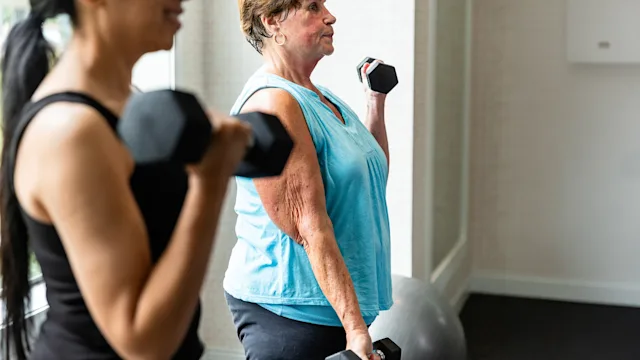
Muscle strengthening (or resistance) exercises apply force to your muscle and cause the muscles to grow in size. Experts recommend resistance training at least twice per week.
Muscle strengthening leads to:
Prevention of muscle loss with age
Boost in metabolism
Stronger bones
Weight maintenance
Reduced risk of chronic health conditions like Type 2 diabetes and heart disease
Cardio
Cardiovascular exercise, or aerobic exercise, raises your heart rate and your breathing rate. It exercises your heart and lungs while you burn energy. Experts recommend getting at least 150 minutes of movement each week.
The benefits of aerobic exercise are:
Improved cardiovascular function
Improvements in blood pressure and cholesterol levels
Lower risk of Type 2 diabetes
Weight maintenance
Reduced risk of certain cancers
Prevention of cognitive decline with age
Balance
Most people don’t think about balance much. But it’s important for good health, especially with age. Improving your balance can help:
Reduce the risk of falls and fall-related injuries
Maintain independence and mobility with age
Maintain reaction time and coordination
Is it possible to diet and exercise and not lose weight?
Yes — and it’s actually quite common. But nutritious eating and exercise have benefits beyond weight. Weight loss is complex and different for everyone. It can be frustrating when you can’t lose weight despite trying to do so by changing your diet and exercise.
Keep in mind that:
Diet and exercise aren’t the only factors that influence weight.
Resistance training builds muscle mass, which elevates total body weight.
It takes time to see the effects of healthy lifestyle changes.
If you’re having trouble losing weight, consider getting help from a clinician with training in weight loss. They can help you explore other options in weight loss.
Frequently asked questions
Walking is great for weight loss, preventing weight gain, and increasing your endurance. It can also help with stress management, blood sugar stabilization, and heart health. It’s also great for beginners or those who don’t want a gym membership.
If you really want to optimize your health, though, it’s a good idea to add strength training a couple times a week. Doing so will protect your bones and heart health.
Both. Research suggests exercise and diet alone can help improve belly fat. But combining the two can lead to greater results.
The 80/20 rule claims that 80% of weight loss is due to diet and 20% is due to exercise. Diet is generally more important than exercise for weight loss. That’s because it’s easier to create a calorie deficit by changing your diet versus burning more calories. That said, there’s not a ton of research to back up this ratio. And we know that weight loss is complicated. It’s not always as simple as calories in, calories out.
Walking is great for weight loss, preventing weight gain, and increasing your endurance. It can also help with stress management, blood sugar stabilization, and heart health. It’s also great for beginners or those who don’t want a gym membership.
If you really want to optimize your health, though, it’s a good idea to add strength training a couple times a week. Doing so will protect your bones and heart health.
Both. Research suggests exercise and diet alone can help improve belly fat. But combining the two can lead to greater results.
The 80/20 rule claims that 80% of weight loss is due to diet and 20% is due to exercise. Diet is generally more important than exercise for weight loss. That’s because it’s easier to create a calorie deficit by changing your diet versus burning more calories. That said, there’s not a ton of research to back up this ratio. And we know that weight loss is complicated. It’s not always as simple as calories in, calories out.
The bottom line
Diet and exercise are both incredibly important to your overall health. This is backed by decades of research. Putting time and effort into both — rather than crash diets, fad workouts, or numbers on a scale — will pay off in the long run.
Making lifestyle changes can feel overwhelming. It helps to make small changes in your daily habits — and consistency is key. Reach out to a healthcare professional if you need guidance, expert referral, or support.

Why trust our experts?



References
American Heart Association. (2024). How much physical activity do you need?
Boushey, C., et al. (2020). Dietary patterns and all-cause mortality: A systematic review [internet]. USDA Nutrition Evidence Systematic Reviews.
Ding, D., et al. (2022). Physical activity, diet quality and all-cause cardiovascular disease and cancer mortality: A prospective study of 346 627 UK Biobank participants. British Journal of Sports Medicine.
Friedenreich, C. M., et al. (2015). Effects of a high vs moderate volume of aerobic exercise on adiposity outcomes in postmenopausal women: A randomized clinical trial. JAMA Oncology.
Joseph, G., et al. (2020). A comparison of diet versus diet + exercise programs for health improvement in middle-aged overweight women. Women’s Health.
Li, Y. et al. (2020). Healthy lifestyle and life expectancy free of cancer, cardiovascular disease, and type 2 diabetes: Prospective cohort study. The BMJ.
Loef, M., et al. (2012). The combined effects of healthy lifestyle behaviors on all cause mortality: A systematic review and meta-analysis. Preventive Medicine.
Malhotra. A., et al. (2015). It is time to bust the myth of physical inactivity and obesity: You cannot outrun a bad diet. British Journal of Sports Medicine.
Merriam-Webster. (n.d.). Diet.
Micha, R., et al. (2017). Association between dietary factors and mortality from heart disease, stroke, and type 2 diabetes in the United States. JAMA.
National Institute on Aging. (2025). Want to get moving? Try different types of exercise! National Institutes of Health.
Nordstoga, A. L., et al. (2019). Long-term changes in body weight and physical activity in relation to all-cause and cardiovascular mortality: The HUNT study. International Journal of Behavioral Nutrition and Physical Activity.
Rhee, E. (2017). Weight cycling and its cardiometabolic impact. Journal of Obesity & Metabolic Syndrome.
van Gemert, W. A., et al. Effect of diet with or without exercise on abdominal fat in postmenopausal women – a randomised trial. BMC Public Health.
Weeldreyer, N. R., et al. (2024). Cardiorespiratory fitness, body mass index and mortality: A systematic review and meta-analysis. British Journal of Sports Medicine.