Key takeaways:
A prostate MRI is an imaging study that gives a clear picture of the prostate. MRIs use magnets instead of radiation to create highly accurate images.
Prostate MRIs can ensure that you get the most accurate prostate biopsy and may help you avoid repeat biopsies.
A prostate MRI is a short procedure and may not require any special preparation.
Prostate cancer is one of the most common cancers in men. Not all types of prostate cancer are the same, though. And not all types need immediate treatment.
What’s more, treatment options for prostate cancer are changing. Prostate MRIs are an important part of care. They allow healthcare professionals to create individualized treatment plans.
Let’s take a closer look at how magnetic resonance imaging (MRI) technology helps in diagnosing and treating prostate cancer — and how this technology can be used in the future.
Search and compare options
Why might I need a prostate MRI?
You may need a prostate MRI if:
You need a prostate biopsy: Prostate MRIs map specific areas where your healthcare team should get samples from the prostate during a prostate biopsy.
You’re undergoing active surveillance: Prostate MRIs may be a routine part of your care plan if your treatment includes active surveillance for low-risk prostate cancer.
Your prostate cancer changed: Prostate MRIs can be used to determine if your prostate cancer is behaving differently.
What are the benefits of a prostate MRI?
There are several benefits of a prostate MRI, including biopsy accuracy and avoiding repeat biopsies. Let’s look at these and more benefits below.
It can give you a more precise prostate biopsy result
Prostate biopsies use ultrasound to help the urologist decide where to put the needle to obtain a tissue sample. It’s possible to “miss” a tumor using this method.
By getting an MRI first, your urologist will have an exact map of where to get a sample. This will make sure that the right tissue is sent for evaluation, so you get the most accurate information.
It may help you avoid prostate biopsies
Prostate MRIs can help you avoid a prostate biopsy if you’re being evaluated for prostate cancer. You may not need a prostate biopsy if:
Your prostate MRI results don’t show evidence of aggressive prostate cancer, and
Your PSA levels and other lab results are within a certain range, and
You’re not at high risk for developing aggressive prostate cancer.
Studies estimate that up to 1 in 3 people with an elevated PSA level may be able to avoid a prostate biopsy if they have a reassuring prostate MRI result.
It can stage prostate cancer quickly so you can start treatment faster
Prostate MRIs can show whether the cancer is only in the prostate or has spread to nearby areas. This is important for staging, and helps with deciding on what kind of surgery and treatment you might need.
It can help you avoid aggressive prostate cancer treatment
Some people don’t need treatment for prostate cancer right away. This is called “active surveillance.” People who are candidates for active surveillance can potentially avoid more aggressive and invasive treatments for months, years, or even longer. A prostate MRI will help the healthcare team get a good biopsy so they can determine if you’re a candidate for active surveillance.
It’s safe
MRI doesn’t use radiation, and it isn’t invasive or painful. It’s one of the safest medical procedures available. So there’s not a lot of risk that comes with getting an MRI — there are, in fact, a lot of benefits.
Are there any risks to getting a prostate MRI?
MRIs are safe, and they’re free of radiation and pain. But there are some possible risks and downsides, including:
Claustrophobia: If you have claustrophobia or don’t like being in small, enclosed spaces, getting an MRI may make you nervous. MRI technologists can talk to you and play music or videos to help distract you. If these techniques aren’t enough, you can have sedation medication to help you get through the MRI.
Allergic reactions: You might need a contrast injection for your MRI. Contrast helps the radiologist see the prostate and other organs more clearly. Some people are allergic to the dye and can have an allergic reaction. But contrast allergies are very rare. There’s always a healthcare professional on site to help in case you have an allergic reaction to the contrast.
Cost: Depending on your deductible, the MRI may still carry a significant cost. You can use funds from a health savings account (HSA) or flexible spending account (FSA) to help offset the cost.
How do prostate MRIs work?
Prostate MRIs work just like other types of MRIs. MRI is a radiology study that uses magnetic fields to create images. It’s one of the most detailed imaging techniques available today. MRIs can produce 2D (flat images) or 3D images.
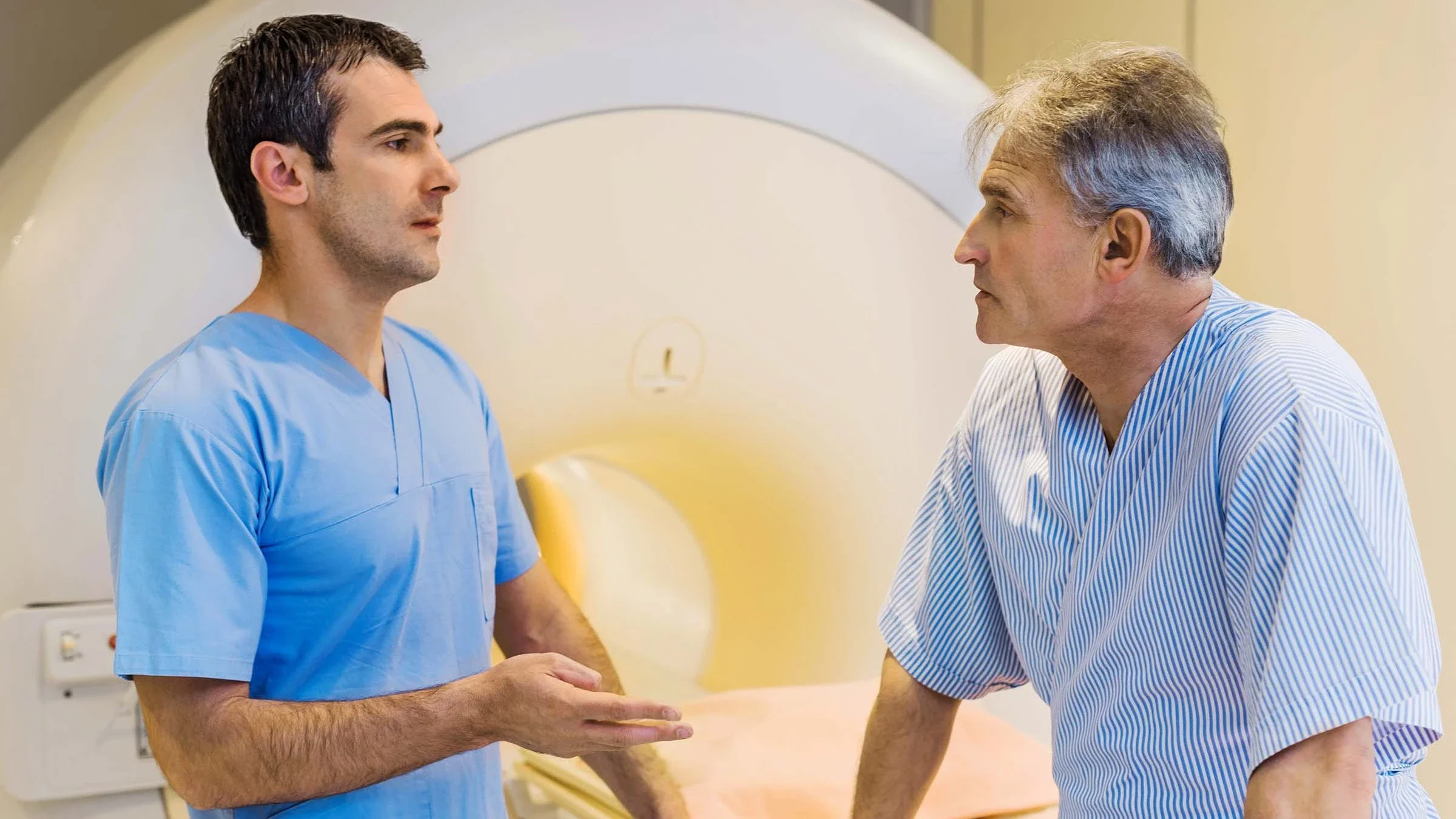
During an MRI, you lie down on a table that’s surrounded by a large tube. This tube contains the MRI magnet. The magnet creates a magnetic field. The protons inside atoms in your body line up in response to the magnetic pull. This allows software to create images of structures inside the body. MRIs are especially useful when trying to look at organs, muscles, and blood vessels.
How do you prepare for a prostate MRI?
There’s not much you need to do to prepare for your MRI. Here are some things you may be asked to do:
Diet changes: You don’t need to change what you eat before a prostate MRI. But if you’re getting sedation medication, you won’t be able to eat or drink anything for about 8 hours before your MRI.
Medication changes: You don’t need to stop your medications before your prostate MRI. If you’re receiving sedation medication before your prostate MRI, your healthcare team may ask you to skip your morning medications or take them after your MRI.
Enema preparation: Your healthcare team may ask you to give yourself an enema before your prostate MRI. This is if you need to use an endorectal coil during your MRI.
Contrast preparation: Your healthcare team may ask you to complete a questionnaire or answer questions if you need contrast for your prostate MRI. This will go over topics like your allergies, medications, and whether you’ve received contrast in the past. They may also ask you to get blood work to check your kidney health.
What can you expect from the procedure?
Here’s what you can expect during your prostate MRI:
Go through a safety check: You’ll go through a safety checklist with the MRI technologist. The technologist will make sure you don’t have any metal in your body from medical devices that aren’t MRI safe. You’ll remove jewelry, watches, or other items that contain metal. You’ll also be asked to change into a gown to make sure there’s no metal in your clothes.
Get in position: Next, you’ll go into the MRI room and lie on the MRI table. If you need contrast for your study, you’ll get an intravenous (IV) line placed, and the technologist will give the contrast through your vein. If your MRI requires an endorectal coil, it will be inserted into your rectum. Since MRI technology has improved, endorectal coils aren’t used that often anymore.
Put in your earplugs: You’ll be given a pair of earplugs to wear during the MRI, since the machine makes loud noises.
Lie still: During the study, the MRI table will be slowly moved into the MRI tube. It’s important to lie as still as possible during the MRI so that the pictures are good quality. You may need to hold your breath for 10 to 20 seconds every once in a while. This is so the movement of your breathing doesn’t interfere with the images.
Head home: After the MRI, you can go about your normal daily activities. It will take hours to days for the radiologist to finish your MRI report. Your healthcare team will follow up with you to go over the results.
How long does a prostate MRI take?
A prostate MRI takes about 30 minutes. This is how long you’ll spend lying on the MRI table. It doesn’t include the time it takes to complete your safety check or have additional procedures like an IV line or endorectal coil placements. It’s a good idea to block 2 hours for the entire appointment.
What happens after the MRI?
A radiologist will look at the images from your MRI and create a report with the findings. Your prostate MRI report will include:
Measurements of your prostate
The location and size of any tumors
PI-RADS score
Any other important findings
Your report will also contain information about whether there’s any sign of cancer in nearby tissue, lymph nodes, and bone.
You and your healthcare team will receive these results and create a care plan based on this information.
What is a PI-RADS score?
A PI-RADS score is a number between 1 and 5. This score describes whether findings on a prostate MRI are likely to represent clinically significant cancer.
“Clinically significant cancer” is a prostate cancer that’s likely to grow, spread, or cause harm if it isn’t treated.
Here’s what PI-RADS scores mean:
PI-RADS 1: Your prostate MRI looks normal. The chance of significant cancer is very low.
PI-RADs 2: Your prostate MRI shows minor changes. But these changes don’t look like cancer and may be due to other causes like inflammation or enlargement. The chance of clinically significant cancer is low.
PI-RADS 3: Your prostate MRI shows changes, but it’s not clear if these changes are cancer. There’s a moderate chance that these changes are due to clinically significant cancer.
PI-RADS 4: Your prostate MRI shows changes that are suspicious for clinically significant cancer. There’s a high chance that these changes are due to clinically significant cancer.
PI-RADS 5: Your prostate MRI shows changes that have classic signs of aggressive prostate cancer. There’s a very high chance these changes are due to clinically significant cancer.
Keep in mind that your PI-RADS score is only one piece of information. Your healthcare team will also use other pieces of information to determine whether you have clinically significant cancer, including biopsy results, PSA levels and trends over time, and your medical history.
Frequently asked questions
There’s no food that causes prostate cancer. But you should try to limit red and processed meats, and foods high in saturated fat. The best foods for prostate health are fresh fruits and vegetables.
You can have caffeine before a prostate MRI, but it may make the scan less comfortable. Caffeine can increase how often you need to urinate. If you already have an enlarged prostate, you may have trouble holding your urine to begin with. Since you won’t be able to use the bathroom during the MRI, an added urge to pee from caffeine could make the experience uncomfortable. Avoiding caffeine beforehand may help you feel more at ease during the scan.
You’ll lie on a table that goes into the MRI tube during a prostate MRI. The space inside the center of the magnet is very small. Some people have a hard time being in small, confined spaces. It can cause anxiety, mental discomfort, and even panic attacks. Let your healthcare team know if you have trouble with confined spaces. They can prescribe a one-time dose of an anxiolytic, a prescription medication that can keep you calm and relaxed during the MRI.
There’s no food that causes prostate cancer. But you should try to limit red and processed meats, and foods high in saturated fat. The best foods for prostate health are fresh fruits and vegetables.
You can have caffeine before a prostate MRI, but it may make the scan less comfortable. Caffeine can increase how often you need to urinate. If you already have an enlarged prostate, you may have trouble holding your urine to begin with. Since you won’t be able to use the bathroom during the MRI, an added urge to pee from caffeine could make the experience uncomfortable. Avoiding caffeine beforehand may help you feel more at ease during the scan.
You’ll lie on a table that goes into the MRI tube during a prostate MRI. The space inside the center of the magnet is very small. Some people have a hard time being in small, confined spaces. It can cause anxiety, mental discomfort, and even panic attacks. Let your healthcare team know if you have trouble with confined spaces. They can prescribe a one-time dose of an anxiolytic, a prescription medication that can keep you calm and relaxed during the MRI.
The bottom line
Prostate MRIs are becoming more common. They’re powerful tools that help your healthcare team get an accurate picture of your prostate. They also help guide prostate biopsies so that you can get accurate results and start treatment as fast as possible. Prostate MRIs take about 30 minutes and are radiation free.

Why trust our experts?




References
Ahmed, H.,U., et al. (2017). Diagnostic accuracy of multi-parametric MRI and TRUS biopsy in prostate cancer (PROMIS): a paired validating confirmatory study. Lancet.
American College of Radiology. (2025). ACR manual on contrast media.
National Health Service. (2025). MRI scan.
National Institute of Biomedical Imaging and Bioengineering. (n.d.). Magnetic resonance imaging (MRI).
Oerther, B., et al. (2024). Update on PI-RADS Version 2.1 Diagnostic Performance Benchmarks for Prostate MRI: Systematic Review and Meta-Analysis. Radiology.
Wei, J. T., et al. (2023). Early detection of prostate cancer: AUA/SUO Guideline Part II: Considerations for a prostate biopsy. Journal of Urology.